
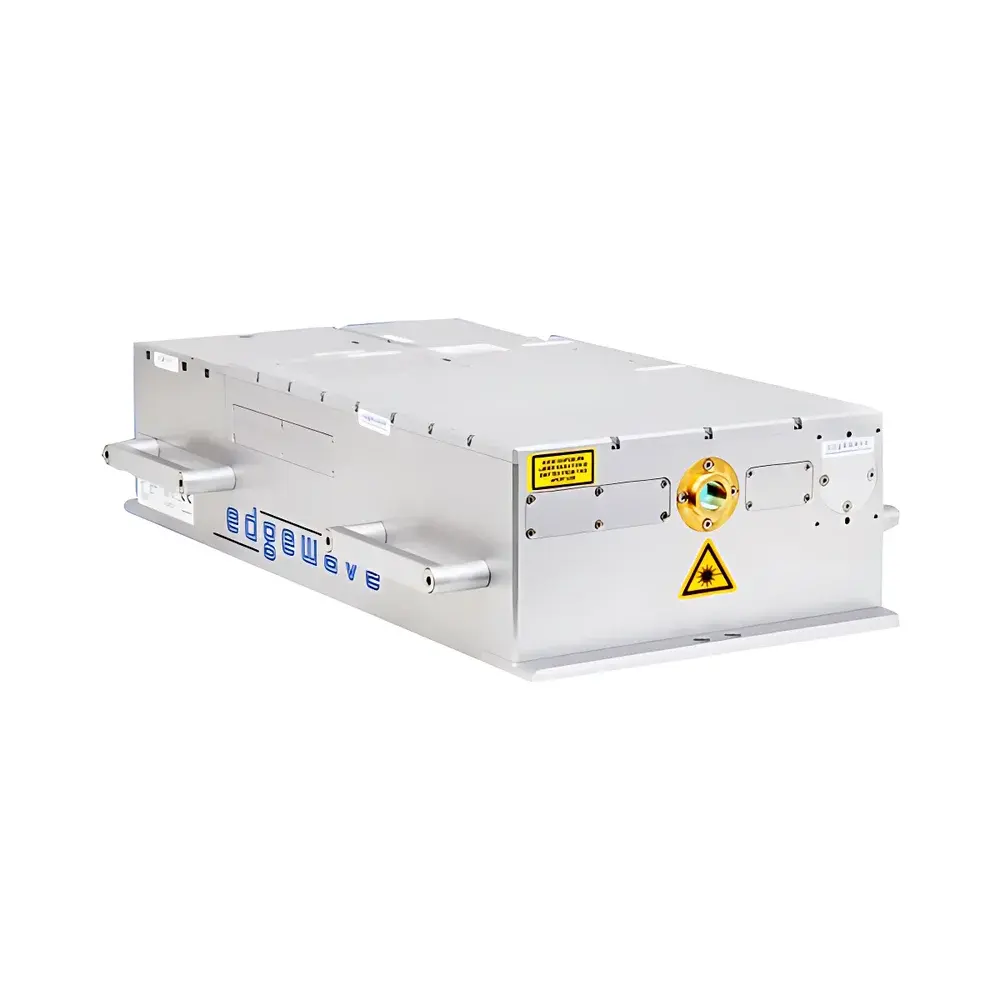
FX-Series Femtosecond Laser System
| Origin | Germany |
|---|---|
| Manufacturer Type | Authorized Distributor |
| Origin Category | Imported |
| Model Series | FX-Series |
| Core Technology | Solid-State Femtosecond Laser |
| Beam Quality (M²) | ≤1.5 |
| Pulse Energy | up to 100 µJ |
| Pulse Duration | 600 fs |
| Peak Power | up to 160 MW |
| Repetition Rate | up to 50 MHz |
| Average Output Power | up to 200 W |
| Wavelength Options | 1030 nm / 515 nm / 343 nm |
| Polarization Ratio | >100:1 |
| Beam Ellipticity (Far-Field) | <10% |
| Beam Diameter (1/e²) | 3 mm |
| Beam Divergence (Full Angle) | 226–500 µrad |
| Energy Stability (RMS) | ≤3% |
| Warm-up Time | 15–30 min |
Overview
The FX-Series Femtosecond Laser System is a high-performance, industrial-grade solid-state ultrafast laser platform engineered for precision micromachining and scientific applications requiring sub-picosecond temporal resolution and exceptional spatial coherence. Based on chirped-pulse amplification (CPA) architecture with Yb-doped fiber or thin-disk oscillator-amplifier configurations, the FX-Series delivers transform-limited pulses with minimal dispersion-induced broadening. Its fundamental wavelength at 1030 nm—combined with optional harmonic generation modules yielding stable 515 nm (second harmonic) and 343 nm (third harmonic) outputs—enables material processing across a wide absorption spectrum, from wide-bandgap dielectrics to metals and transparent polymers. Designed for continuous operation in cleanroom-integrated production lines or university ultrafast optics laboratories, the system complies with IEC 60825-1:2014 Class 4 laser safety standards and incorporates interlocked beam enclosures, real-time power monitoring, and redundant thermal management.
Key Features
- Three-wavelength platform supporting 1030 nm (fundamental), 515 nm (SHG), and 343 nm (THG) outputs via integrated nonlinear crystals and temperature-stabilized harmonic separation optics.
- Optimized beam delivery: M² ≤ 1.5 ensures diffraction-limited focusing down to sub-micron spot sizes, critical for high-aspect-ratio ablation and low-heat-affected-zone (HAZ) processing.
- High pulse-to-pulse stability: RMS energy fluctuation ≤ 3% over 8 hours enables reproducible process outcomes in regulated manufacturing environments.
- Flexible repetition rate control: Full software-tunable range from single-shot to 50 MHz, allowing optimization between throughput (high-rep-rate scanning) and peak-intensity-driven nonlinear interactions (low-rep-rate drilling).
- Robust mechanical architecture: Monolithic optical bench design with active vibration damping and hermetically sealed cavity housing minimizes alignment drift under factory-floor conditions.
- Comprehensive diagnostics interface: Integrated photodiode array, fast photodetector output, and analog monitor signals support closed-loop process feedback integration with motion controllers and vision systems.
Sample Compatibility & Compliance
The FX-Series demonstrates broad compatibility with industrially relevant materials including monocrystalline silicon, sapphire, fused silica, copper, stainless steel, polyimide, and ITO-coated glass. Its ultrashort pulse duration (<600 fs) suppresses thermal diffusion, enabling cold ablation mechanisms essential for high-fidelity patterning in photovoltaic cell scribing, display TFT layer structuring, and medical device stent cutting. The system meets ISO 13849-1 PL e functional safety requirements for integration into automated machinery and supports CE marking per Machinery Directive 2006/42/EC and EMC Directive 2014/30/EU. Harmonic modules are qualified per ISO 11146-1 for beam parameter measurement traceability. For pharmaceutical or biotech R&D use, optional FDA 21 CFR Part 11–compliant audit trail logging is available via the control software suite.
Software & Data Management
Operation is managed through the FX-Control Suite—a Windows-based application offering deterministic real-time pulse parameter adjustment (wavelength, rep rate, pulse energy, burst mode sequencing) with ≤100 µs latency. All configuration changes are timestamped and logged with user authentication. Raw diagnostic data (pulse energy, cavity temperature, pump diode current) are exported in HDF5 format for post-process statistical analysis. The API supports LabVIEW, Python (PyVISA), and MATLAB integration for custom automation workflows. Optional cloud-sync module enables remote firmware updates and centralized fleet monitoring across multi-site manufacturing deployments—fully compliant with GLP/GMP documentation requirements for validation protocols.
Applications
- Photovoltaics: Selective emitter formation, edge isolation, and trenching in PERC and TOPCon solar cells; ablation of transparent conductive oxides (TCO) without substrate damage.
- Display Manufacturing: High-resolution patterning of LTPS backplanes, micro-LED transfer via laser lift-off (LLO), and repair of OLED pixel defects.
- PCB & Flexible Electronics: Drilling micro-vias (<25 µm) in HDI substrates; cutting flex-rigid boards with zero delamination; trimming thin-film resistors with ±0.1% tolerance.
- Automotive Components: Precision drilling of fuel injector nozzles (stainless steel, Inconel); surface texturing of cylinder liners for friction reduction.
- Academic & Industrial Research: Pump-probe spectroscopy setups, THz generation, multiphoton microscopy excitation sources, and laser-induced breakdown spectroscopy (LIBS) calibration standards.
FAQ
What cooling method does the FX-Series require?
Air-cooling is standard for FXxxx-1 and FXxxx-2 models; FXxxx-3 (343 nm) requires recirculating chiller with ≤20 °C setpoint and ≥1.5 kW heat rejection capacity.
Can the system be integrated with galvo scanners or CNC stages?
Yes—native TTL and analog modulation inputs support direct synchronization with third-party scan heads and motion controllers; full timing diagrams and trigger specifications are provided in the Integration Manual.
Is wavelength switching automated?
Harmonic selection is motorized and software-controlled; switching between 1030/515/343 nm takes <15 seconds with automatic beam path realignment and power recalibration.
What maintenance intervals are recommended?
Optical alignment verification every 6 months; harmonic crystal inspection annually; pump diode lifetime rated at ≥20,000 operating hours under specified thermal conditions.
Does the system include beam diagnostics?
Standard configuration includes integrated beam profiler port (M² measurement-ready), high-speed photodiode monitor, and real-time power meter with ±1% NIST-traceable calibration certificate.



