
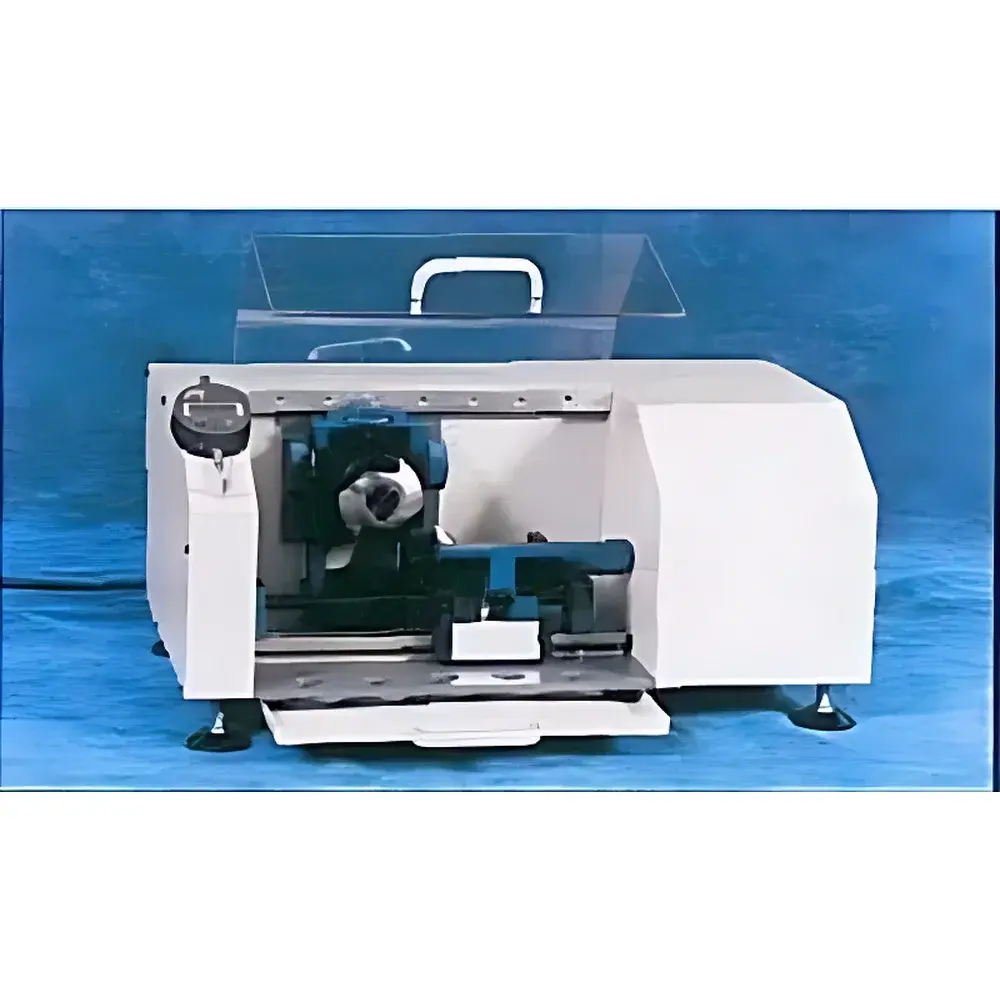
Galdabini DV-2000 Automatic Circulating Test Specimen Electric Notcher
| Brand | Galdabini |
|---|---|
| Model | DV-2000 |
| Origin | Italy |
| Type | Motorized Precision Notching Machine for Polymer Impact Testing Specimens |
| Power Supply | 220–240 V, 50 Hz, Single Phase |
| Dimensions (H×W×D) | 390 × 660 × 450 mm |
| Weight | ~38 kg |
| Cutting Speed Range | 350–2000 rpm (digitally adjustable with memory function) |
| Notch Depth Adjustment | Micrometer-driven, calibrated depth dial |
| Notch Geometry Support | Standardized U- and V-notches per ISO 179, ISO 180, ASTM D256, ASTM D6110, and EN ISO 13802 |
| Sample Hold-down | Centering fixture with linear anti-vibration slide rail |
| Waste Collection | Removable, cleanable chip tray |
| Display | Large backlit LCD with intuitive touch/keypad interface |
| Compliance | Designed for GLP-compliant laboratories |
Overview
The Galdabini DV-2000 Automatic Circulating Test Specimen Electric Notcher is a precision-engineered sample preparation instrument designed specifically for the reproducible generation of standardized stress-concentration notches in thermoplastic, thermoset, and elastomeric polymer specimens. It operates on the principle of controlled rotary milling using a dual-tooth carbide-tipped cutting wheel, enabling geometrically accurate U- and V-shaped notches that comply with international impact testing standards—including ISO 179 (Charpy), ISO 180 (Izod), ASTM D256, ASTM D6110 (instrumented impact), and EN ISO 13802. Unlike manual or semi-automatic notchers, the DV-2000 integrates closed-loop speed control, micrometer-level depth calibration, and centering fixtures to eliminate operator-induced variability—ensuring that fracture initiation consistently occurs at the intended notch root during subsequent mechanical testing.
Key Features
- Dual-tooth hardened carbide cutting wheel compatible with all standard notch geometries (U-type per ISO 179-1, V-type per ISO 180-1) and material classes—from rigid PVC and polycarbonate to flexible TPEs and filled composites.
- Digitally adjustable rotational speed range from 350 to 2000 rpm, with non-volatile memory to recall up to 10 user-defined profiles for different material families or test protocols.
- Micrometer-based vertical adjustment mechanism with engraved depth scale (0.1 mm resolution), coupled with a fixed-depth reference plate for traceable, repeatable notch depth setting.
- Linear slide rail system with engraved width scale, enabling precise measurement of residual ligament width post-notching—critical for normalized impact energy calculation.
- Centering fixture with self-aligning clamping jaws and vibration-damped linear motion ensures specimen symmetry and minimizes lateral deflection during cutting.
- Backlit LCD interface with tactile keypad and optional touch activation provides real-time feedback on speed, depth, cycle count, and system status—designed for glove-compatible operation in QC labs.
- Removable stainless-steel chip tray with ergonomic handle simplifies maintenance and prevents cross-contamination between material batches.
Sample Compatibility & Compliance
The DV-2000 accommodates rectangular bars up to 10 × 10 × 80 mm (standard ISO/ASTM dimensions), with optional custom fixtures available for non-standard cross-sections. Its mechanical architecture complies with ISO 17025 requirements for equipment used in accredited testing laboratories: all critical parameters (speed, depth, positioning) are directly traceable to internal calibration routines and documented in the machine’s operational log. The notcher supports full integration into quality management systems requiring 21 CFR Part 11–compliant electronic records when paired with Galdabini’s optional DataLink software module (sold separately). All structural components meet CE machinery directive 2006/42/EC and RoHS 2011/65/EU specifications.
Software & Data Management
While the DV-2000 operates as a standalone instrument, its embedded firmware supports RS-232 and USB-B connectivity for external data logging and remote parameter configuration. Optional Galdabini DataLink v3.2 software enables automated test sequence programming, digital signature capture for operator verification, and export of timestamped notch parameters (depth, speed, date/time, operator ID) in CSV or XML format—facilitating alignment with laboratory information management systems (LIMS) and audit trails required under GLP or GMP frameworks. Firmware updates are delivered via secure HTTPS portal and include version-controlled release notes compliant with IEC 62304 medical device software lifecycle standards.
Applications
- Preparation of Charpy and Izod impact test specimens for polymer qualification in automotive, aerospace, and medical device manufacturing.
- Routine QC notching in ISO 9001-certified production labs where inter-laboratory reproducibility must meet ≤±0.05 mm depth tolerance per ISO 179-2 Annex B.
- Research-grade specimen conditioning for fatigue and fracture mechanics studies involving crack-tip plasticity analysis.
- Calibration support for instrumented impact testers—where consistent notch geometry is prerequisite for valid J-integral or CTOD calculations.
- Multi-material validation workflows requiring rapid reconfiguration between engineering plastics (e.g., PEEK, PEI) and elastomers (e.g., EPDM, TPU).
FAQ
What standards does the DV-2000 support for notch geometry and depth tolerance?
It conforms to ISO 179-1 (U-notch, depth 2.0 ± 0.05 mm), ISO 180-1 (V-notch, depth 2.0 ± 0.05 mm), ASTM D256 (V-notch, depth 2.0 ± 0.025 mm), and ASTM D6110 (variable depth per specimen thickness).
Can the machine be validated for use in regulated environments (e.g., FDA-regulated labs)?
Yes—when operated with documented calibration procedures, change control logs, and optional DataLink software, it meets foundational requirements for 21 CFR Part 11 compliance and supports IQ/OQ/PQ protocol execution.
Is the dual-tooth cutting wheel replaceable, and what is its expected service life?
The wheel is field-replaceable using standard M6 tooling; typical lifespan exceeds 5,000 notches on unfilled polypropylene, decreasing proportionally with glass- or mineral-filled compounds.
Does the DV-2000 require compressed air or external coolant?
No—it is fully electric and dry-cutting; thermal management relies on optimized spindle heat dissipation and intermittent duty cycling.
How is traceability maintained across multiple operators and shifts?
Each notch cycle stores operator ID (if entered), timestamp, speed, depth, and cycle number in non-volatile memory; exportable logs enable full chain-of-custody reconstruction.



