
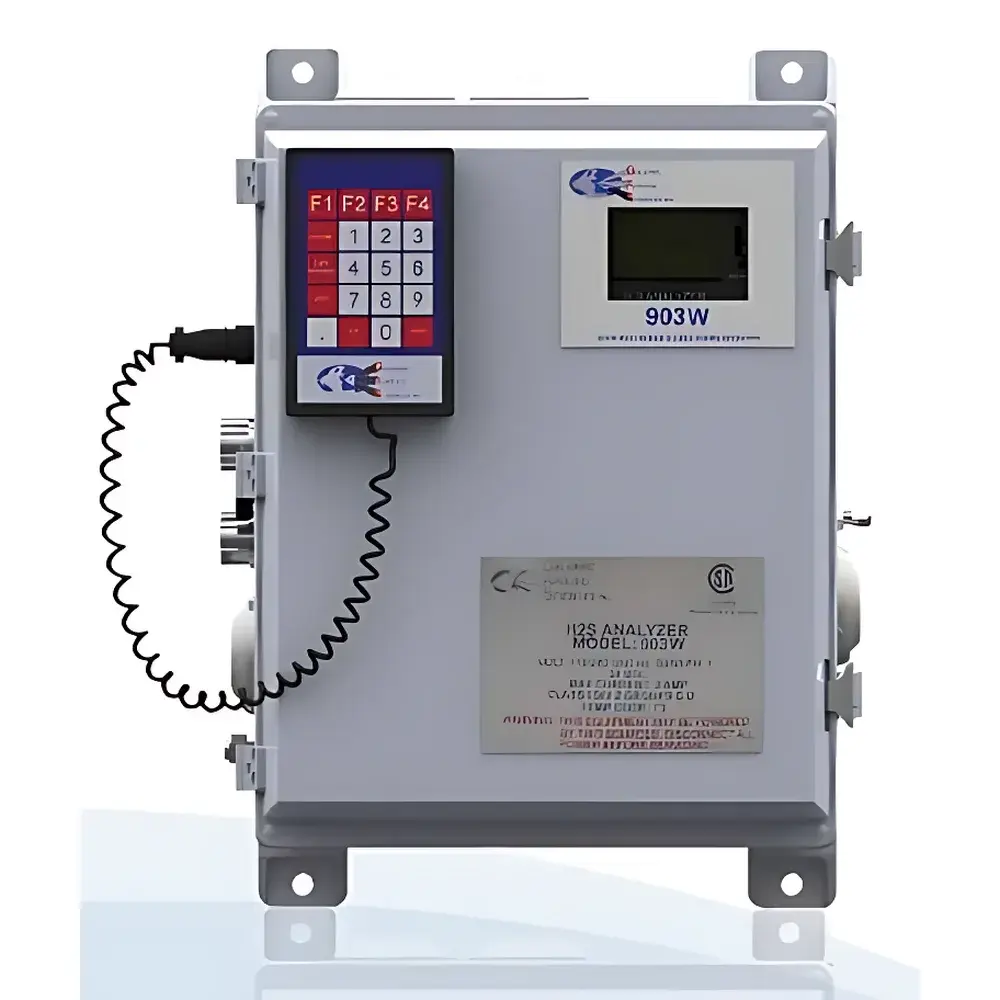
Galvanic 903W H₂S and Total Sulfur Analyzer
| Brand | Galvanic |
|---|---|
| Origin | Canada |
| Model | 903W |
| Instrument Type | Online Gas Analyzer |
| Target Gas | Hydrogen Sulfide (H₂S) |
| Response Time (T₉₀) | < 20 s |
| Measurement Accuracy | ±10 ppb (LOD) |
| Measurement Range | 0–2000 ppm (undiluted) |
| Linearity | ±1% FS |
| Repeatability | ±1% FS (>1 ppm), ±2.5% FS (<1 ppm) |
| Operating Temperature | 10–50 °C |
| Power Input | 90–240 VAC / 10–36 VDC |
| Certifications | CSA C/US, Class I, Div 2, Groups B, C, D, T3 |
Overview
The Galvanic 903W H₂S and Total Sulfur Analyzer is a high-precision, online optical gas analyzer engineered for continuous measurement of hydrogen sulfide (H₂S) and total reduced sulfur (TRS) compounds in industrial process streams, flare gases, biogas, and ambient or stack emissions. It employs the well-established lead acetate tape method—a colorimetric technique based on the irreversible reaction between H₂S and impregnated cellulose acetate paper, producing a measurable brown-colored lead sulfide deposit. Unlike conventional tape-based analyzers, the 903W integrates proprietary optical detection architecture with dual-microprocessor control, 24-bit analog-to-digital conversion, and on-board temperature stabilization of the sensor module to ensure long-term baseline stability and minimize drift. Its undiluted 0–2000 ppm dynamic range eliminates the need for external dilution systems under most operational conditions—significantly reducing maintenance overhead and calibration complexity while preserving measurement integrity across wide concentration gradients.
Key Features
- Lead acetate tape methodology compliant with EPA Method 16, ASTM D4084, and ISO 8573-7 for trace H₂S quantification
- Dual-processor architecture with real-time event timestamping and automatic zero/span correction per analysis cycle
- Integrated permeation membrane humidifier ensuring optimal moisture conditioning of sample gas—accelerating reaction kinetics and preventing paper desiccation or oversaturation
- Optical tape counter with programmable low-tape-warning threshold; typical tape life: 5 weeks at 3-minute cycle, up to 14 weeks under low-concentration conditions
- Modular I/O suite: six isolated 4–20 mA analog outputs (span-configurable), three SPDT alarm relays (expandable to six), eight discrete inputs (four dry-contact, four wet-sink), and seven optional solenoid drivers
- Multi-protocol digital interface: RS-232, RS-485, USB, and Ethernet (optional); all support Modbus RTU/TCP for seamless integration into DCS, SCADA, or EMS platforms
- On-device 128×64 LCD with tactile keypad (intrinsically safe D1 variant available); 10 status LEDs for rapid system diagnostics
- Field-upgradable firmware via USB or Ethernet; non-volatile memory stores ≥10 months of 1-second resolution H₂S concentration data (512 KB)
Sample Compatibility & Compliance
The 903W is validated for use with corrosive, high-humidity, and particulate-laden gas matrices typical of sour gas processing, wastewater treatment off-gas, landfill leachate vents, and refinery fuel gas headers. Sample conditioning is simplified by its integrated humidifier and optional high-pressure sampling module (up to 100 psig). The analyzer meets CSA C/US certification requirements for Class I, Division 2, Groups B, C, D, T3 hazardous locations. Its design supports GLP-compliant operation through audit-trail-enabled calibration logging, user-access-level controls, and time-stamped event records—including manual overrides, relay activations, and tape advancement events. While not inherently 21 CFR Part 11 compliant, full electronic record integrity can be achieved when paired with validated third-party data acquisition software meeting ALCOA+ principles.
Software & Data Management
Galvanic’s Windows-based configuration and monitoring software provides full instrument supervision—including flow conversion algorithms, multi-range H₂S/total sulfur mode switching, automated calibration sequence execution, and span gas verification reporting. The software enables remote parameter adjustment, historical trend review, and export of CSV-formatted datasets compatible with LIMS and regulatory reporting tools. All calibration actions—including zero checks, span adjustments, and tape replacement logs—are stored with operator ID, timestamp, and result values. Firmware updates are performed in-field without hardware disassembly, and configuration templates can be saved and deployed across fleet installations to ensure inter-unit consistency.
Applications
- Continuous H₂S monitoring in natural gas sweetening units and amine regenerator overheads
- Biogas quality assurance in anaerobic digesters and upgrading facilities
- Flare gas compliance monitoring per EPA 40 CFR Part 60 Subpart Ja and EU IED Directive
- Odor control system feedback in municipal wastewater treatment plants
- Total sulfur quantification in syngas and Fischer–Tropsch feedstocks where COS and mercaptans coexist with H₂S
- Ambient air monitoring near industrial fence lines under local air quality management programs
FAQ
Does the 903W require external dilution for measurements above 200 ppm?
No—the analyzer is designed for direct, undiluted measurement across its full 0–2000 ppm range. Dilution is only recommended for applications exceeding 2000 ppm or where cross-sensitivity from other sulfur species necessitates signal attenuation.
Can the 903W distinguish between H₂S and other reduced sulfur compounds?
In standard configuration, it measures total reactive sulfur (H₂S + COS + mercaptans) when used with the optional total sulfur module. For selective H₂S-only measurement, the base configuration with lead acetate tape provides high specificity due to kinetic selectivity and optimized humidification.
What is the minimum detectable concentration (MDL) and how is it verified?
The instrument achieves a practical detection limit of 10 ppb (signal-to-noise ratio ≥3) under stable ambient conditions. MDL validation follows EPA Method 16 protocol using certified calibration gases and repeated blank injections.
Is the tape consumption rate adjustable?
Yes—users may configure cycle time from 60 seconds to 10 minutes via software. Shorter cycles increase sensitivity at low concentrations but reduce tape life; longer cycles optimize longevity for stable, higher-concentration streams.
How does the system handle high-particulate or condensing sample streams?
An optional heated sample probe and particulate filter kit (with back-purge capability) is available. When combined with the permeation humidifier, the system maintains consistent paper reactivity even under variable dew point conditions.







