Galvanic Accuseries Copper Ion Analyzer
| Brand | Galvanic |
|---|---|
| Origin | USA |
| Manufacturer Type | Authorized Distributor |
| Origin Category | Imported |
| Model | Accuseries Copper Ion Concentration Analyzer |
| Measurement Principle | Bathocuproine (BCO) Colorimetric Method |
| Range | 0–10 ppm Cu²⁺ |
| Optical Technology | Dual-Wavelength Photometry |
| Probe Type | Fiber-Optic Immersion Probe |
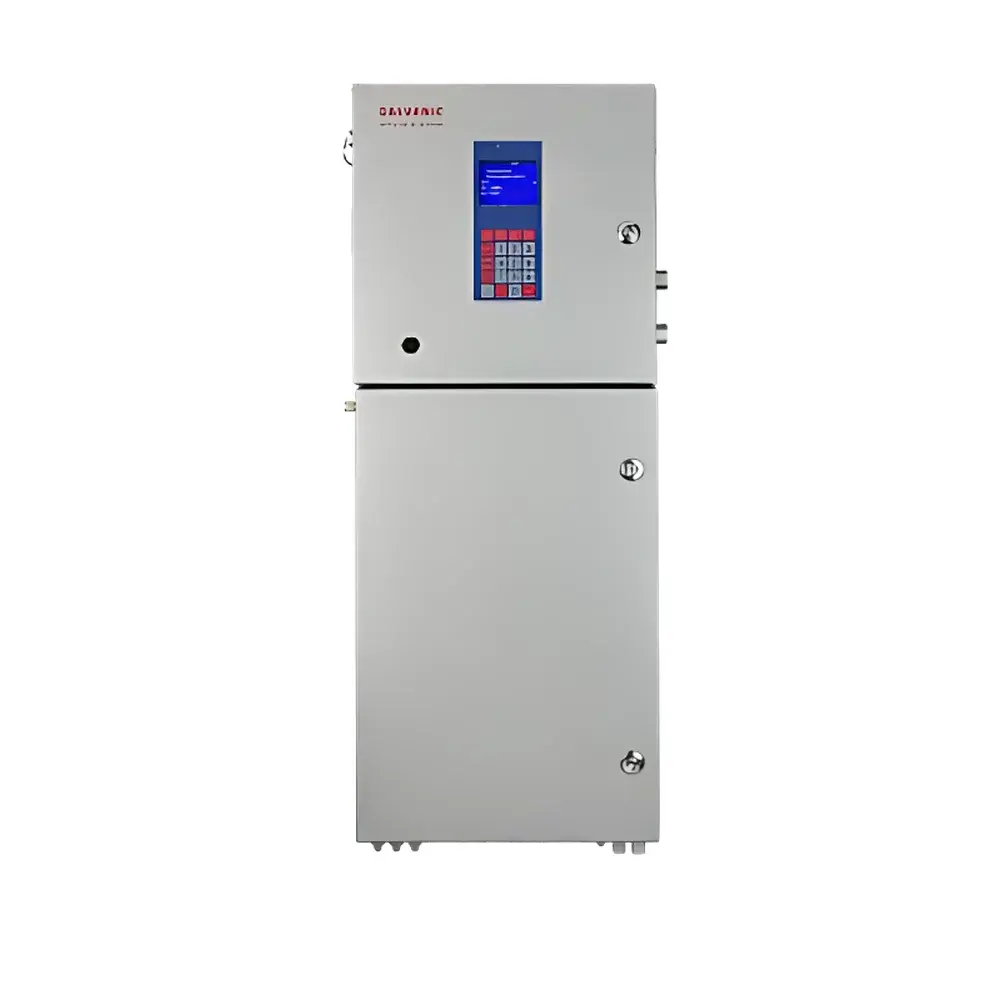
| Display | High-Resolution LCD with Dedicated Function Keypad |
| Communication Interfaces | 4–20 mA, Modbus TCP/IP, RS232, RS485, USB, GUI PC Direct Connection, Relay Outputs |
| Automation | Fully Automated 24/7 Operation — Auto-Calibration, Auto-Cleaning, Reagent Auto-Fill |
| System Architecture | Physically Isolated Electronic Control Unit and Sample Analysis Module |
| Maximum Flow Paths | 6 Independent Channels |
| Corrosion Resistance | IP65-rated Enclosure |
| Diagnostic Capability | Real-Time Remote Self-Diagnosis with Alarms for Sample Absence, Low Reagent Level, Flow Failure, and Optical Path Obstruction |
| Compliance | Designed for Continuous Emission Monitoring (CEM) and Process Analytical Technology (PAT) Environments |
| Software Support | Web-based Configuration Interface with Audit Trail Logging (21 CFR Part 11 Ready) |
Overview
The Galvanic Accuseries Copper Ion Analyzer is a fully automated, online process analyzer engineered for continuous, real-time quantification of dissolved copper ions (Cu²⁺) in industrial aqueous streams. It employs the standardized bathocuproine (BCO) colorimetric method—recognized in ASTM D1688 and ISO 8586 for trace metal analysis—where Cu²⁺ forms a stable orange-red complex with bathocuproine disulfonate under controlled pH and reducing conditions. Absorbance is measured photometrically at dual wavelengths (typically 480 nm and reference wavelength >600 nm) to compensate for turbidity, color interference, and fouling-induced signal drift. Unlike benchtop spectrophotometers or manual titration methods, the Accuseries platform operates unattended for extended periods, delivering high reproducibility (±2% RSD) in demanding environments such as electroplating rinse tanks, hydrometallurgical leach solutions, copper smelter effluents, and chemical manufacturing wastewater.
Key Features
- Dual-wavelength photometric detection eliminates measurement bias from suspended solids, colored organics, or particulate buildup—critical for long-term stability in non-filtered process streams.
- Fiber-optic immersion probe enables in-situ measurement without sample extraction, minimizing maintenance frequency and eliminating flow-cell clogging risks.
- Modular hardware architecture separates electronics (control unit) from wet chemistry components (reagent manifold, reaction coil, optical cell), ensuring system uptime: failure in one flow path does not halt operation of others.
- Integrated reagent management system autonomously monitors reagent volume, triggers refill alerts, and performs scheduled cleaning cycles using pressurized air and acid wash—supporting 30+ days of uninterrupted operation between service intervals.
- Industrial-grade enclosure meets IP65 requirements and incorporates corrosion-resistant materials (e.g., PTFE-lined fluid paths, Hastelloy C-276 fittings) for reliable performance in H₂S- and chlorine-laden atmospheres typical of metal finishing facilities.
- Embedded web server provides remote configuration, live data visualization, diagnostic logs, and firmware updates via standard Ethernet—no proprietary software installation required.
Sample Compatibility & Compliance
The Accuseries analyzer accepts raw, unfiltered samples with TSS ≤ 100 mg/L and temperature range of 5–45 °C. It is validated for use with acidic (pH 2–4) and near-neutral (pH 5–7) matrices common in copper electrowinning electrolytes, PCB etchant recovery lines, and mine drainage treatment systems. All analytical procedures comply with EPA Method 200.7 (ICP-OES validation reference) and support GLP/GMP documentation requirements through timestamped audit trails, user-access logging, and electronic signature capability (21 CFR Part 11 compliant when deployed with validated IT infrastructure). Calibration verification standards are traceable to NIST SRM 3198 (Copper Standard Solution).
Software & Data Management
Configuration and monitoring occur via an embedded HTML5-based interface accessible over LAN/WAN. The system supports OPC UA and Modbus TCP/IP for seamless integration into DCS, SCADA, or MES platforms. All measurements, alarms, calibration events, and diagnostic states are time-stamped and exportable in CSV or XML format. Optional cloud connectivity enables predictive maintenance analytics—such as optical window fouling rate estimation or reagent consumption trending—via secure TLS 1.2 encrypted channels. Data integrity safeguards include cyclic redundancy checks (CRC) on all communication frames and write-protected flash memory for critical firmware partitions.
Applications
- Electroplating: Real-time monitoring of copper concentration in acid sulfate plating baths to maintain bath balance and reduce drag-out losses.
- Hydrometallurgy: In-line control of Cu²⁺ levels during solvent extraction (SX) and electrowinning (EW) circuits for optimized current efficiency and cathode quality.
- Chemical Manufacturing: Closed-loop feedback for copper catalyst recovery in oxidation processes and wastewater pretreatment prior to discharge compliance.
- Mining & Smelting: Continuous measurement of copper in heap leach PLS (pregnant leach solution) and tailings pond influent to inform resin loading and precipitation control strategies.
- Power Generation: Monitoring copper corrosion products in condensate polishers and feedwater systems to prevent turbine deposit formation per EPRI guidelines.
FAQ
What is the minimum detectable concentration for copper using this analyzer?
The practical limit of quantitation (LOQ) is 0.05 ppm Cu²⁺ under routine field conditions, consistent with the 0–10 ppm full-scale range and BCO method sensitivity.
Can the system be integrated with existing PLCs or DCS platforms?
Yes—native Modbus TCP/IP and 4–20 mA analog outputs enable direct connection to Allen-Bradley, Siemens, Honeywell, and Yokogawa control systems without protocol converters.
How often does the system require calibration verification?
Factory-recommended verification interval is every 7 days using certified standard solutions; however, automated daily zero/span checks are performed internally to ensure ongoing accuracy.
Is hazardous area certification available for installation in classified zones?
ATEX and IECEx certifications are available upon request for Zone 2/Class I Div 2 configurations, including explosion-proof enclosures and intrinsically safe probe variants.
Does the analyzer support multi-stream analysis without additional analyzers?
Yes—the modular design allows up to six independent sample streams to be sequentially analyzed using a single central analyzer unit, reducing CAPEX and footprint while maintaining individual calibration and alarm profiles per channel.
Related Products