
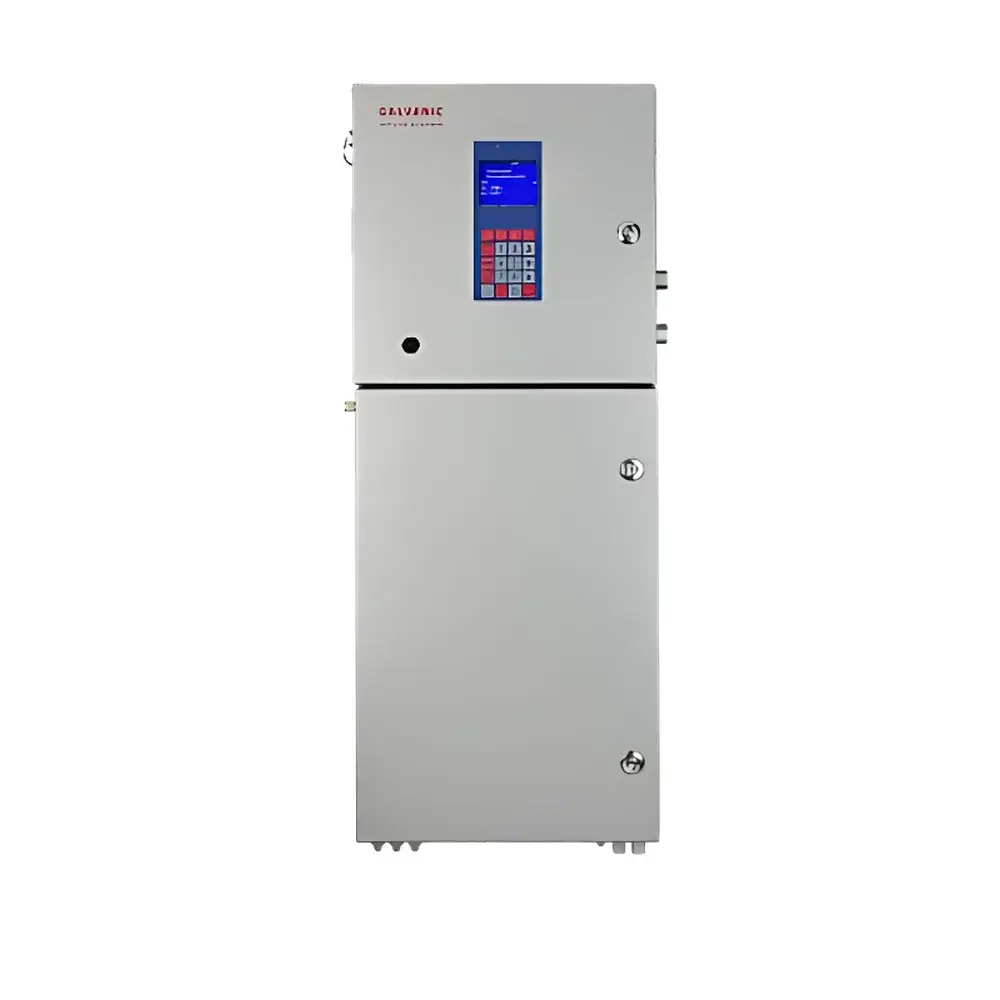
Galvanic Accuseries-LPA Online Calcium & Magnesium Analyzer
| Brand | Galvanic |
|---|---|
| Origin | USA |
| Model | Accuseries-LPA Online Analyzer |
| Instrument Type | Online Multi-Ion Analyzer |
| Measurement Range | 0–200 ppb (as Ca²⁺/Mg²⁺) |
| Detection Limit | <1 ppb (typical, method-dependent) |
| Response Time | ≤10 min (T90) |
| Accuracy | ±1% of reading |
| Operating Temperature | −20 to +60 °C |
| Communication Interfaces | 4–20 mA, Modbus TCP/IP, RS232, RS485, USB, GUI PC Direct Connection, Relay Outputs |
| Sample Flow Paths | Up to 6 independent streams (modular configuration) |
| Enclosure Rating | IP65 (corrosion-resistant housing, H₂S/Cl₂ tolerant) |
Overview
The Galvanic Accuseries-LPA Online Calcium & Magnesium Analyzer is an industrial-grade, photometric ion analyzer engineered for continuous, real-time quantification of dissolved calcium and magnesium ions in process water and wastewater streams. It operates on the principle of dual-wavelength spectrophotometry, utilizing selective colorimetric reagents that form stable, absorbance-proportional complexes with Ca²⁺ and Mg²⁺ under controlled pH and chelation conditions. Unlike single-wavelength systems, the dual-wavelength optical architecture actively compensates for sample turbidity, suspended solids, and background chromophore interference—ensuring high reproducibility in challenging matrices such as chlor-alkali brine, power plant condensate polishers, and specialty process waters. Designed for unattended 24/7 operation, the system integrates fully automated reagent delivery, flow-cell cleaning, calibration verification, and multi-point standardization—eliminating manual intervention while maintaining traceable metrological integrity.
Key Features
- Dual-wavelength photometric detection with built-in turbidity compensation—minimizes drift and matrix-induced bias in non-filtered or high-solids samples.
- Fiber-optic probe architecture isolates the optical sensing module from thermal and mechanical stress, significantly extending service intervals and reducing preventive maintenance frequency.
- Modular fluidic design supports up to six independent sample streams; each channel maintains autonomous timing, calibration, and alarm logic—ideal for multi-point monitoring in distributed water treatment networks.
- Electrically isolated architecture: the analytical module (wet chemistry section) is physically and electrically decoupled from the main control unit, enabling continued DCS/PLC communication and fault reporting even during localized fluidic subsystem failure.
- Corrosion-resistant enclosure rated IP65, with chemically inert wetted materials (e.g., PFA, PVDF, sapphire optics) engineered for long-term exposure to H₂S, Cl₂, hypochlorite, and low-pH industrial effluents.
- Embedded self-diagnostic suite monitors reagent levels, sample flow integrity, air bubble presence, optical path cleanliness, and calibration validity—triggering configurable relay alarms and event logs compliant with ISA-84 SIS requirements.
Sample Compatibility & Compliance
The Accuseries-LPA is validated for use with clarified, filtered, and moderately turbid aqueous samples typical of industrial water circuits—including reverse osmosis permeate, boiler feedwater, cooling tower blowdown, and chlor-alkali electrolyte recirculation loops. It complies with ASTM D511 (Standard Test Methods for Calcium and Magnesium in Water) and ISO 6059 (Water quality — Determination of calcium and magnesium — EDTA titrimetric method) for method equivalence in online mode. Its firmware and data handling architecture support audit-trail functionality aligned with FDA 21 CFR Part 11 requirements when deployed in GMP-regulated utilities. All electrical interfaces meet IEC 61000-6-2 (EMC immunity) and IEC 61000-6-4 (EMC emissions) standards.
Software & Data Management
The analyzer runs embedded Linux-based firmware with a web-accessible GUI (HTTPS-enabled), supporting remote configuration, real-time trend visualization, and historical data export in CSV or XML formats. Integrated Modbus TCP/IP and 4–20 mA analog outputs enable seamless integration into DCS, SCADA, or MES platforms. Event logs—including calibration events, reagent depletion warnings, flow faults, and optical diagnostics—are time-stamped with UTC synchronization and retained for ≥30 days onboard. Optional cloud telemetry (via MQTT or OPC UA) allows centralized fleet monitoring across geographically dispersed installations without requiring on-site IT infrastructure.
Applications
- Chlor-alkali production: Continuous monitoring of Ca²⁺/Mg²⁺ in brine purification to prevent membrane fouling and electrolyzer scaling.
- Thermal power generation: Feedwater and condensate quality assurance per EPRI guidelines, ensuring compliance with turbine metallurgy limits (e.g., <5 ppb Ca²⁺ in ultra-supercritical units).
- Pharmaceutical water systems: Monitoring of purified water (PW) and water for injection (WFI) loop conductivity surrogates where hardness ions indicate pretreatment breakthrough.
- Municipal desalination plants: Post-reverse osmosis hardness verification prior to blending or distribution.
- Chemical manufacturing: Closed-loop process water reuse control where calcium/magnesium accumulation impacts catalyst lifetime or product purity.
FAQ
What sample preparation is required prior to analysis?
No filtration or dilution is required for most industrial applications; however, samples with >50 NTU turbidity or >10 mg/L total suspended solids should be pre-filtered using a 5-µm inline filter to protect the flow cell.
Does the system support automatic calibration verification?
Yes—users may schedule daily or weekly auto-checks against primary standards; results are logged and trigger alerts if deviation exceeds ±2% of expected value.
Can the analyzer operate in hazardous area environments?
The base unit is rated for Zone 2/Class I Div 2; optional ATEX/IECEx-certified versions are available upon request for classified locations.
Is method validation documentation provided?
Galvanic supplies IQ/OQ documentation templates, performance qualification protocols, and a full traceable certificate of conformance with NIST-traceable standards used during factory testing.
How is reagent consumption managed?
Reagent volumes are tracked in real time via integrated level sensors; low-level alerts activate 4–20 mA and relay outputs, and usage history is exportable for predictive inventory planning.







