
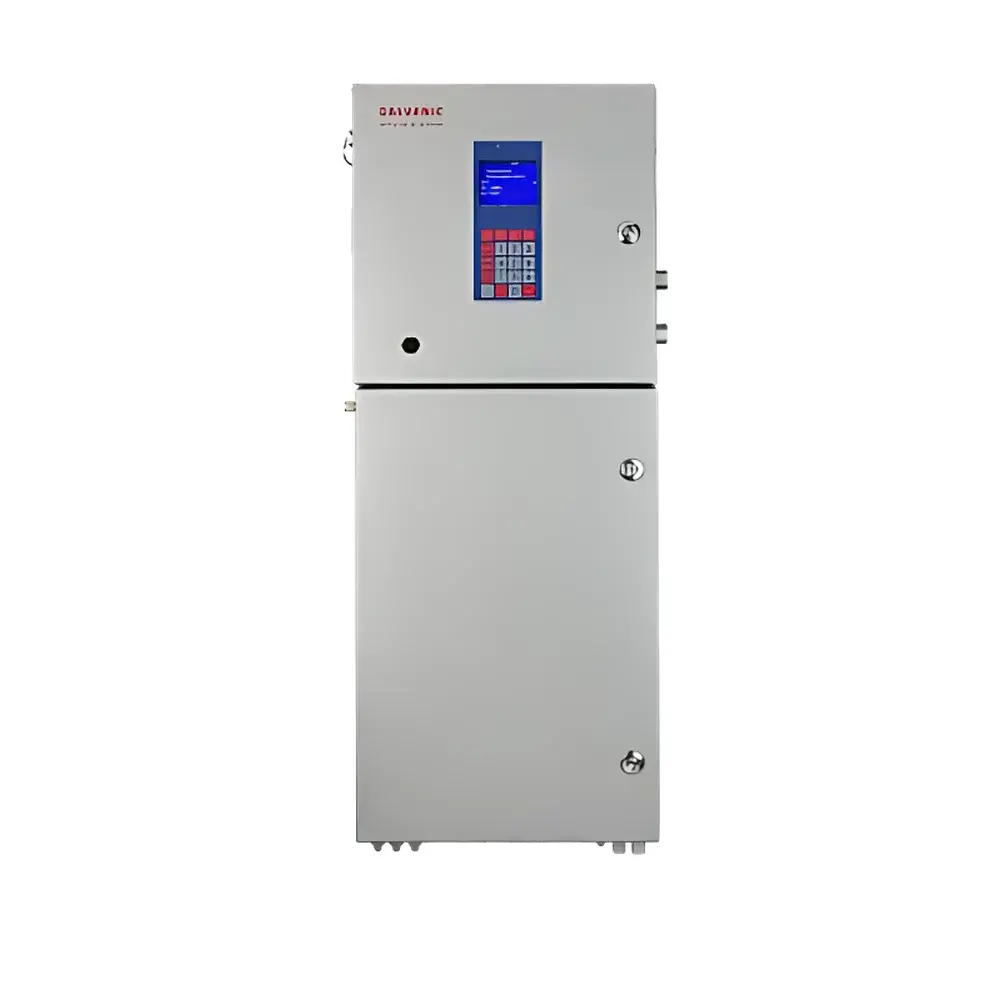
Galvanic Accuseries LPA Online Chloride Analyzer
| Brand | Galvanic |
|---|---|
| Origin | USA |
| Model | Accuseries LPA Online Analyzer |
| Instrument Type | Online Chloride Analyzer |
| Measurement Range | 0–50 ppm |
| Detection Limit | 0.1 ppm |
| Response Time | 8 min |
| Accuracy | ±1% of reading |
| Operating Temperature Range | −20 °C to +60 °C |
| Communication Interfaces | 4–20 mA, Modbus TCP/IP, RS232, RS458, USB, GUI PC Direct Connection, Relay Outputs |
| Sample Streams | Up to 6 independent flow paths |
| Analytical Method | Potentiometric Titration |
| Enclosure Rating | IP65 (corrosion-resistant, H₂S/Cl₂ tolerant, moisture-proof) |
| Service Life | Designed for continuous 24/7 operation with automated reagent management |
Overview
The Galvanic Accuseries LPA Online Chloride Analyzer is an industrial-grade, fully automated potentiometric titration system engineered for continuous, real-time monitoring of chloride ion (Cl⁻) concentration in demanding process and wastewater streams. Unlike optical or ion-selective electrode (ISE)-based systems, the LPA employs a robust, reagent-driven potentiometric endpoint detection method—providing high selectivity, long-term stability, and minimal interferences from turbidity, color, or complex matrix ions commonly found in metallurgical effluents, electroplating rinse waters, mining leachates, textile dye baths, and ultrapure water loops in semiconductor fabrication. Its architecture separates electronic control modules from wet chemistry components, enabling fault-isolated operation and extended service intervals in corrosive or high-humidity environments.
Key Features
- Modular flow-path design supporting up to six independent sample streams—ideal for multi-point monitoring across plant-wide discharge points or treatment stages.
- Integrated 24/7 autonomous operation: automatic reagent dosing, electrode cleaning, calibration verification, and endpoint titration—all without manual intervention.
- Dual-zone enclosure: electronics compartment (IP65-rated, sealed against moisture and H₂S/Cl₂ ingress) physically isolated from the wet chemistry module to ensure operational continuity during fluidic subsystem maintenance.
- High-visibility LCD interface with dedicated function keys for local configuration, diagnostic navigation, and real-time status review—even under low-light or glove-box conditions.
- Comprehensive alarm framework: detects and reports low reagent level, absent sample flow, electrode drift, calibration failure, and abnormal titration curve morphology—each with configurable relay outputs and digital event logging.
- Multi-protocol connectivity: native support for 4–20 mA analog output, Modbus TCP/IP (for DCS/SCADA integration), RS232/RS485 serial communication, USB host mode for firmware updates, and GUI-based PC software for advanced diagnostics and audit trail review.
Sample Compatibility & Compliance
The LPA analyzer is validated for use with aqueous matrices containing suspended solids ≤50 mg/L, total dissolved solids (TDS) ≤10,000 ppm, and pH 2–12. It meets ASTM D3223–21 (Standard Test Method for Chloride Ion in Water by Potentiometric Titration) and is compatible with ISO 9001-certified QA/QC workflows. Its hardware and embedded firmware support GLP-compliant data integrity requirements—including time-stamped measurement records, operator ID logging (via optional network authentication), and immutable audit trails for calibration events, maintenance actions, and alarm triggers. While not FDA 21 CFR Part 11–certified out-of-the-box, its data export structure (CSV/Excel-compatible) and traceable event logs facilitate validation under regulated pharmaceutical or biotech water system protocols.
Software & Data Management
The embedded analyzer firmware includes onboard data buffering (≥30 days of 5-minute interval measurements), configurable reporting intervals, and secure remote access via Ethernet. The optional Accuseries Desktop Suite provides graphical titration curve visualization, method parameter optimization tools, historical trend overlays, and batch export for LIMS integration. All calibration and maintenance logs are timestamped and exportable with cryptographic hash verification to ensure data provenance. Firmware updates are delivered via signed binary packages, preserving system integrity during field upgrades.
Applications
- Metal finishing plants: monitoring chloride breakthrough in passivation rinse tanks and acid recovery circuits.
- Coal and base metal mining: tracking Cl⁻ accumulation in heap leach solutions and tailings pond discharge.
- Textile manufacturing: verifying chloride removal post-bleaching to prevent fiber degradation and dye fixation failure.
- Semiconductor fab UPW loops: ensuring sub-ppm chloride compliance prior to photolithography and etch tool feed lines.
- Power plant condensate polishing: detecting early-stage condenser tube leakage through chloride anomaly detection.
FAQ
What analytical principle does the LPA use, and why is it preferred over ISE-based chloride sensors?
It uses standardized potentiometric titration with silver nitrate (AgNO₃) as titrant and a double-junction reference electrode—delivering superior accuracy, matrix tolerance, and long-term drift stability compared to membrane-based ISEs in high-conductivity or sulfide-rich streams.
Can the system operate unattended for extended periods?
Yes. With standard reagent packs (2L AgNO₃ and 2L indicator solution), the LPA supports ≥30 days of continuous analysis at 15-minute sampling intervals, including automated cleaning and calibration cycles.
Is remote diagnostics supported without third-party SCADA integration?
Yes. Built-in web server enables browser-based access to live status, historical data plots, and firmware diagnostics over standard Ethernet—no proprietary gateway required.
How is compliance with environmental discharge reporting standards ensured?
All measurements include embedded UTC timestamps, instrument ID, method version, and operator-assigned sample point tags—exportable in CSV format for direct ingestion into EPA e-Reporting portals or internal EHS databases.
What maintenance intervals are recommended for routine operation?
Electrode polishing and reference junction cleaning every 90 days; full fluidic path inspection and seal replacement every 12 months—documented in the onboard maintenance log with due-date alerts.







