
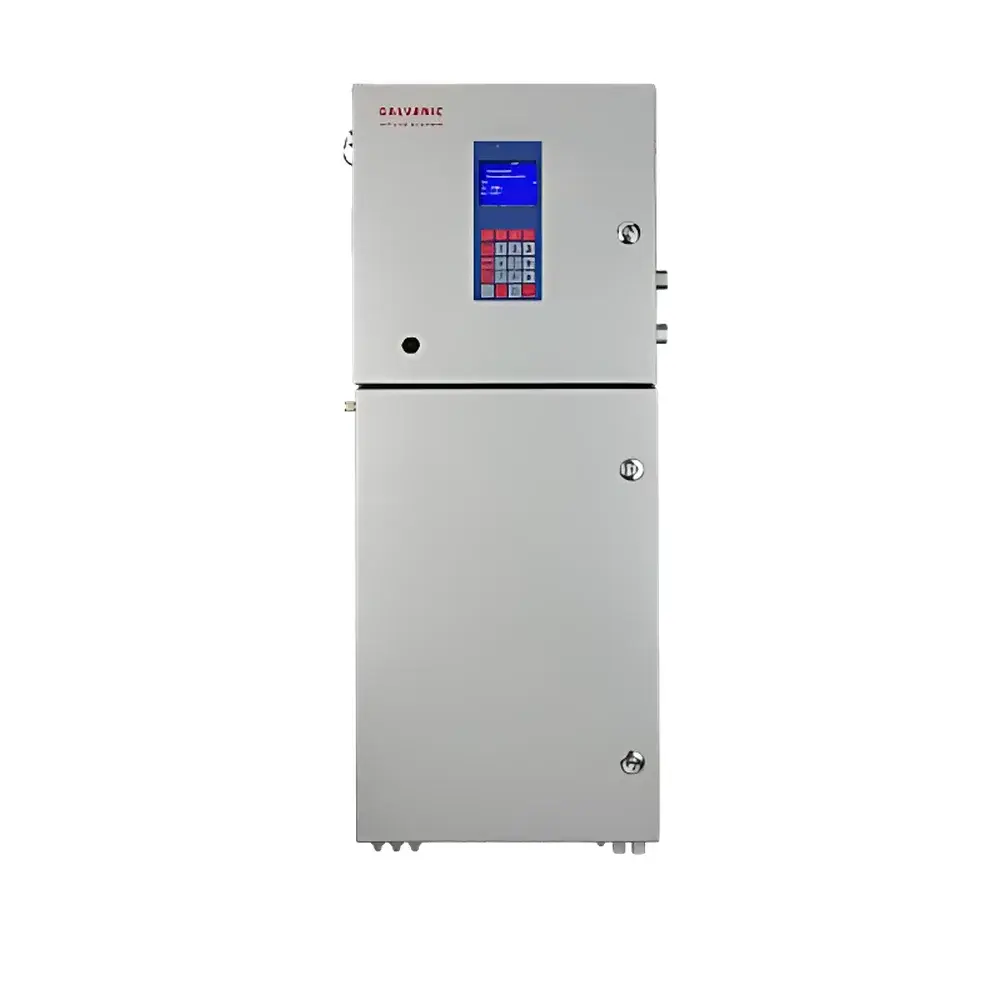
Galvanic Accuseries LPA Online Sodium Analyzer
| Brand | Galvanic |
|---|---|
| Origin | USA |
| Model | Accuseries LPA Online Analyzer |
| Instrument Type | Online Sodium Ion Analyzer |
| Measurement Range | 0–10,000 ppb |
| Detection Limit | 0 ppb |
| Response Time | 10 min |
| Accuracy | ±1% of reading |
| Operating Temperature | −20 to +60 °C |
| Communication Interfaces | 4–20 mA, Modbus TCP/IP, RS232, RS485, USB, GUI PC Direct Connection |
| Sample Streams | Up to 6 modular flow paths |
| Compliance | Designed for continuous operation in industrial water monitoring per ASTM D4192, ISO 10523, and USP <643> guidance for sodium in purified water systems |
Overview
The Galvanic Accuseries LPA Online Sodium Analyzer is an industrial-grade, continuous-monitoring system engineered for precise, real-time quantification of sodium ion (Na⁺) concentration in aqueous process streams. It operates on the principle of potentiometric measurement using a solid-state, high-selectivity ion-selective electrode (ISE), calibrated against NIST-traceable standards and validated for long-term stability under dynamic flow conditions. Unlike laboratory-based atomic absorption or ICP-MS methods, this analyzer delivers rapid, reagent-free electrochemical detection optimized for critical water quality control points—including boiler feedwater, condensate return loops, demineralized water systems, and effluent discharge monitoring in power generation, petrochemical refining, and semiconductor ultrapure water (UPW) facilities. Its architecture integrates electrochemical sensing with embedded microfluidics and adaptive signal conditioning to maintain accuracy across variable conductivity, pH (pH 5–11), and temperature gradients—without requiring sample dilution or acidification.
Key Features
- Modular multi-stream capability: Supports up to six independent sample inlet paths via configurable solenoid valve manifolds, enabling simultaneous monitoring of boiler drum water, steam condensate, and makeup water without hardware duplication.
- True “robotic chemist” automation: Fully autonomous daily calibration (zero and span), electrode surface cleaning via pulsed air/water purge, reagent replenishment, and diagnostic self-checks—all executed without operator intervention.
- Electrochemically isolated measurement core: Physical and electrical separation between the ISE sensor module and main processing unit prevents cross-contamination and ensures uninterrupted data logging even during sensor maintenance or failure.
- Ruggedized industrial enclosure: IP66-rated housing with corrosion-resistant 316L stainless steel wetted parts and H₂S/Cl₂-resistant polymer seals; rated for ambient operation from −20 °C to +60 °C with optional heated sample line integration.
- Embedded diagnostics and alarm hierarchy: Real-time monitoring of electrode potential drift, reference junction integrity, sample flow rate, reagent level, and air purge pressure—with configurable relay outputs and event-triggered Modbus alerts to DCS/PLC systems.
- Intuitive local HMI: High-resolution LCD touchscreen with backlit keypad for field configuration, trend review (7-day onboard storage), and manual override of calibration cycles or cleaning sequences.
Sample Compatibility & Compliance
The Accuseries LPA is validated for use with low-conductivity waters (0.1–5 µS/cm) and moderate ionic strength matrices (up to 500 µS/cm), including deionized water, reverse osmosis permeate, turbine condensate, and treated wastewater effluents. It meets performance criteria referenced in ASTM D4192 (Standard Test Method for Sodium Ion in Water by Ion-Selective Electrode), ISO 10523 (Water Quality — Determination of pH), and aligns with USP recommendations for sodium monitoring in pharmaceutical water systems. The system supports GLP-compliant audit trails when integrated with third-party SCADA platforms, and its firmware includes time-stamped calibration logs, sensor health metrics, and user-access authentication—facilitating FDA 21 CFR Part 11 readiness where electronic records are required.
Software & Data Management
Data acquisition and remote management are enabled through dual-path connectivity: analog 4–20 mA output for legacy DCS integration and native Ethernet-based Modbus TCP/IP for modern IIoT architectures. A browser-accessible web interface provides secure HTTPS access to live readings, historical trends (exportable as CSV), configuration parameters, and diagnostic reports. Optional Galvanic CloudLink™ gateway enables encrypted MQTT telemetry to cloud-based dashboards, supporting predictive maintenance modeling based on electrode impedance decay patterns and calibration frequency drift. All firmware updates are delivered via signed OTA packages with SHA-256 verification to ensure system integrity.
Applications
- Power generation: Continuous sodium monitoring in HP/LP turbine steam cycles to detect early-stage cation resin breakthrough and prevent superheater corrosion.
- Petrochemical refining: Feedwater purity assurance at hydrogen reformer and hydrocracker desalting units where Na⁺ > 5 ppb risks catalyst poisoning.
- Pharmaceutical manufacturing: USP -compliant sodium surveillance in WFI (Water for Injection) and Purified Water distribution loops.
- Municipal drinking water: Regulatory compliance tracking for sodium limits per WHO guidelines (20 mg/L) in post-chlorination and softening processes.
- Desalination plants: Brine reject stream characterization and RO membrane integrity verification via sodium chloride leakage detection.
FAQ
What is the recommended calibration frequency for routine operation?
Daily automated two-point calibration (zero and mid-range standard) is standard; extended intervals (e.g., weekly) may be implemented with documented risk assessment and trending validation per ISO/IEC 17025 requirements.
Can the analyzer operate unattended for extended periods?
Yes—designed for 365-day continuous service with scheduled maintenance every 6 months, including ISE membrane replacement and reference electrolyte refill.
Is the system compatible with hazardous area classifications?
The base unit is rated for Class 1, Division 2 (NEC) / Zone 2 (IECEx); explosion-proof variants (ATEX/IECEx certified) are available upon request.
How is data integrity ensured during communication outages?
Onboard non-volatile memory retains 30 days of 1-minute interval data; synchronization resumes automatically upon network recovery with timestamp-consistent gap filling.
Does the analyzer support third-party LIMS integration?
Yes—via Modbus TCP/IP or OPC UA (with optional add-on module), enabling direct ingestion into LabVantage, Thermo Fisher SampleManager, or custom SQL-based LIMS platforms.
Related Products







