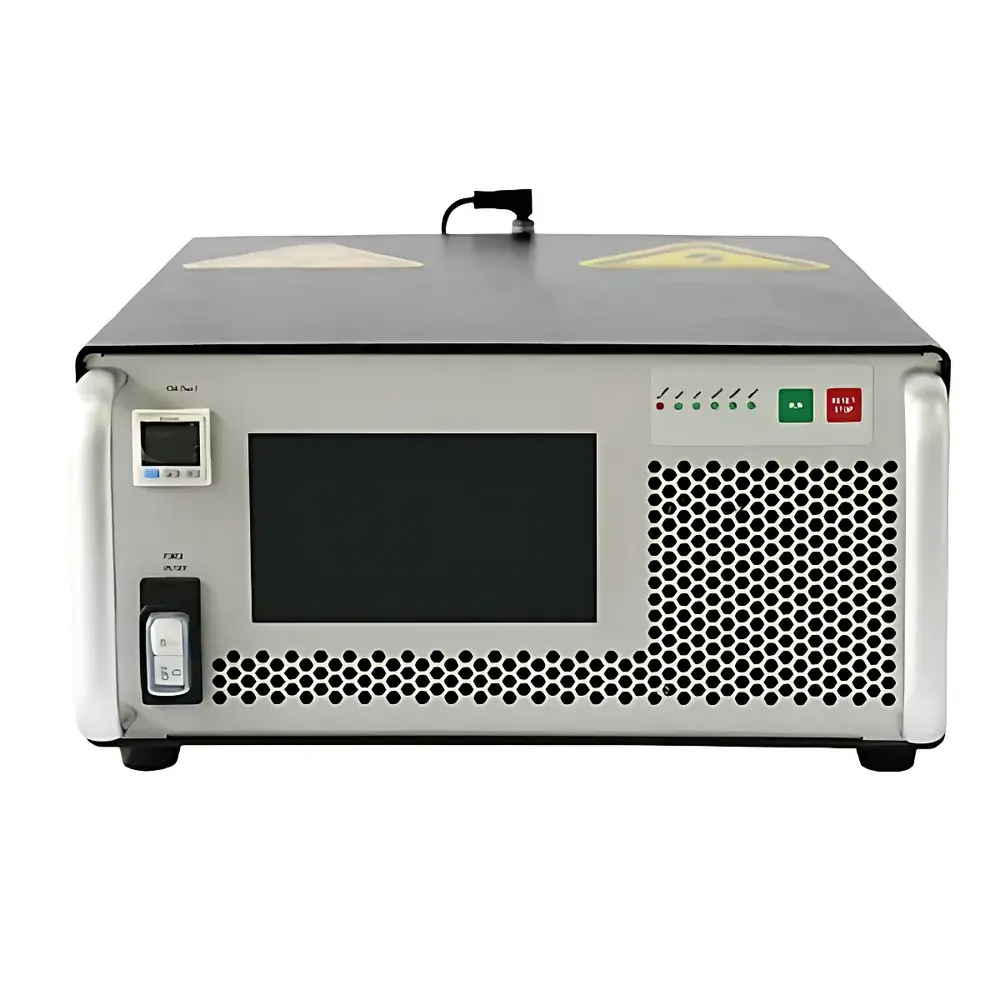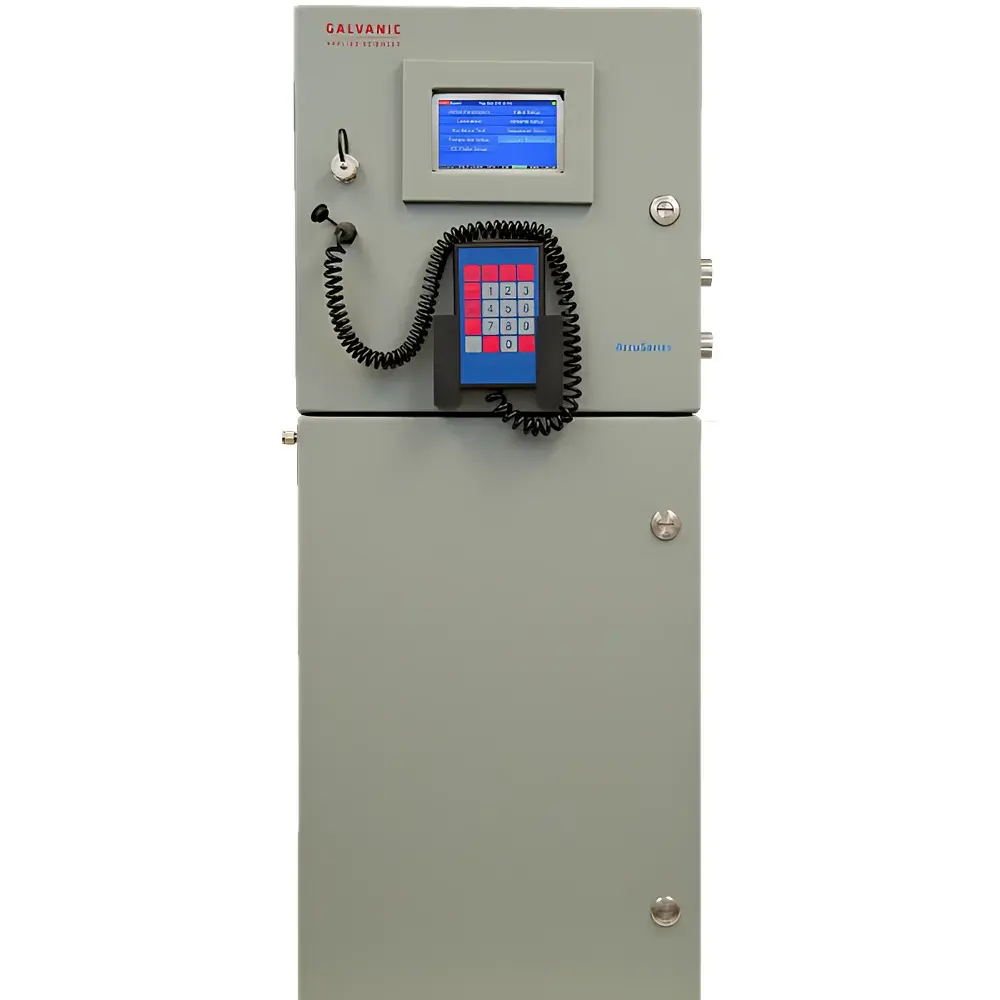
Galvanic AccuSeries Online Sodium Hydroxide Analyzer
| Brand | Galvanic |
|---|---|
| Origin | USA |
| Manufacturer Type | Authorized Distributor |
| Origin Category | Imported |
| Model | AccuSeries |
| Pricing | Upon Request |
| Measurement Principle | Potentiometric Titration with pH Endpoint Detection |
| Range Options | 0–1 g/L or 0–0.5 g/L (customizable per application) |
| Accuracy | ±1% of Full Scale |
| Linearity | ±1% of Full Scale |
| Repeatability | ±1% of Full Scale |
| Response Time | 3–12 minutes |
| Operating Temperature | –20 °C to +60 °C |
| Dimensions | 1016 mm × 406 mm × 241 mm |
| Weight | 45.3 kg |
| Power Consumption | 100 W |
| Supply Voltage | 10–32 VDC or 90–240 VAC |
| Analog Outputs | Up to eight 4–20 mA isolated outputs |
| Communication Protocols | Modbus RTU (RS-232/RS-485), Modbus TCP/IP, USB, GUI PC Direct Connection |
| Relay Outputs | Configurable alarm and control relays |
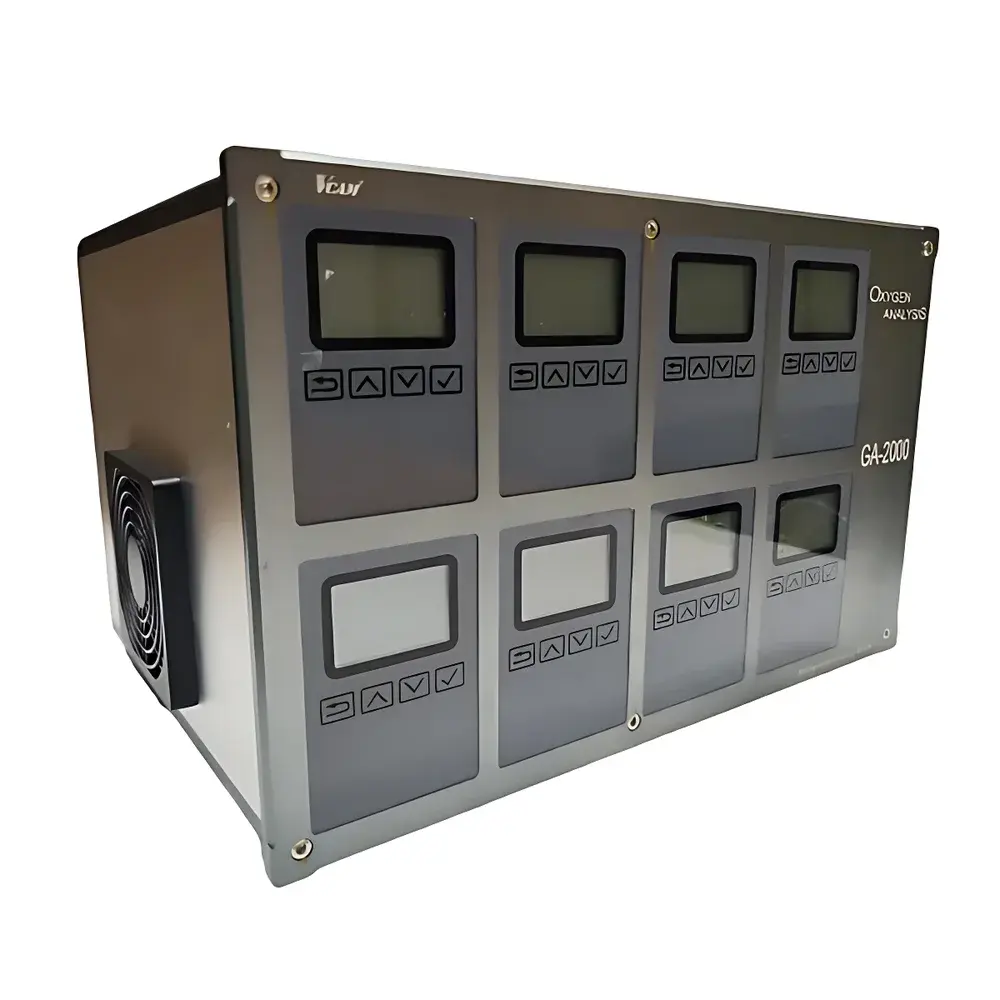
| Sample Streams | Up to six independent flow paths (modular expansion) |
| Enclosure Rating | IP65-rated corrosion-resistant housing |
| Compliance | Designed for hazardous area compatibility (Class I, Div 2 optional), supports GLP/GMP audit trails via software logging |
Overview
The Galvanic AccuSeries Online Sodium Hydroxide Analyzer is an industrial-grade, fully automated process analyzer engineered for continuous, real-time quantification of hydroxide ion (OH⁻) concentration in aggressive aqueous streams. It employs potentiometric titration with a high-stability pH electrode as the endpoint detection mechanism—ensuring robust performance in environments where traditional conductivity-based methods suffer from interferences (e.g., chloride, carbonate, or variable ionic strength). The system is purpose-built for mission-critical applications in chlor-alkali plants (brine purification), coal chemical processing, and petrochemical wastewater treatment—where precise NaOH monitoring directly impacts electrolyzer efficiency, caustic recovery yield, and regulatory compliance with discharge limits.
Key Features
- Modular architecture enabling up to six independent sample streams—each with dedicated reagent delivery, titration cell, and waste handling—without cross-contamination or downtime.
- Electronically isolated sample analysis module and main control unit: failure in fluidic subsystems does not compromise data acquisition, DCS/PLC communication, or system diagnostics.
- True “robotic chemist” operation: fully autonomous 24/7 cycles including auto-zero calibration, reagent replenishment, electrode conditioning, post-measurement cleaning, and endpoint validation.
- Corrosion-resistant wetted materials (e.g., PFA, PVDF, Hastelloy C-276) certified for long-term exposure to H₂S, Cl₂, hypochlorite, and concentrated caustic solutions.
- Integrated remote diagnostic suite with predictive fault alerts—including low reagent level, no sample flow, electrode drift, and abnormal titration curve slope—transmitted via Modbus or relay outputs.
- High-resolution color LCD interface with tactile keypad support for on-site configuration, method editing, and real-time status visualization without external PC dependency.
Sample Compatibility & Compliance
The AccuSeries accommodates complex matrices common in heavy industry: turbid brines, sulfide-laden effluents, and oxidizing caustic solutions. Its pH electrode-based endpoint detection eliminates interference from non-hydroxide alkalinity (e.g., CO₃²⁻, HCO₃⁻), delivering superior selectivity over conductimetric alternatives. The analyzer meets mechanical and electrical requirements for installation in Class I, Division 2 hazardous locations (certification documentation available upon request). All firmware and data logs are structured to support GLP and GMP environments—audit trail timestamps, user authentication, and change history are retained internally and exportable via USB or network interface. While not inherently FDA 21 CFR Part 11 compliant, the system can be deployed within validated workflows when integrated with third-party electronic signature and access control layers.
Software & Data Management
Configuration, calibration, and method development occur through either the onboard GUI or Galvanic’s Windows-based AccuConfig™ desktop application. Each analytical method defines precise sequences: pre-titration rinse volume, reagent addition rate, stirring speed, endpoint stability window, and post-analysis flush duration. All parameters are stored with version control and timestamped modification records. Data output includes raw titration curves, calculated OH⁻ concentration (g/L), confidence metrics (e.g., R² of titration fit), and diagnostic flags. Eight isolated 4–20 mA analog outputs can be assigned to primary concentration, secondary diagnostics (e.g., electrode impedance), or alarm states. Modbus TCP/IP enables native integration into DeltaV, Emerson DeltaV, Siemens PCS7, and Honeywell Experion DCS platforms.
Applications
- Chlor-alkali production: Continuous monitoring of NaOH residual in saturated brine prior to membrane electrolysis—preventing catalyst poisoning and optimizing caustic recycle ratios.
- Coal gasification wastewater: Quantifying free OH⁻ in high-salinity, sulfide-rich streams to guide neutralization dosing and meet EPA NPDES pH and alkalinity discharge thresholds.
- Petrochemical refinery effluent: Tracking caustic wash residuals in sour water stripper overheads and amine regenerator blowdown—supporting sulfur recovery unit feed consistency.
- Chemical manufacturing: In-line verification of NaOH concentration in batch reactor quench streams or scrubber liquor circulation loops.
FAQ
What titrant is used in the AccuSeries system?
Standard configuration employs standardized hydrochloric acid (HCl) solution; alternative titrants (e.g., HNO₃) are supported upon method validation.
Can the analyzer operate unattended for extended periods?
Yes—typical reagent refill interval exceeds 30 days at standard 6-minute cycle time; consumables (electrodes, tubing, filters) are rated for ≥6 months under nominal conditions.
Is temperature compensation applied during measurement?
Automatic temperature correction is embedded in the titration algorithm using a built-in Pt100 sensor located at the titration cell inlet.
How is electrode maintenance handled?
The system performs automated electrode immersion cleaning with deionized water before and after each analysis; manual recalibration is required only after electrode replacement or significant drift (>±15 mV baseline shift).
Does the AccuSeries support custom reporting formats?
Raw data exports (CSV, TXT) include all intermediate values; third-party SCADA historians or LIMS systems may apply proprietary formatting rules via Modbus register mapping.