
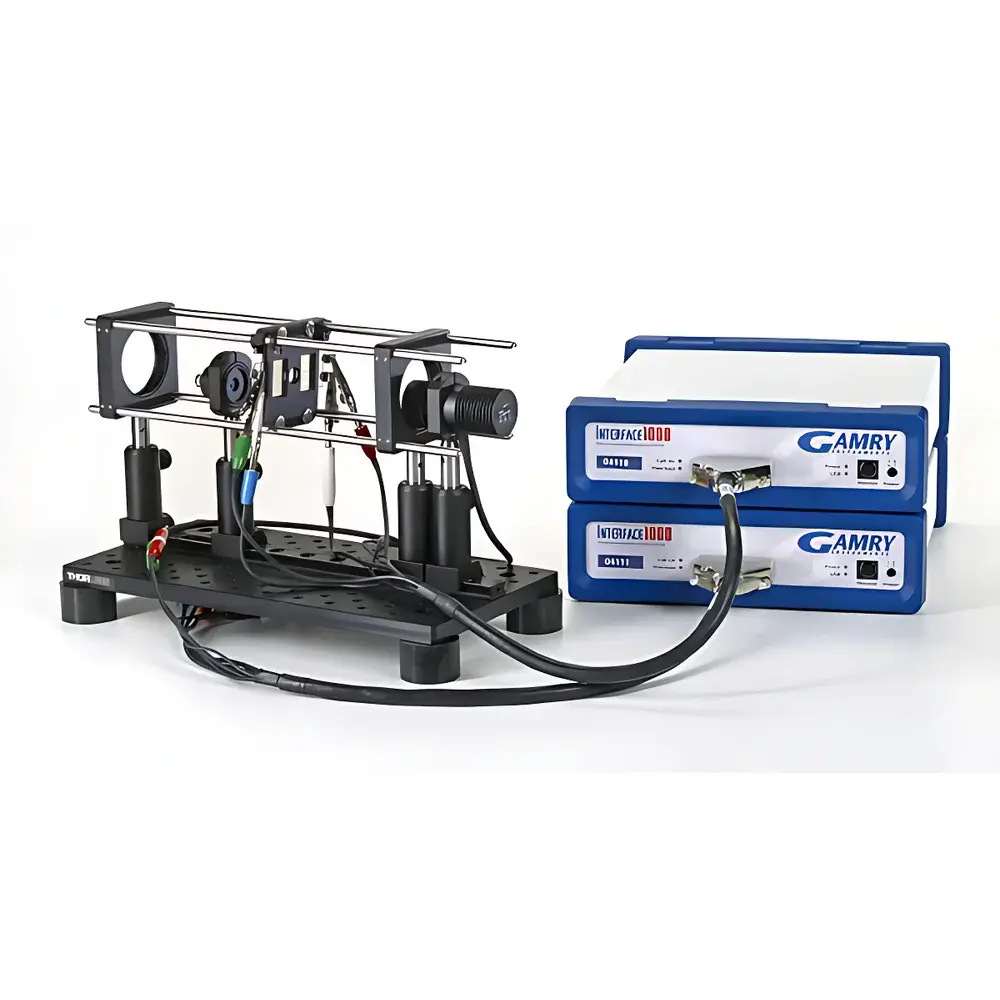
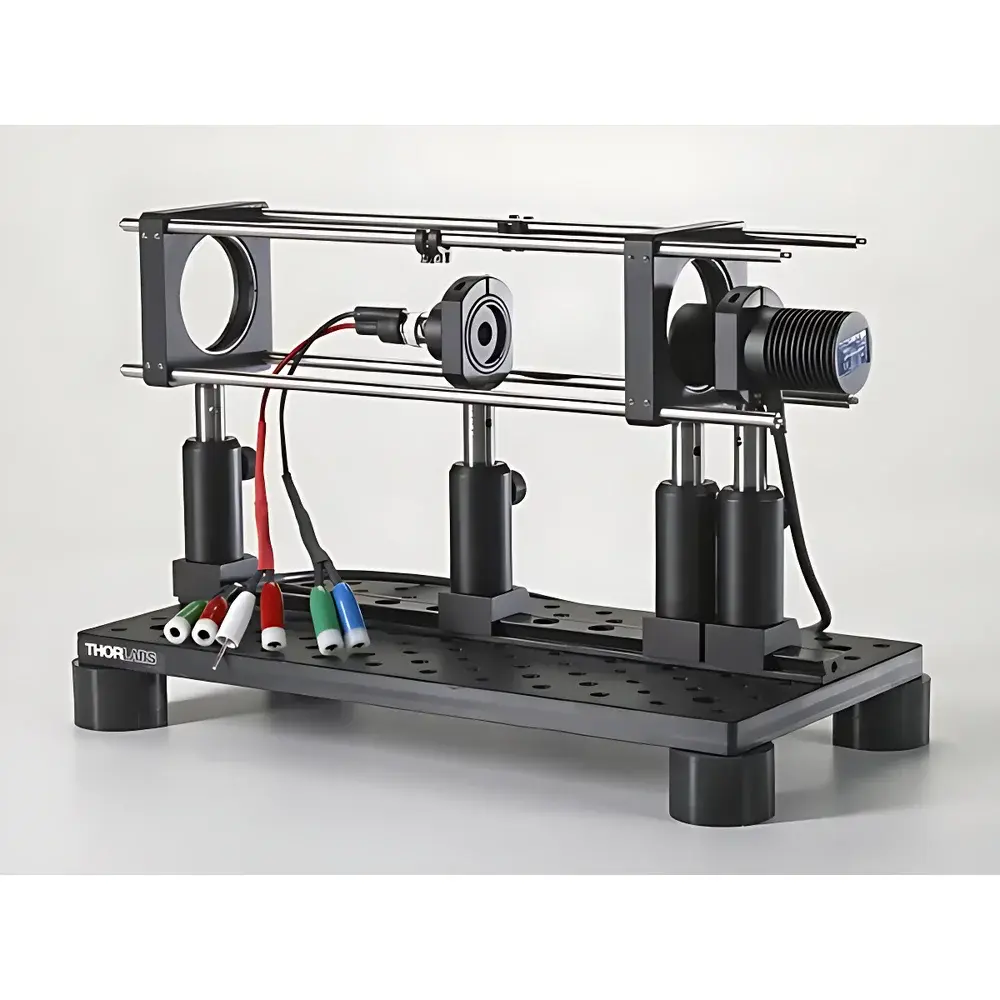
Gamry IMPS/IMVS Intensity-Modulated Photocurrent/Photovoltage Spectroscopy System
| Brand | Gamry |
|---|---|
| Origin | USA |
| Model | IMPS/IMVS |
| Current Range | 10 nA – 1 A |
| Current Accuracy | ±0.3% |
| Potential Accuracy | ±0.2% |
| Potentiostatic Range | ±12 V |
| AC Impedance Frequency Range | 10 µHz – 1 MHz |
| Instrument Type | Electrochemical Workstation |
Overview
The Gamry IMPS/IMVS Intensity-Modulated Photocurrent/Photovoltage Spectroscopy System is a purpose-engineered electrochemical workstation designed for quantitative, frequency-resolved characterization of photoactive materials and devices—particularly dye-sensitized solar cells (DSSCs), perovskite photovoltaics, organic photovoltaics (OPVs), and photoelectrochemical (PEC) systems. It operates on the principle of intensity-modulated spectroscopy, where a sinusoidally modulated light source perturbs the sample under controlled potentiostatic or galvanostatic bias, enabling separation of charge generation, transport, and recombination kinetics via phase-resolved photocurrent (IMPS) and photovoltage (IMVS) response. Unlike conventional steady-state techniques, IMPS/IMVS delivers dynamic insight into carrier lifetime, electron diffusion length, interfacial recombination resistance, and transport time—parameters critical to device optimization and mechanistic validation in renewable energy research.
Key Features
- Integrated modular optical platform with precision LED driver and real-time intensity modulation control (10 µHz–1 MHz)
- Dedicated dummy cell module for background signal subtraction and baseline correction
- 3D-printed, adjustable battery fixtures compatible with standard and custom-sized solar cells (e.g., 1 cm², 0.25 cm², flexible substrates)
- Multi-wavelength LED support: factory-calibrated red (630 nm), blue (470 nm), orange (590 nm), yellow (585 nm), and white-light sources; external light source interface available via TTL/analogue input
- High-fidelity potentiostat with ±12 V compliance, 10 nA–1 A current range, and metrologically traceable accuracy (±0.3% current, ±0.2% potential)
- Full EIS capability up to 1 MHz with single-sine and multi-sine options, supporting both potentiostatic and galvanostatic modes
- Robust architecture compliant with IEEE 1139 and ASTM E2422 standards for impedance measurement uncertainty quantification
Sample Compatibility & Compliance
The system accommodates solid-state, liquid-junction, and quasi-solid-state photoelectrodes across rigid (FTO, ITO glass) and flexible (PET, metal foil) substrates. It supports standard three-electrode configurations (working, counter, reference) as well as two-electrode photovoltaic mode. All electrochemical protocols—including cyclic voltammetry, I–V sweeps, chronoamperometry, and transient photocurrent analysis—are fully programmable and reproducible. The hardware and firmware are designed to meet GLP-compliant data integrity requirements: audit trails, user access control, electronic signatures, and 21 CFR Part 11–ready software configuration (when paired with Gamry Framework v9.5+). Device calibration is traceable to NIST-certified shunt resistors and reference electrodes (Ag/AgCl, SCE).
Software & Data Management
Controlled via Gamry Framework™ electrochemical software, the IMPS/IMVS system provides synchronized acquisition of optical modulation signals, current/voltage transients, and impedance spectra. Real-time FFT-based demodulation ensures accurate extraction of IMPS/IMVS transfer functions (|HIMPS|, ∠HIMPS, |HIMVS|, ∠HIMVS). Data export supports HDF5, ASCII, and Excel formats; built-in modeling tools include equivalent circuit fitting (EC-Lab®-compatible syntax), Bode/Nyquist visualization, and lifetime diffusion length calculation (τn, Ln) using published analytical expressions (e.g., Bisquert’s transmission line models). Raw datasets retain full metadata (timestamp, lamp intensity, bias potential, temperature, electrode area), ensuring FAIR (Findable, Accessible, Interoperable, Reusable) data practices.
Applications
- Quantitative determination of electron recombination lifetime (τrec) and transport time (τtr) in mesoporous metal oxide photoanodes
- Interfacial kinetic mapping of hole transport layers (HTLs) in perovskite solar cells under operational bias
- Stability assessment of photocatalysts under prolonged illumination via time-series IMPS/IMVS monitoring
- Correlation of photovoltage decay dynamics with open-circuit voltage (VOC) loss mechanisms
- Validation of charge-selective contact performance in tandem and bifacial photovoltaic architectures
- Support for ISO 18558 (photoelectrochemical characterization) and IEC 61215-2 (PV module qualification) auxiliary testing workflows
FAQ
What distinguishes IMPS from IMVS measurements?
IMPS measures the complex photocurrent response to modulated light intensity under constant potential, revealing transport and collection efficiency. IMVS measures the complex photovoltage response under constant current (or open-circuit conditions), directly probing recombination kinetics and minority carrier lifetime.
Can the system perform simultaneous dark and illuminated EIS?
Yes—via automated sequence scripting, users can acquire baseline EIS in darkness followed by IMPS/IMVS under calibrated illumination, all within a single experiment file.
Is external light source integration supported?
Yes—the system includes a TTL-synchronized optical trigger port and analogue intensity control interface, enabling seamless integration with lasers, xenon lamps, or monochromators equipped with appropriate modulation drivers.
Does the dummy cell require calibration?
No—the dummy cell is a passive, non-electroactive reference fixture used solely for optical path matching and stray-light subtraction; it requires no electrical calibration but must be optically aligned during setup.
How is current accuracy maintained across the full 10 nA–1 A range?
Through auto-ranging current interrupter (ARI) technology and cascaded low-noise transimpedance amplifiers, each optimized for specific decades, with continuous internal gain verification against precision references.





