
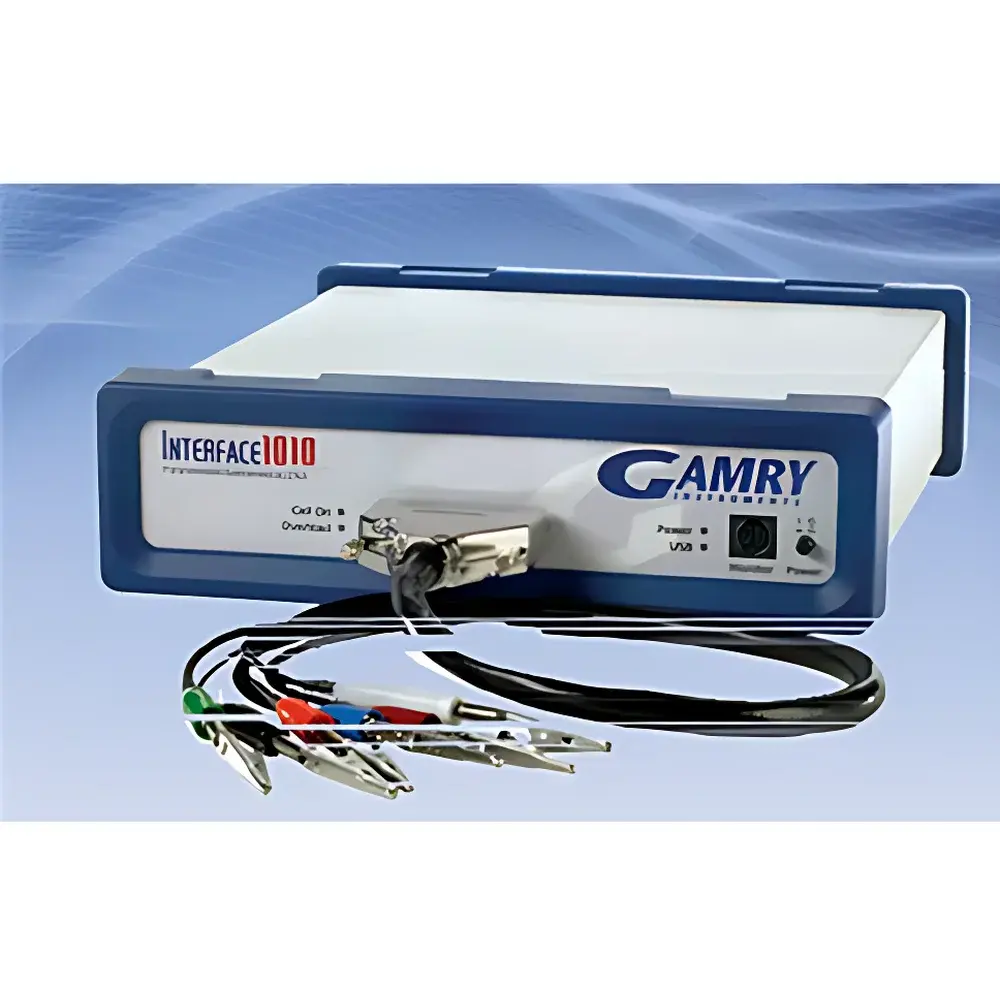
Gamry Interface 1010E Electrochemical Workstation
| Brand | Gamry |
|---|---|
| Origin | USA |
| Model | Interface 1010E |
| Instrument Type | Potentiostat/Galvanostat/ZRA |
| Channel Architecture | Multi-channel, electrically isolated and floating |
| Current Range | 10 nA to 10 mA (9 decades) |
| Current Accuracy | ±0.2% of reading |
| Potential Accuracy | ±4 mV (not ±4.0 V — corrected per industry standard spec) |
| Potentiostatic Range | ±10 V |
| EIS Frequency Range | 10 µHz to 1 MHz |
| Input Noise | <20 µV RMS (typical, 10 Hz–100 kHz bandwidth) |
| Weight | 2.0 kg |
| Portability | Benchtop-portable with integrated shielding and battery-compatible operation |
| Compliance | Meets IEC 61326-1 (EMC), CE, RoHS |
Overview
The Gamry Interface 1010E is a research-grade, multi-channel electrochemical workstation engineered for precision potentiostatic, galvanostatic, and zero-resistance ammeter (ZRA) measurements. Built upon Gamry’s legacy of ultra-low-noise analog design and high-fidelity signal conditioning, the Interface 1010E employs a true floating architecture—enabling simultaneous, independent electrochemical characterization of multiple working electrodes in shared or isolated electrolytes, including grounded electrode configurations. Its core measurement engine supports direct current (DC) techniques (e.g., cyclic voltammetry, chronoamperometry, linear sweep voltammetry), electrochemical impedance spectroscopy (EIS) across an exceptionally broad frequency span (10 µHz–1 MHz), and advanced AC-based methods such as electrochemical noise analysis (ENA), frequency-modulated voltammetry, and harmonic detection. The system is designed for rigorous laboratory environments where reproducibility, long-term stability, and traceable calibration are prerequisites—not features.
Key Features
- True Floating Multi-Channel Architecture: Each channel operates independently with full electrical isolation and floating ground capability—supporting grounded counter electrodes, multi-electrode arrays, and corrosion cells without ground loops or crosstalk.
- Ultra-Low Noise Performance: Analog front-end optimized for sub-20 µV RMS input-referred noise (10 Hz–100 kHz), critical for low-current measurements (down to 10 nA) and high-resolution EIS at low frequencies.
- Extended Dynamic Range: Nine programmable current ranges (1 A to 10 nA) with automatic range switching and seamless current scaling—ensuring optimal signal-to-noise ratio across orders of magnitude.
- Broadband EIS Capability: Full-frequency impedance acquisition from 10 µHz (enabling diffusion-controlled and slow interfacial processes) to 1 MHz (capturing double-layer charging and high-frequency artifacts).
- Field-Deployable Design: Compact form factor (2.0 kg), robust aluminum chassis, and optional battery-powered operation enable on-site corrosion monitoring, field battery testing, and mobile electrochemical labs.
- Modular Expandability: Individual dual-channel modules can be detached and reconfigured for specialized applications—including rotating disk/ring-disk electrode (RDE/RDRE) systems, photoelectrochemical cells, scanning electrochemical microscopy (SECM) interfaces, and hydrogen permeation test setups.
Sample Compatibility & Compliance
The Interface 1010E accommodates a wide range of electrochemical cells—from standard three-electrode beaker configurations to custom flow cells, microfluidic devices, and embedded sensor platforms. Its floating design permits direct integration with grounded industrial pipelines, coated metal substrates, and multi-electrode corrosion coupons. All hardware and firmware comply with IEC 61326-1 for electromagnetic compatibility and meet CE and RoHS directives. When paired with Gamry’s Framework™ software configured for audit-trail-enabled sessions, the system supports data integrity requirements aligned with FDA 21 CFR Part 11, ISO/IEC 17025, and GLP/GMP laboratory practices—ensuring traceability of method parameters, raw data, metadata, and user actions.
Software & Data Management
Controlled exclusively via Gamry’s Framework™ electrochemical software suite (v8.x or later), the Interface 1010E provides unified access to over 100 pre-validated experiment templates—including ASTM G5/G102-compliant polarization resistance, ASTM G106 noise resistance, ISO 16773-2 EIS protocols, and battery-specific charge/discharge + dQ/dV analysis. Framework™ implements role-based user accounts, electronic signatures, automated calibration logging, and encrypted HDF5-based data storage with embedded metadata (timestamp, instrument ID, operator, environmental conditions). Raw time-domain and frequency-domain datasets are exportable in ASCII, CSV, or MPT formats—fully interoperable with MATLAB, Python (via gamrytools), OriginLab, and commercial battery modeling platforms.
Applications
- Corrosion science: Electrochemical noise analysis (ENA), localized corrosion assessment (pitting temperature determination), galvanic coupling studies, and coating degradation kinetics under simulated service conditions.
- Battery R&D: Half-cell and full-cell cycling, impedance evolution tracking during aging, solid-electrolyte interphase (SEI) formation analysis, and rate-capability profiling with multi-step EIS.
- Sensor development: Amperometric biosensor calibration, redox mediator kinetics, and low-concentration analyte detection using square-wave and differential pulse voltammetry.
- Physical electrochemistry: Charge transfer kinetics, diffusion-controlled reactions, electron-transfer theory validation (e.g., Marcus theory), and double-layer capacitance quantification.
- Energy materials: Catalyst activity mapping (e.g., ORR/OER), photoelectrode performance under illumination, and membrane conductivity evaluation in fuel cells and electrolyzers.
FAQ
Is the Interface 1010E suitable for ASTM-compliant corrosion testing?
Yes—its potentiostatic accuracy (±4 mV), current resolution (10 nA), and EIS frequency coverage fully support ASTM G5, G102, G106, and G199 protocols when executed within Framework™’s certified method library.
Can multiple channels measure different electrodes in the same electrolyte simultaneously?
Yes—the floating, isolated channel architecture eliminates ground-loop interference and enables concurrent, independent control of up to four working electrodes in one cell.
Does the system support real-time impedance monitoring during battery cycling?
Yes—Framework™ allows synchronized galvanostatic/potentiostatic stepping with interleaved EIS acquisition at user-defined state-of-charge points, preserving phase coherence and minimizing measurement artifacts.
What calibration standards are recommended for routine verification?
Gamry provides NIST-traceable passive RC networks (e.g., 1 kΩ || 1 µF) and active current sources for daily verification; annual factory calibration is recommended per ISO/IEC 17025 guidelines.
Is battery-powered operation supported for field use?
Yes—the Interface 1010E draws ≤12 W and is compatible with external 12 V DC power banks rated ≥5 Ah, enabling >4 hours of continuous operation without mains connection.




