
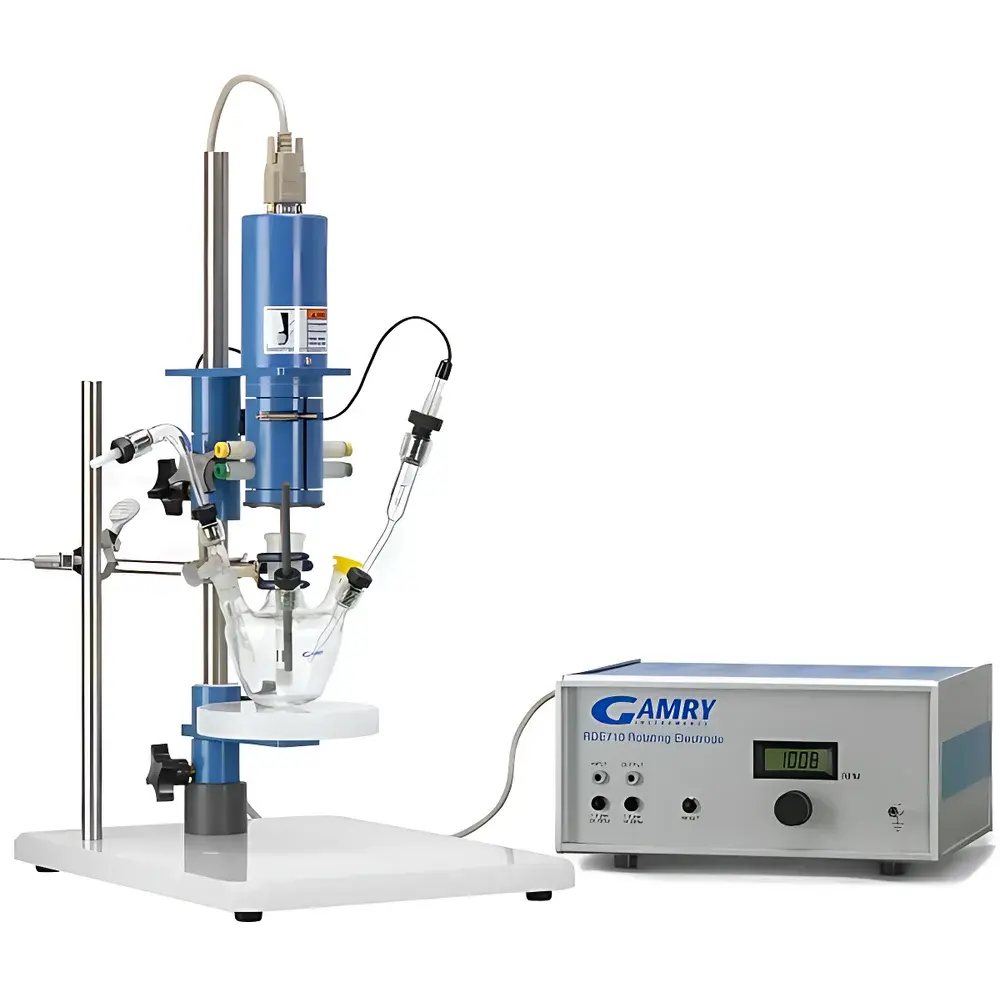
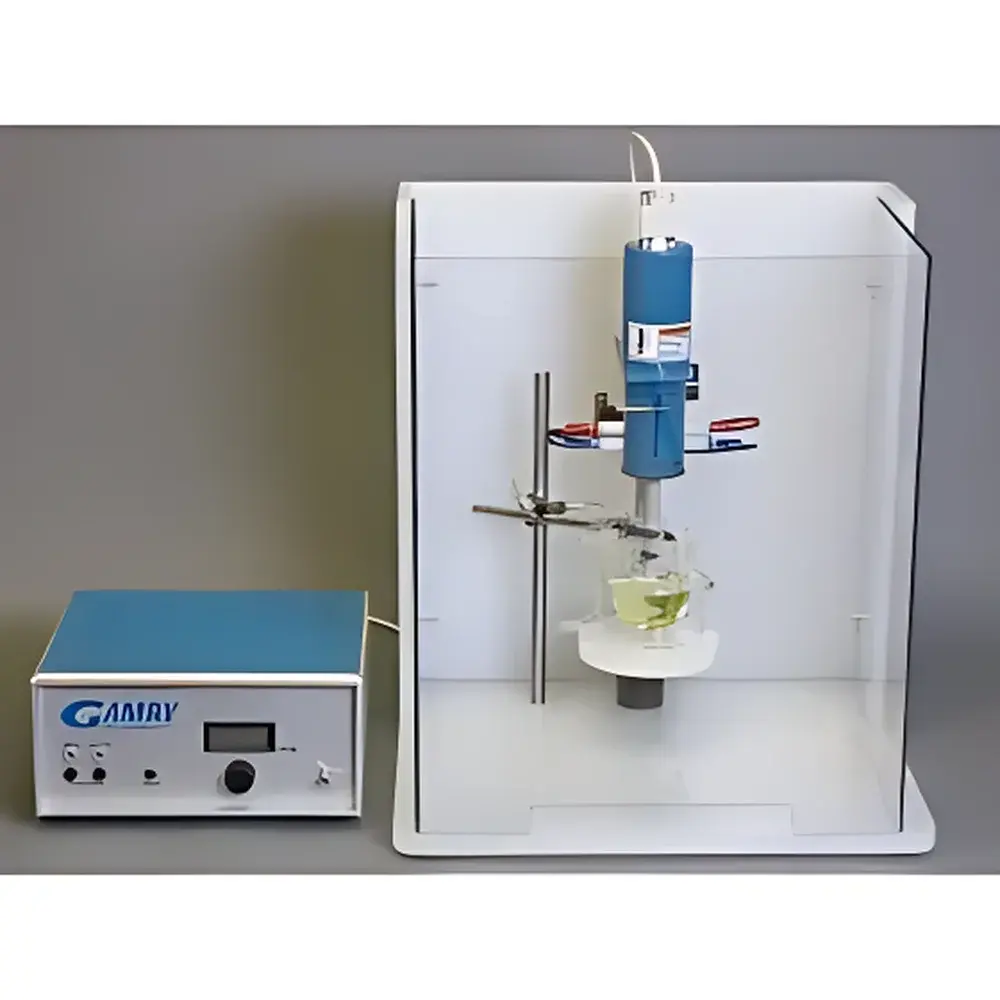
Gamry RDE710 Rotating Disk Electrode
| Brand | Gamry |
|---|---|
| Origin | USA |
| Model | RDE710 |
| Rotation Speed Range | 50–10,000 rpm |
| Electrode Compatibility | Rotating Disk Electrode (RDE), Rotating Ring-Disk Electrode (RRDE), Rotating Cylinder Electrode (RCE) |
| Current Range | 600 fA – 600 mA (20 aA resolution) |
| Control Interface | LCD display with manual speed knob + analog/digital input for external potentiostat synchronization (e.g., Gamry Framework software or third-party systems) |
| Compliance | Designed for GLP/GMP-aligned electrochemical testing |
Overview
The Gamry RDE710 Rotating Disk Electrode is a precision-engineered electrochemical rotation system designed for controlled mass-transport studies in fundamental and applied electrochemistry. Based on the classical Levich equation and Koutecký–Levich analysis, the RDE710 enables quantitative investigation of diffusion-controlled kinetics, electron-transfer rates, and catalytic efficiency by imposing well-defined hydrodynamic boundary conditions at the electrode surface. Its modular architecture supports three primary electrode configurations—rotating disk (RDE), rotating ring-disk (RRDE), and rotating cylinder (RCE)—each serving distinct experimental objectives: RDE for kinetic parameter extraction, RRDE for intermediate detection and reaction pathway elucidation, and RCE for flow-corrosion simulation under turbulent flow regimes. The system operates across a calibrated rotational speed range of 50–10,000 rpm, delivering reproducible laminar flow (for RDE/RRDE) or turbulent flow (for RCE), critical for modeling real-world electrochemical environments such as fuel cell cathodes, corrosion pipelines, and electrocatalyst layers.
Key Features
- High-precision motorized rotation stage with digital speed control and real-time LCD feedback; speed accuracy ±0.5% of setpoint across full range
- Modular electrode holder design accommodating standard 6 mm OD rods, with interchangeable shafts: RDE/RCE shaft (P/N 970-07) and RRDE-specific shaft (P/N 970-10)
- Electrode compatibility with common working materials including Pt, Au, glassy carbon, 1018 carbon steel, 316 stainless steel, and 430 stainless steel; custom substrates supported upon request
- Integrated analog and digital I/O ports for synchronized triggering and speed modulation via external potentiostats (e.g., Gamry Interface 1010E, Reference 600+, or compatible third-party instruments)
- Thermally stable housing with low-vibration bearing assembly to minimize mechanical noise during long-duration chronoamperometric or impedance measurements
- Designed for seamless integration into automated test sequences using Gamry Framework™ software or Python-based instrument control (via COM/SCPI protocols)
Sample Compatibility & Compliance
The RDE710 accommodates standardized electrochemical cells (e.g., 3-electrode Teflon®-lined cells, cylindrical flow cells, and custom-built corrosion cells) and supports both aqueous and non-aqueous electrolytes. It is routinely deployed in laboratories adhering to ASTM G5 (potentiostatic/potentiodynamic polarization), ASTM G180 (electrochemical impedance spectroscopy for coatings), ISO 16773 (corrosion testing of metallic biomaterials), and USP (sterile electrochemical sensor qualification). All mechanical components comply with RoHS directives, and electrical interfaces meet IEC 61000-4-3 EMC standards. When paired with dual-potentiostats, the system satisfies FDA 21 CFR Part 11 requirements for audit-trail-enabled RRDE experiments involving reaction intermediate quantification.
Software & Data Management
The RDE710 operates natively within Gamry Framework™ v9.x or later, enabling user-defined script-based experiment sequencing—including multi-step rotation ramping, potential-step/scan coupling, and conditional logic for adaptive data acquisition. Raw rotation speed signals are timestamped and logged alongside electrochemical data streams (current, potential, phase angle), ensuring traceable correlation between hydrodynamic and faradaic responses. Export formats include ASCII (.txt), Excel (.xlsx), and binary (.gam) for post-processing in MATLAB®, Python (with gamrytools library), or OriginPro®. Audit trails, electronic signatures, and version-controlled method files support GLP/GMP documentation workflows.
Applications
- Catalyst activity evaluation (e.g., ORR, OER, HER) via Koutecký–Levich analysis and Tafel slope derivation
- Fuel cell electrode characterization under controlled oxygen mass transport conditions
- Corrosion rate quantification in simulated pipeline environments using RCE configuration with carbon steel or stainless-steel cylinders
- Reaction mechanism studies via RRDE detection of unstable intermediates (e.g., H₂O₂ in ORR, CO in methanol oxidation)
- Hydrogen permeation and embrittlement assessment in metallurgical R&D
- Electrodeposition kinetics and coating stability testing under forced convection
- Sensor response calibration under defined mass-transfer regimes
FAQ
What electrode types are supported out-of-the-box?
Standard configurations include rotating disk electrodes (RDE), rotating ring-disk electrodes (RRDE), and rotating cylinder electrodes (RCE). Common material options are Pt, Au, glassy carbon, 1018 carbon steel, 316 SS, and 430 SS.
Can the RDE710 be controlled remotely via computer?
Yes—via analog voltage input (0–10 V = 0–10,000 rpm) or digital TTL/RS-232 commands, fully integrated with Gamry Framework™ and compatible with LabVIEW™ and Python automation frameworks.
Is the system suitable for high-current applications such as battery electrode testing?
With the optional 30 A current extension module and appropriate current shunt, the RDE710 supports high-current rotating electrode studies, including Li-ion anode/cathode slurry evaluation under convective conditions.
Does Gamry provide RRDE-specific potentiostat pairing guidance?
Yes—Gamry recommends dual-channel potentiostats (e.g., Interface 1010E + Reference 3000) for independent control of disk and ring potentials, with hardware-synchronized data acquisition and built-in RRDE analysis templates.
How is mechanical alignment verified during installation?
Each unit includes a laser collimation jig and runout gauge; typical radial runout is ≤5 µm at 10,000 rpm, verified per ISO 20816-1 vibration severity standards.




