
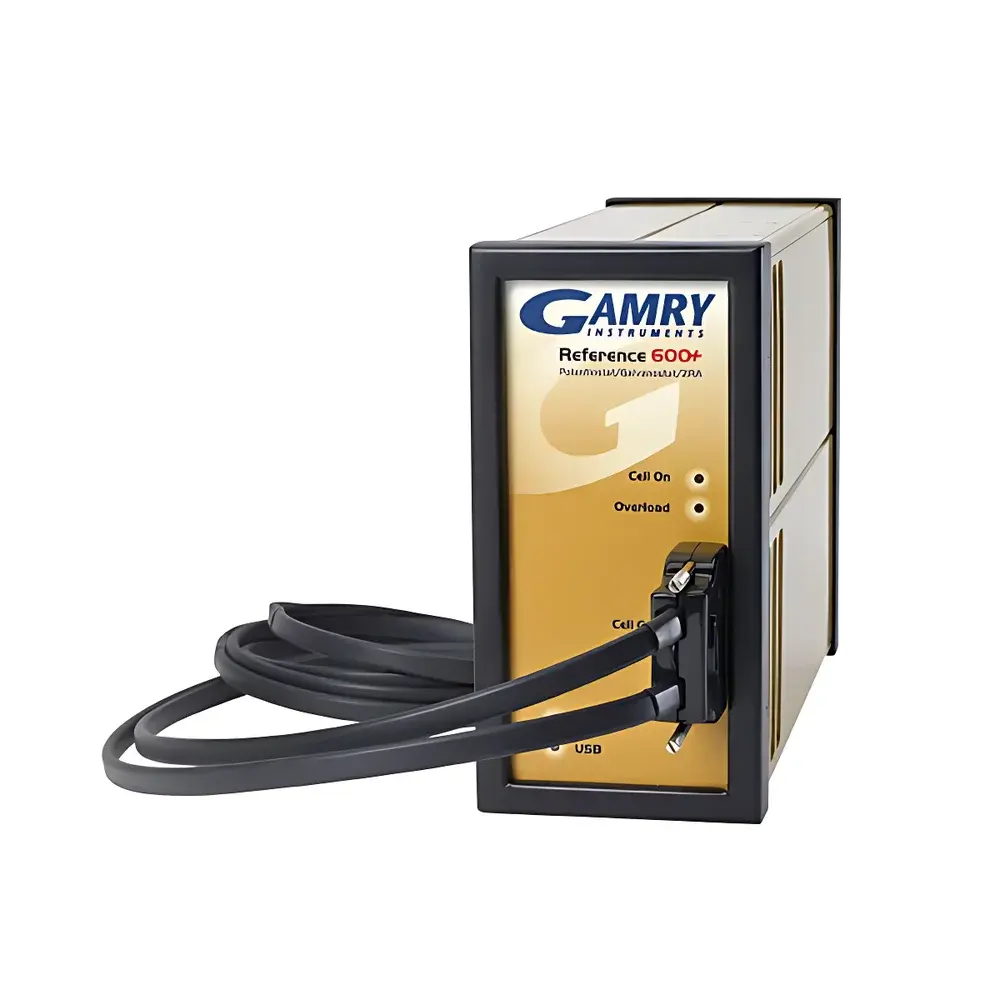
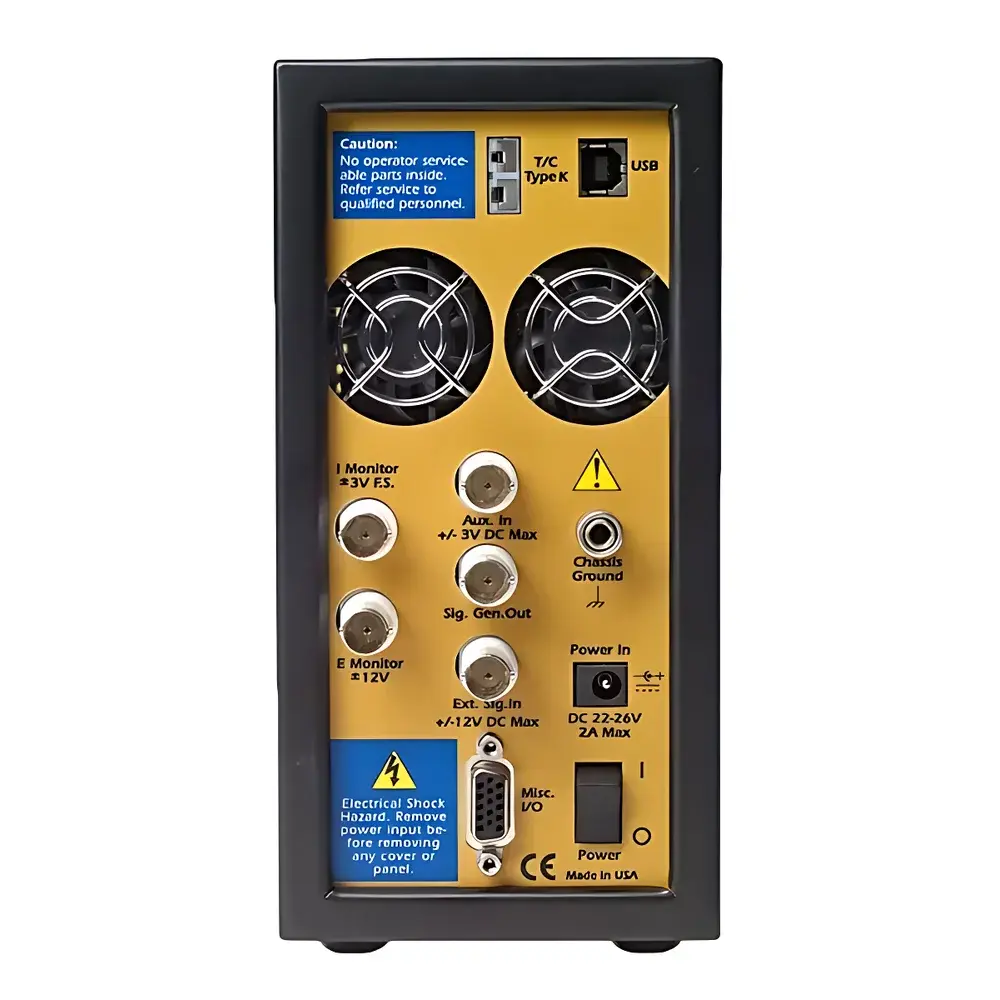
Gamry Reference 600+ Electrochemical Workstation
| Brand | Gamry |
|---|---|
| Origin | USA |
| Model | Reference 600 Plus |
| Channel Configuration | Multi-channel workstation |
| Current Range | ±600 mA |
| Current Resolution | 20 aA |
| Potential Accuracy | ±1 µV |
| Potentiostatic Range | ±22 V |
| EIS Frequency Range | 10 µHz – 5 MHz |
Overview
The Gamry Reference 600+ is a research-grade, USB-connected electrochemical workstation engineered for high-fidelity potentiostatic, galvanostatic, and zero-resistance ammeter (ZRA) measurements. It operates on the principle of controlled-potential or controlled-current perturbation of electrochemical interfaces, enabling quantitative analysis of charge transfer kinetics, interfacial capacitance, mass transport, and corrosion behavior. Its floating-ground architecture ensures compatibility with pressurized autoclaves, battery test cells, and multi-technique coupling setups—including in situ Raman, UV-Vis, EQCM, RDE, SECM, IMPS/IMVS, and TEM-based electrochemical cells. Designed for laboratory environments requiring long-term stability and low-noise performance, the instrument delivers sub-picoampere current resolution and microvolt-level potential control—critical for studying slow kinetic processes, ultrathin films, single-molecule electron transfer, and low-conductivity electrolytes.
Key Features
- Ultra-low current resolution of 20 aA (attoampere), validated experimentally, with 11 programmable current ranges spanning ±60 pA to ±600 mA
- Potential accuracy of ±1 µV, supported by high-stability reference circuitry and <2 µVrms background noise
- True floating-ground design enabling safe operation in high-voltage or isolated electrochemical systems (e.g., high-pressure reactors, bipolar electrode configurations)
- Wide EIS frequency coverage from 10 µHz to 5 MHz, with <2% error at 1 MHz—enabling characterization of both slow diffusion-controlled processes and fast double-layer charging dynamics
- High-speed scanning capability up to 1200 V/s in cyclic voltammetry mode, suitable for transient analysis and high-rate battery testing
- Dual-channel synchronization support for simultaneous multi-electrode experiments and differential measurements
- Integrated hardware-based IR compensation using current-interrupt and positive-feedback methods for accurate ohmic drop correction
- Robust signal filtering architecture ensuring stable operation in electrically noisy environments without compromising data integrity
Sample Compatibility & Compliance
The Reference 600+ accommodates standard 2-, 3-, 4-, and 5-electrode configurations, supporting conventional three-electrode cells, rotating disk electrodes (RDE), scanning electrochemical microscopy (SECM) probes, and custom-built flow cells. Its input impedance exceeds 1014 Ω || <0.2 pF, minimizing loading effects during high-impedance measurements such as passive film characterization or biological membrane studies. The system complies with key international standards including ASTM G59 (potentiodynamic polarization), ASTM G102 (electrochemical impedance calculations), ASTM G106 (cyclic polarization for pitting evaluation), and ISO 17475 (corrosion testing of metallic biomaterials). Data acquisition and reporting workflows are compatible with GLP/GMP documentation requirements, and optional audit-trail-enabled software modules meet FDA 21 CFR Part 11 criteria for regulated laboratories.
Software & Data Management
Control and analysis are performed via Gamry’s Framework™ software platform—a modular, scriptable environment supporting full experimental automation and sequence programming. Core application packages include EIS300™ (electrochemical impedance spectroscopy), PHE200™ (physical electrochemistry), DC105™ (DC corrosion testing), PWR800™ (battery and energy storage characterization), and ESA410™ (electrochemical noise analysis). All data are stored in open-format .DTA files, readable by third-party tools such as MATLAB, Python (via Gamry’s official API), and OriginLab. Real-time parameter monitoring, automatic baseline correction, Kramers–Kronig validation, and equivalent circuit fitting (using embedded ZView®-compatible models) are natively supported. Software updates are delivered through secure, version-controlled repositories with full backward compatibility across instrument generations.
Applications
- Battery and fuel cell R&D: Charge/discharge profiling, rate capability assessment, SEI formation kinetics, and impedance evolution under cycling
- Corrosion science: Tafel analysis, electrochemical noise monitoring (ENM), critical pitting temperature (CPT) per ASTM G150, and localized corrosion mapping
- Electrocatalysis: HER/OER/ORR activity quantification, turnover frequency (TOF) estimation, and catalyst stability evaluation
- Biosensor development: Amperometric detection limits, enzyme kinetics modeling, and redox mediator diffusion studies
- Materials electrochemistry: Conducting polymer doping/dedoping, metal oxide charge storage mechanisms, and nanomaterial surface functionalization
- Environmental electroanalysis: Trace heavy metal detection (e.g., Pb²⁺, Cd²⁺) via anodic stripping voltammetry (ASV) and adsorptive stripping techniques
FAQ
What electrode configurations does the Reference 600+ support?
It supports 2-, 3-, 4-, and 5-electrode setups, including working, counter, reference, auxiliary, and pseudo-reference electrodes—with independent control of each channel where applicable.
Is the instrument suitable for high-temperature or high-pressure electrochemical experiments?
Yes—the floating-ground design allows direct integration with autoclaves, sealed battery testers, and other insulated systems without ground-loop interference or safety hazards.
Can EIS data be acquired simultaneously with DC techniques like CV or chronoamperometry?
Yes, via Gamry’s Hybrid EIS mode, which interleaves impedance measurements within potentiostatic or galvanostatic sequences without interrupting the primary experiment.
Does the system comply with regulatory data integrity requirements?
When configured with optional audit-trail and electronic signature modules, it satisfies FDA 21 CFR Part 11, EU Annex 11, and ISO/IEC 17025 traceability mandates.
How is calibration performed and maintained?
Calibration is performed using NIST-traceable standards; factory calibration certificates are provided, and user-accessible verification routines ensure ongoing accuracy between scheduled service intervals.




