
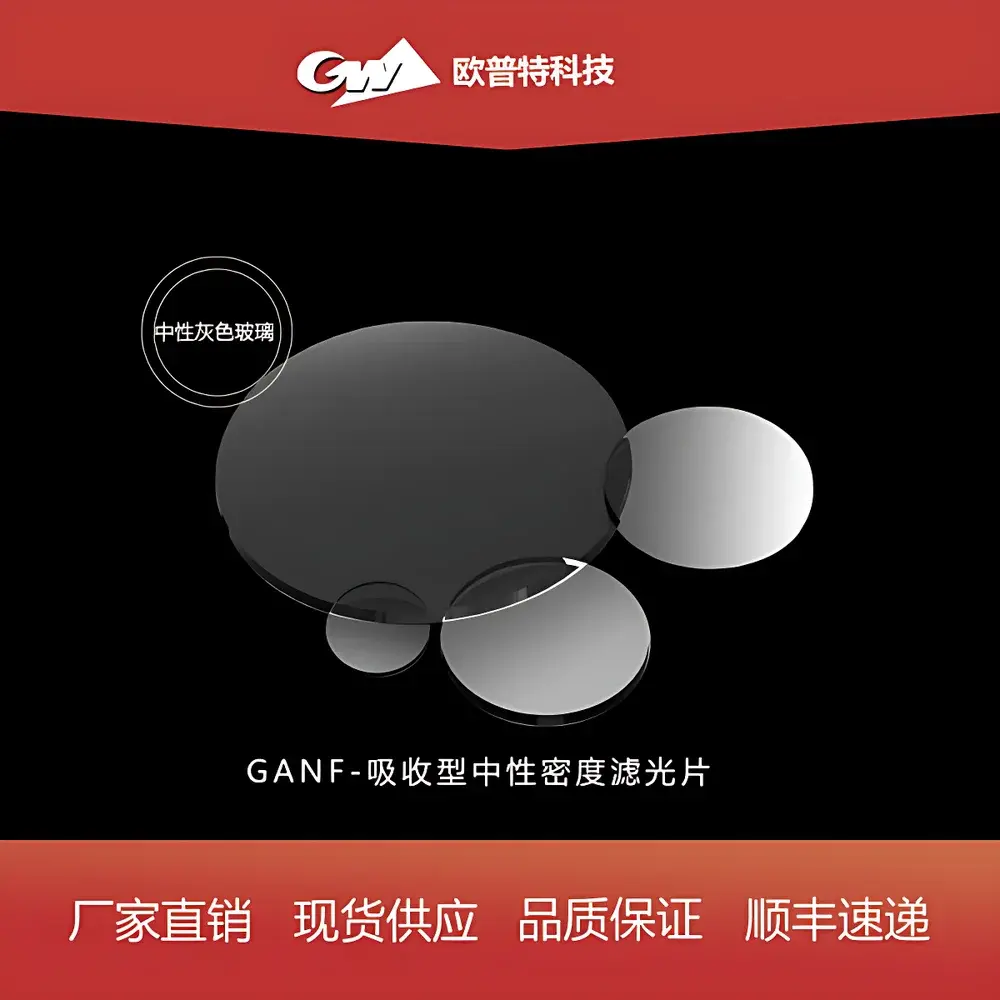
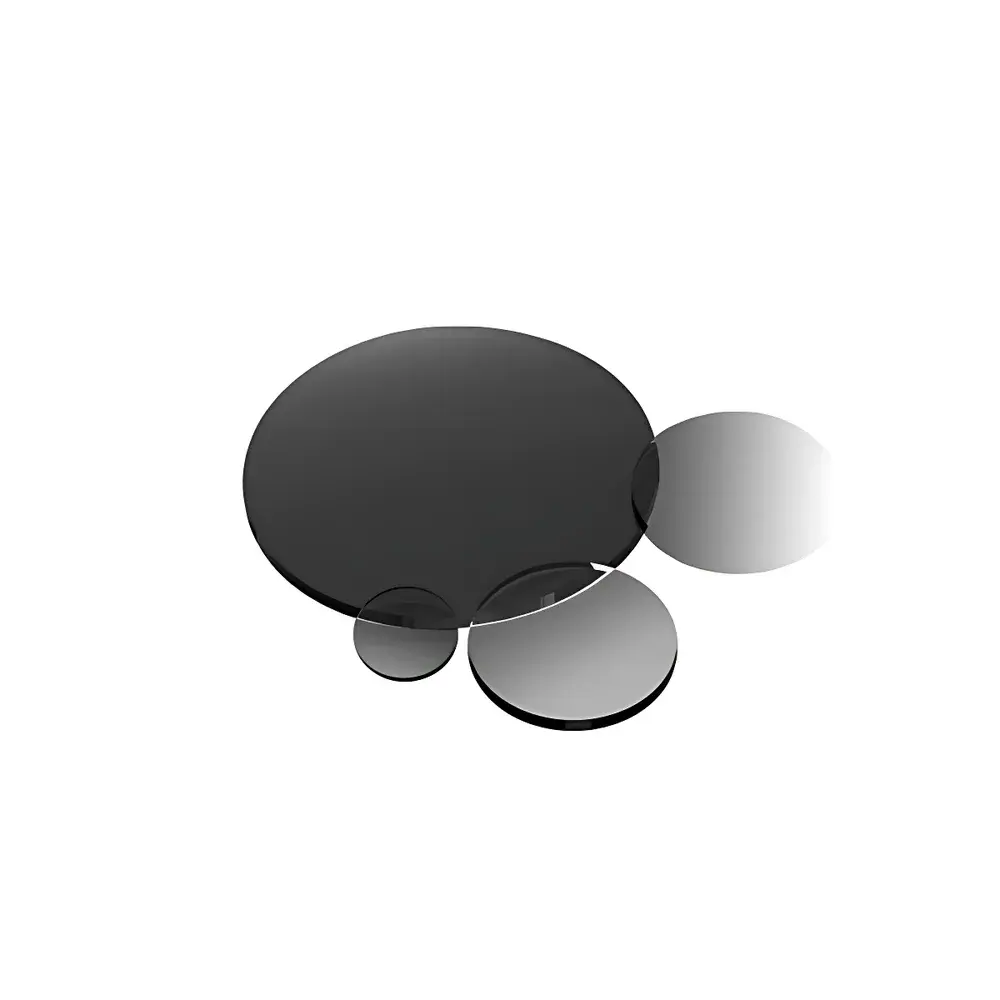
GANF Absorptive Neutral Density (ND) Filter
| Origin | Beijing |
|---|---|
| Manufacturer Type | Distributor |
| Origin Category | Domestic (China) |
| Model | GANF |
| Price Range | USD $0.15–75 |
| Component Category | Optical Element |
| Optical Density (OD) | 0.1–2.0 |
| Transmission (T) | 1%–79% |
| Thickness | 1.25–2.44 mm |
| Available Diameters | Φ12.5 mm, Φ25 mm, Φ50 mm |
| Square Format | 50 × 50 mm |
Overview
The GANF Absorptive Neutral Density (ND) Filter is a precision optical component engineered for uniform attenuation of incident light across the visible and near-infrared spectral range (typically 400–1100 nm). Unlike reflective ND filters, which rely on partial reflection and risk ghosting or polarization sensitivity, the GANF series employs homogeneous absorption-based attenuation using optically stable, spectrally neutral glass doped with controlled metal oxide or rare-earth absorbers. This ensures flat spectral transmission profiles, minimal wavefront distortion (< λ/4 @ 633 nm), and negligible angular dependence—critical for quantitative imaging, laser power management, and photometric calibration applications. Each filter is manufactured to ISO 10110-7 surface quality standards (scratch-dig 60-40), with anti-reflection (AR) coating options available upon request for reduced Fresnel losses at air-glass interfaces.
Key Features
- True neutral density performance: OD tolerance ±0.05 over specified wavelength range; spectral flatness deviation < ±0.03 OD across 450–900 nm
- High spatial uniformity: OD variation ≤ ±0.02 across clear aperture (measured via calibrated CCD-based densitometry)
- Thermal and irradiance stability: Rated for continuous-wave laser exposure up to 5 W/cm² at 532 nm without measurable OD drift (tested per ISO 11551)
- Robust mechanical construction: Precision-ground and polished substrate with chamfered edges; thickness tolerance ±0.05 mm
- Multiple mounting-ready formats: Standard diameters (Φ12.5 mm, Φ25 mm, Φ50 mm) and square (50 × 50 mm) variants with engraved product codes for traceability
- Compliant with RoHS 2015/863/EU and REACH SVHC regulations; no cadmium, lead, or hexavalent chromium in absorber matrix
Sample Compatibility & Compliance
The GANF ND filters are compatible with standard kinematic mounts (e.g., Thorlabs SM-series, Newport KM100), lens tubes, and filter wheels designed for metric-threaded or retaining-ring retention. They exhibit no birefringence under linearly polarized illumination and maintain consistent OD values independent of input polarization state—verified per ISO 9211-4. All units are supplied with individual calibration certificates traceable to NIM (National Institute of Metrology, China), reporting measured OD at 550 nm and 633 nm. For regulated environments—including ISO/IEC 17025-accredited labs and GLP-compliant optical testing workflows—the filters support audit-ready documentation packages including uncertainty budgets (k = 2) and environmental test records (temperature cycling: −20 °C to +70 °C, 5 cycles).
Software & Data Management
While inherently passive components, GANF ND filters integrate seamlessly into automated optical systems via standardized mechanical interfaces and digital asset tracking. Each product code (e.g., GANF-D25-010) corresponds to a unique entry in the manufacturer’s online optical component database, accessible via API for inventory synchronization with LabVantage, STARLIMS, or custom LIMS deployments. Calibration data—including spectral transmittance curves (380–1000 nm, 1 nm resolution), OD uncertainty maps, and batch-level homogeneity reports—are delivered in vendor-neutral CSV and XML formats compliant with ASTM E2917-21 (Standard Practice for Spectral Transmittance Data Exchange). Optional QR-code-labeled mounting rings enable barcode-scanned log entries in electronic lab notebooks (ELNs) satisfying FDA 21 CFR Part 11 requirements for audit trails.
Applications
- Laser safety and power scaling: Precise attenuation of CW and pulsed lasers (e.g., Nd:YAG, Ti:Sapphire, diode lasers) prior to beam profiling cameras or photodiodes
- Quantitative microscopy: Controlling illumination intensity in fluorescence, confocal, and brightfield systems without altering color balance or excitation/emission ratios
- Photometric reference standards: Serving as transfer standards in radiometric calibration chains for integrating spheres and spectroradiometers
- Optical system alignment: Enabling safe real-time observation of high-intensity interference patterns or diffraction orders during setup
- Machine vision lighting control: Stabilizing exposure in industrial inspection systems operating under variable ambient or structured illumination
- Educational optics labs: Demonstrating Beer-Lambert law, dynamic range extension, and signal-to-noise optimization principles
FAQ
What spectral range is guaranteed for neutral performance?
The GANF series maintains OD deviation < ±0.05 across 400–1000 nm for OD ≤ 1.0, and 450–900 nm for OD ≥ 1.3. Full spectral transmittance data is provided with each shipment.
Can these filters be used with ultraviolet (UV) or mid-infrared (MIR) sources?
No. The absorber chemistry and substrate material (optical crown glass) are optimized for visible–NIR. UV exposure may induce solarization; MIR transmission is not characterized and not recommended.
Is there a maximum permissible laser fluence for pulsed operation?
Yes. For nanosecond pulses (10 ns, 10 Hz), the damage threshold is 0.5 J/cm² at 1064 nm (tested per ISO 21254-1). Consult technical support for femtosecond or high-repetition-rate applications.
Do you offer custom OD values or non-standard dimensions?
Yes. Custom OD values (in 0.01 increments from OD 0.05 to 3.0) and dimensions (up to Φ100 mm or 100 × 100 mm square) are available with NRE tooling and 8-week lead time.
How is optical density verified and certified?
Each filter undergoes double-pass spectrophotometric measurement on a Shimadzu UV-3600i with 1 nm bandwidth, referenced to NIST-traceable standards. Certificates include expanded uncertainty (k=2) and measurement conditions.




