
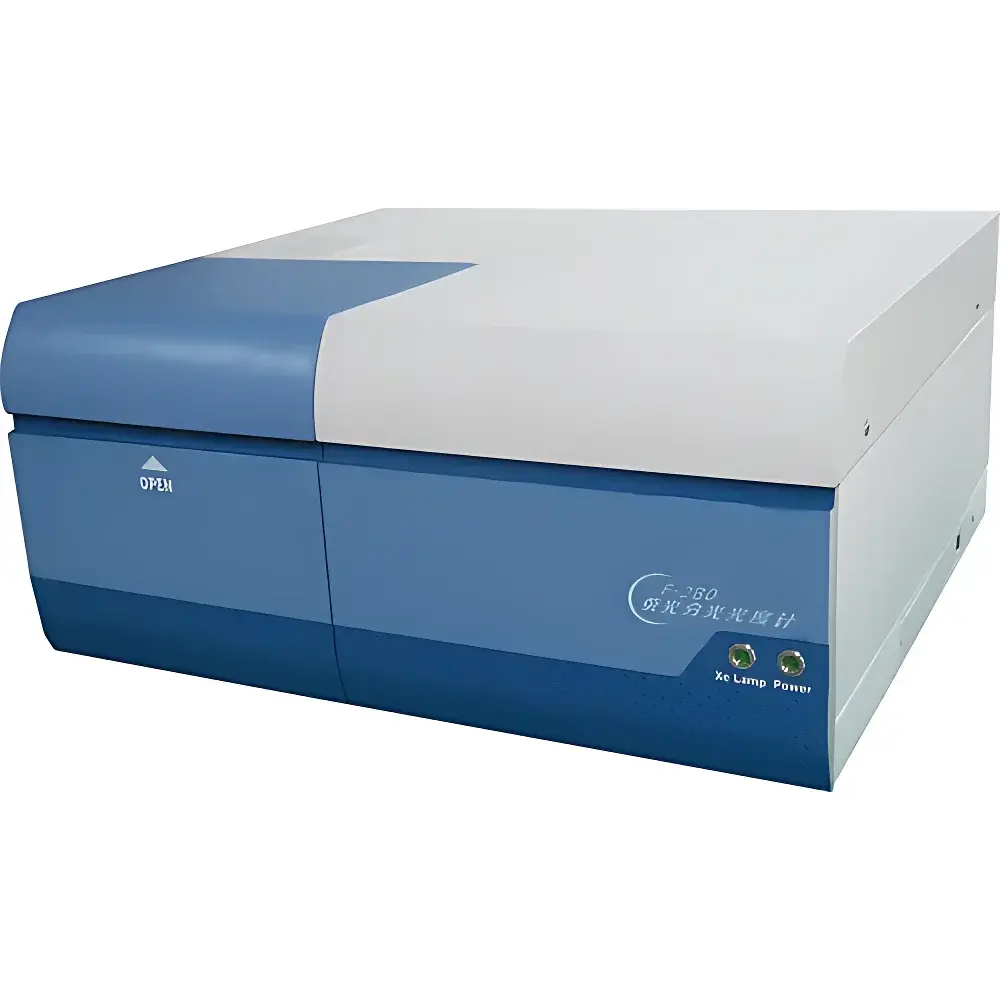
Gangdong F-280 Molecular Fluorescence Spectrophotometer
| Brand | Gangdong |
|---|---|
| Origin | Tianjin, China |
| Manufacturer Type | Direct Manufacturer |
| Model | F-280 |
| Wavelength Range (EX/EM) | 200–760 nm (extendable to 900 nm with optional PMT) |
| Spectral Bandwidth (EX/EM) | 1.0–20.0 nm (adjustable in 5 steps) |
| Wavelength Accuracy | ±0.4 nm |
| Wavelength Repeatability | ≤0.2 nm |
| Resolution | 0.2 nm |
| Sensitivity (P-P) | >130:1 (water Raman peak) |
| Excitation Source | 150 W ozone-free xenon arc lamp |
| Scan Speeds | 30–3000 nm/min (6 modes) |
| Minimum Sample Volume | 0.5 mL (in 10 mm cuvette) |
| Dimensions | 670 × 540 × 310 mm |
| Weight | ~45 kg |
| Interface | USB 2.0 |
| Operating Systems | Windows XP, Windows 7 |
Overview
The Gangdong F-280 Molecular Fluorescence Spectrophotometer is a research-grade benchtop instrument engineered for quantitative and qualitative fluorescence analysis across academic, pharmaceutical, environmental, and quality control laboratories. It operates on the principle of photoluminescence spectroscopy—measuring the intensity and spectral distribution of photons emitted by analytes following excitation with monochromatic light. The system employs dual concave holographic gratings (1200 L/mm) for both excitation (EX) and emission (EM) monochromators, enabling high optical throughput and minimal stray light. With a standard wavelength range of 200–760 nm—expandable to 900 nm via optional red-sensitive photomultiplier tube (PMT)—the F-280 supports broad-spectrum fluorophore characterization, including aromatic compounds, proteins, nucleic acids, quantum dots, and lanthanide complexes. Its precision-engineered mechanical architecture, featuring imported high-density lead-screw scanning mechanisms and multi-CPU motor control, ensures stable wavelength positioning and low thermal drift—critical for long-duration kinetic or temperature-dependent measurements.
Key Features
- Dual-monochromator optical design: Independent EX and EM gratings with selectable slit widths (1.0–20.0 nm) provide full flexibility in signal-to-noise optimization and spectral resolution control.
- Three-dimensional fluorescence scanning: Automated synchronous acquisition of excitation-emission matrices (EEMs) enables rapid identification of fluorophore signatures, quenching behavior, and complex mixture deconvolution—widely applied in environmental humic substance analysis and pharmaceutical impurity profiling.
- Optimized sample protection architecture: Integrated beam chopper and gated emission shutter reduce cumulative photodamage during repeated scans; particularly beneficial for photosensitive biomolecules (e.g., NADH, flavins) and photolabile dyes.
- Horizontal slit geometry: Uniform horizontal slits for both excitation and emission paths increase photon collection efficiency and permit accurate quantification with as little as 0.5 mL sample volume in standard 10-mm quartz cuvettes.
- Dynamic response calibration: Eight-step adjustable detector response time (4 ms–8 s) accommodates both fast transient decays and slow diffusion-limited processes without hardware modification.
- Robust hardware integration: Ozone-free 150 W xenon lamp with automatic lamp alignment and thermal management ensures >2000-hour operational lifetime and consistent irradiance output over extended use cycles.
Sample Compatibility & Compliance
The F-280 accommodates liquid, solid, and powdered samples through interchangeable accessories—including solid-sample holders, thermostatted magnetic-stirring cuvette jackets (±0.1 °C stability), automated 8-position sample changers, polarization modules, and immersion probes. All optical components comply with ISO 17025 traceability requirements for calibration verification. The instrument’s software architecture supports audit trail generation per FDA 21 CFR Part 11 guidelines, including user authentication, electronic signature capture, and immutable record retention. Full 3Q (IQ/OQ/PQ) documentation packages are available upon request to support GLP/GMP validation workflows in regulated environments such as pharmaceutical QC labs adhering to USP and ICH Q2(R2).
Software & Data Management
Bundled with Gangdong’s proprietary FluoroVision™ workstation, the F-280 delivers intuitive operation via a Windows-native GUI supporting real-time spectral preview, multi-curve overlay, and batch processing. Dual-background subtraction algorithms allow independent correction for solvent Raman scattering and instrumental dark current—essential for low-concentration trace analysis. Data export conforms to ASTM E131-22 standard formats (.csv, .txt, .jdx), ensuring compatibility with third-party chemometric tools (e.g., MATLAB, OriginLab, Unscrambler). The software enforces role-based access control (three-tier permission hierarchy) and maintains timestamped logs of all parameter changes, measurement executions, and report generations—fully satisfying regulatory expectations for data integrity and procedural accountability.
Applications
- Quantitative determination of polycyclic aromatic hydrocarbons (PAHs) in soil and water extracts per EPA Method 8310.
- Protein conformational analysis via intrinsic tryptophan fluorescence and synchronous scanning.
- Drug-excipient interaction studies using fluorescence quenching titrations.
- Quality assessment of fluorescent whitening agents in textiles and detergents.
- Real-time monitoring of enzymatic reactions (e.g., protease activity assays using fluorogenic substrates).
- EEM-based fingerprinting of dissolved organic matter (DOM) in wastewater treatment process control.
FAQ
What is the maximum achievable spectral resolution under standard configuration?
The instrument achieves a nominal resolution of 0.2 nm, verified using mercury-argon line spectra per ISO 10477 Annex B.
Can the F-280 perform time-resolved fluorescence measurements?
No—the F-280 is a steady-state spectrophotometer. Time-resolved capability requires pulsed excitation sources and TCSPC electronics, which are not integrated.
Is compliance with pharmacopeial methods (e.g., USP, EP) validated out-of-the-box?
Yes—preconfigured methods for USP (fluorescence spectrophotometry) and EP 2.2.25 are included; full method validation kits and IQ/OQ protocols are available separately.
Does the system support external triggering or synchronization with auxiliary equipment?
Yes—TTL-compatible trigger I/O ports enable precise coordination with temperature controllers, flow injection systems, or electrochemical workstations.
What maintenance intervals are recommended for optimal performance?
Lamp replacement every 2000 hours; grating alignment verification annually; PMT gain recalibration quarterly using certified reference standards.



