
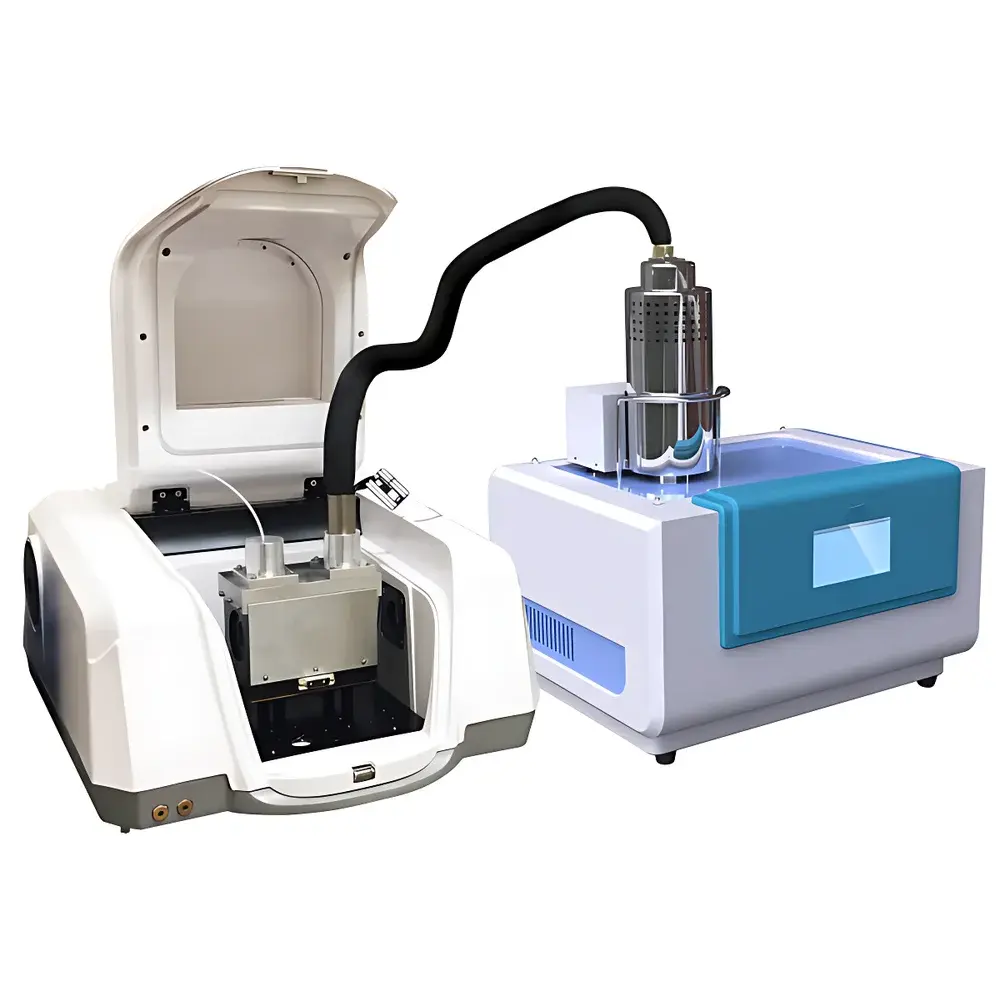
Gangdong TG-FTIR Coupled Thermogravimetric Analyzer and Fourier Transform Infrared Spectrometer
| Brand | Gangdong |
|---|---|
| Origin | Tianjin, China |
| Manufacturer | Gangdong Technology Co., Ltd. |
| Model | TG-FTIR |
| Instrument Type | Laboratory Benchtop System |
| FTIR Spectral Range | 7800–350 cm⁻¹ |
| FTIR Resolution | 0.5 cm⁻¹ |
| Scan Speed | 130,000 scans/sec |
| Signal-to-Noise Ratio | 30,000:1 |
| Gas Cell Path Length | 100 mm |
| Gas Cell Material | Stainless Steel |
| Gas Cell Internal Diameter (max/center) | 28 mm / 16 mm |
| Gas Cell Volume | 38.5 mL |
| IR Window | 38 × 6 mm BaF₂ or KBr (standard) |
| Transfer Line | 3 mm OD × 1 m PTFE-sheathed heated tubing |
| Gas Cell Max Temp | 300 °C |
| Transfer Line Max Temp | 230 °C |
| Temp Control Accuracy | ±1.0 °C |
| Detector | Imported High-Sensitivity DLATGS (Deuterated L-Alanine Doped Triglycine Sulfate), Liquid-Nitrogen-Free Operation |
Overview
The Gangdong TG-FTIR Coupled Thermogravimetric Analyzer and Fourier Transform Infrared Spectrometer is an integrated hyphenated analytical platform engineered for real-time, in situ identification of volatile and gaseous decomposition products evolved during thermal processes. This system couples a high-precision thermogravimetric analyzer (TGA) with a laboratory-grade FTIR spectrometer (model FTIR-850) via a thermally controlled, vacuum-tight interface. The core measurement principle relies on simultaneous mass-loss monitoring (via microbalance under controlled heating ramps or isothermal holds) and synchronous infrared spectral acquisition of evolved gases—enabling direct correlation between weight change events and molecular functional group signatures (e.g., CO₂ at 2349 cm⁻¹, H₂O at 3750–3500 cm⁻¹, carbonyls at 1750–1650 cm⁻¹, hydrocarbons at 2960–2850 cm⁻¹). Designed for rigorous materials characterization workflows, the system supports ASTM E1131, ISO 11358, and USP <1225> method validation frameworks, and is routinely deployed in polymer thermal stability assessment, pharmaceutical excipient degradation profiling, and catalytic reaction mechanism studies.
Key Features
- Vacuum-sealed, leak-tight coupling interface ensures quantitative gas transfer from TGA furnace to IR gas cell without dilution or condensation artifacts
- Heated stainless-steel gas cell (100 mm path length, dual-conical optical design) with precise temperature control up to 300 °C—prevents recondensation of semi-volatiles and maintains spectral fidelity
- PTFE-sheathed, electrically heated transfer line (1 m, 3 mm OD) rated to 230 °C, with independent PID-controlled thermal zoning
- High-sensitivity DLATGS detector enables rapid-scanning FTIR acquisition (130,000 scans/sec) without cryogenic cooling—reducing operational overhead and increasing instrument uptime
- Optimized optical path geometry delivers high signal throughput and low etalon interference, supporting robust baseline stability across full spectral range (7800–350 cm⁻¹)
- Modular architecture allows seamless integration with third-party TGA systems (e.g., TA Instruments Q500, Netzsch STA 449 F3, Mettler Toledo TGA/DSC 3+) or retrofitted upgrade of existing Gangdong FTIR-850 units
Sample Compatibility & Compliance
The TG-FTIR system accommodates solid and powdered samples (typically 1–20 mg) placed in standard alumina or platinum crucibles. It is compatible with inert (N₂, Ar), oxidative (air, O₂), and reactive (H₂, CO) atmospheres regulated via mass flow controllers. All hardware components—including gas cell, transfer line, and exhaust tubing—meet ISO 8573-1 Class 4 purity requirements for compressed air/gas handling. The system supports GLP-compliant data acquisition when paired with validated software modules that enforce electronic signature, audit trail, and 21 CFR Part 11–compliant user access controls. Routine performance verification follows ASTM E1640 (TGA calibration) and ASTM E1421 (FTIR photometric accuracy).
Software & Data Management
Bundled with Gangdong’s proprietary TG-IR Fusion Suite (v3.2+), the system provides synchronized acquisition, time-resolved spectral deconvolution, and kinetic analysis tools. Raw interferograms are processed using phase-corrected Mertz algorithm with apodization (Blackman-Harris 3-term). Spectral libraries include NIST/EPA/NIH IR Database (22,000+ entries) and custom-built polymer pyrolysis reference sets (ABS, EVA, PA6, PA66, PP, PET). Data export formats include ASCII (.csv), JCAMP-DX (.dx), and HDF5 for MATLAB/Python interoperability. All raw and processed datasets are timestamped, checksummed, and stored in hierarchical project folders with immutable metadata (operator ID, method parameters, environmental conditions).
Applications
- Thermal decomposition kinetics and evolved gas analysis (EGA) of engineering polymers and composites
- Residual solvent quantification and desorption profiling in active pharmaceutical ingredients (APIs)
- Char formation mechanisms and oxidation onset in carbonaceous materials (coal, biomass, activated carbon)
- Catalyst deactivation studies via adsorbed-species evolution tracking during temperature-programmed desorption (TPD)
- Adhesive burnout behavior in multilayer electronic substrates and aerospace prepregs
- Moisture loss, decarboxylation, and deamination pathways in biopolymers and peptides
- Corrosion product evolution (e.g., HCl, SO₂, NOₓ) from halogenated flame retardants under thermal stress
- Real-time monitoring of gas-phase intermediates in solid-state reactions (e.g., metal oxide reduction, carbonate decomposition)
FAQ
Can the TG-FTIR system be interfaced with non-Gangdong TGA instruments?
Yes—the coupling interface is mechanically and thermally standardized to accept 6–8 mm OD effluent tubing from major commercial TGA platforms, including TA Instruments, Netzsch, Mettler Toledo, and PerkinElmer models.
Is liquid nitrogen required for detector operation?
No—the system employs a thermoelectrically cooled DLATGS detector, eliminating cryogen dependency while maintaining SNR ≥30,000:1 at 4 cm⁻¹ resolution.
What is the minimum detectable concentration for common evolved gases?
Detection limits vary by compound and matrix but typically range from 1–5 ppmv for CO₂, H₂O, and CH₄ under optimal flow and temperature conditions (validated per ISO 13735 Annex B).
Does the software support kinetic modeling (e.g., Friedman, Ozawa-Flynn-Wall)?
Yes—TG-IR Fusion Suite includes built-in isoconversional analysis modules compliant with ICTAC Kinetics Project recommendations.
Are IR window materials customizable for aggressive gas environments?
Standard windows use BaF₂ (transmission range: 7800–800 cm⁻¹); optional KBr (7800–400 cm⁻¹) or ZnSe (6000–600 cm⁻¹) windows are available for corrosive or high-humidity applications.
Related Products





