
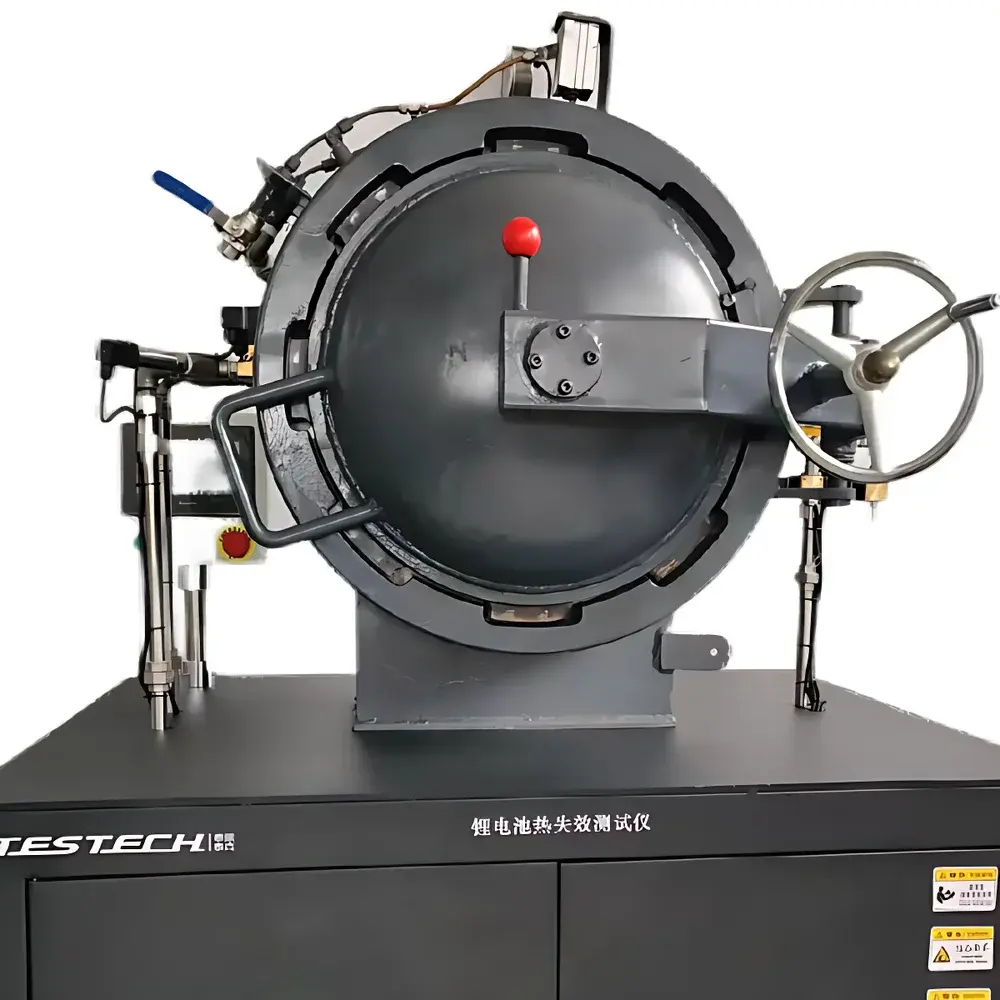
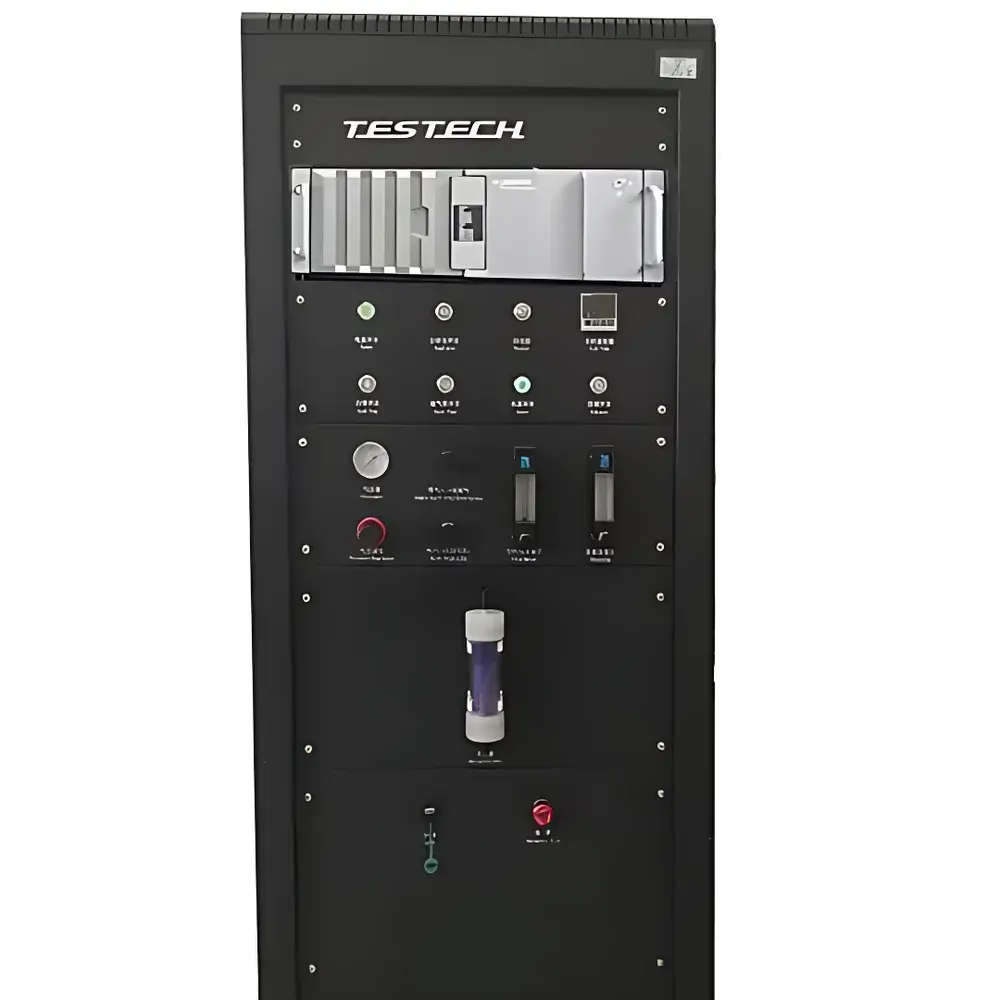
Gas Analysis Coupling System for Lithium Battery Thermal Runaway Monitoring
| Brand | TESTech |
|---|---|
| Model | TTech-CQG-01 |
| Origin | Jiangsu, China |
| Manufacturer Type | Direct Manufacturer |
| Country of Origin | China |
| Price Range | USD 0.14–0.28 (per unit basis, indicative only) |
Overview
The TESTech TTech-CQG-01 Gas Analysis Coupling System is an integrated, purpose-built platform engineered for real-time, in-situ monitoring of gaseous species evolved during lithium-ion battery thermal runaway events. It combines controlled abuse-condition simulation with high-sensitivity, multi-component gas quantification using Fourier Transform Infrared (FTIR) spectroscopy. Unlike conventional offline gas sampling methods—where post-event collection introduces delays, contamination risks, and compositional bias—the TTech-CQG-01 enables continuous, time-resolved measurement of up to 50 individual gas species with second-level temporal resolution. The system operates on the principle of quantitative FTIR absorption spectroscopy, leveraging characteristic vibrational absorption bands across the mid-infrared range (typically 4000–600 cm⁻¹) to identify and quantify gases such as CO, CO₂, H₂, CH₄, C₂H₄, HF, PF₃, POF₃, and organic volatiles (e.g., EC, DMC, EMC decomposition products). This capability supports mechanistic understanding of electrolyte decomposition pathways, SEI/CEI evolution, and cathode–electrolyte interfacial reactions under realistic abuse conditions.
Key Features
- Integrated thermal runaway simulation chamber with programmable heating, mechanical penetration (needle刺 module), and electrical abuse (overcharge/overdischarge) triggering options
- Real-time pressure and temperature acquisition synchronized with gas analysis (sampling rate ≥ 1 Hz)
- High-stability, heated gas transfer lines (up to 200 °C) to prevent condensation of volatile decomposition products
- FTIR spectrometer with MCT detector, spectral resolution ≤ 0.5 cm⁻¹, and pathlength-optimized multipass cell (effective optical path ≥ 10 m)
- Pre-loaded, battery-specific quantitative gas calibration library compliant with ISO 17025 traceability standards
- Modular architecture supporting future expansion with electrochemical impedance spectroscopy (EIS) or mass spectrometry (MS) coupling interfaces
Sample Compatibility & Compliance
The TTech-CQG-01 accommodates cylindrical (18650, 21700), prismatic, and pouch-format Li-ion cells (up to 50 Ah nominal capacity) within its sealed, explosion-resistant test chamber (rated to 15 bar burst pressure). All wetted surfaces are electropolished 316L stainless steel or PFA-lined to ensure chemical inertness toward HF, PF₅, and acidic decomposition intermediates. The system complies with UL 1642 Annex B, IEC 62619 Clause 8.2.3 (abuse testing), and GB/T 36276–2018 (lithium battery safety requirements for energy storage). Data integrity meets GLP and GMP-aligned audit trail requirements per FDA 21 CFR Part 11, including electronic signature support, user access control, and immutable raw spectral data archiving.
Software & Data Management
Acquisition and analysis are managed via TESTech’s proprietary CQG-Studio software, a Windows-based application built on .NET Framework with deterministic real-time scheduling. The software provides synchronized multi-channel visualization (gas concentration vs. time, T vs. t, P vs. t), automated peak deconvolution using constrained least-squares fitting, and stoichiometric ratio calculation (e.g., CO/CO₂, HF/PF₃) for reaction pathway inference. Export formats include CSV, HDF5, and ASTM E2937-compliant XML for LIMS integration. All spectral scans are stored with full metadata (instrument configuration, calibration status, environmental conditions), enabling retrospective reprocessing and method validation per ISO/IEC 17025:2017 Clause 7.7.
Applications
- Thermal runaway mechanism studies: correlating gas evolution profiles with voltage collapse, venting onset, and flame propagation
- Electrolyte formulation screening: evaluating fluorinated carbonate stability, additive efficacy (e.g., flame retardants), and SEI-forming agent decomposition thresholds
- Safety protocol development: defining critical gas concentration thresholds (e.g., 100 ppm HF) for early-warning detection systems
- Cell-to-cell propagation analysis: quantifying cross-contamination gas fluxes in module-level tests
- Regulatory submission support: generating reproducible, auditable datasets for UN 38.3, CE, and CCC certification dossiers
FAQ
Does the system support quantitative analysis of hydrogen fluoride (HF)?
Yes. The FTIR module includes dedicated spectral windows and calibration curves for HF detection down to 0.5 ppm (v/v) with ±5% relative uncertainty at 10 ppm, validated against NIST-traceable gas standards.
Can the system be operated under inert atmosphere (e.g., Ar or N₂)?
Yes. The chamber features dual gas inlets and mass flow controllers for purging and background gas conditioning; baseline subtraction routines automatically compensate for carrier gas interference.
Is third-party software integration (e.g., MATLAB, Python) supported?
Yes. CQG-Studio provides a documented COM API and HDF5-based raw data export, enabling custom scripting for advanced chemometrics, PCA, or kinetic modeling workflows.
What maintenance is required for the FTIR optical path?
The spectrometer uses sealed, desiccated optics; routine maintenance is limited to quarterly verification of purge gas dew point (< −40 °C) and annual recalibration using certified reference gases per ISO 6141.





