
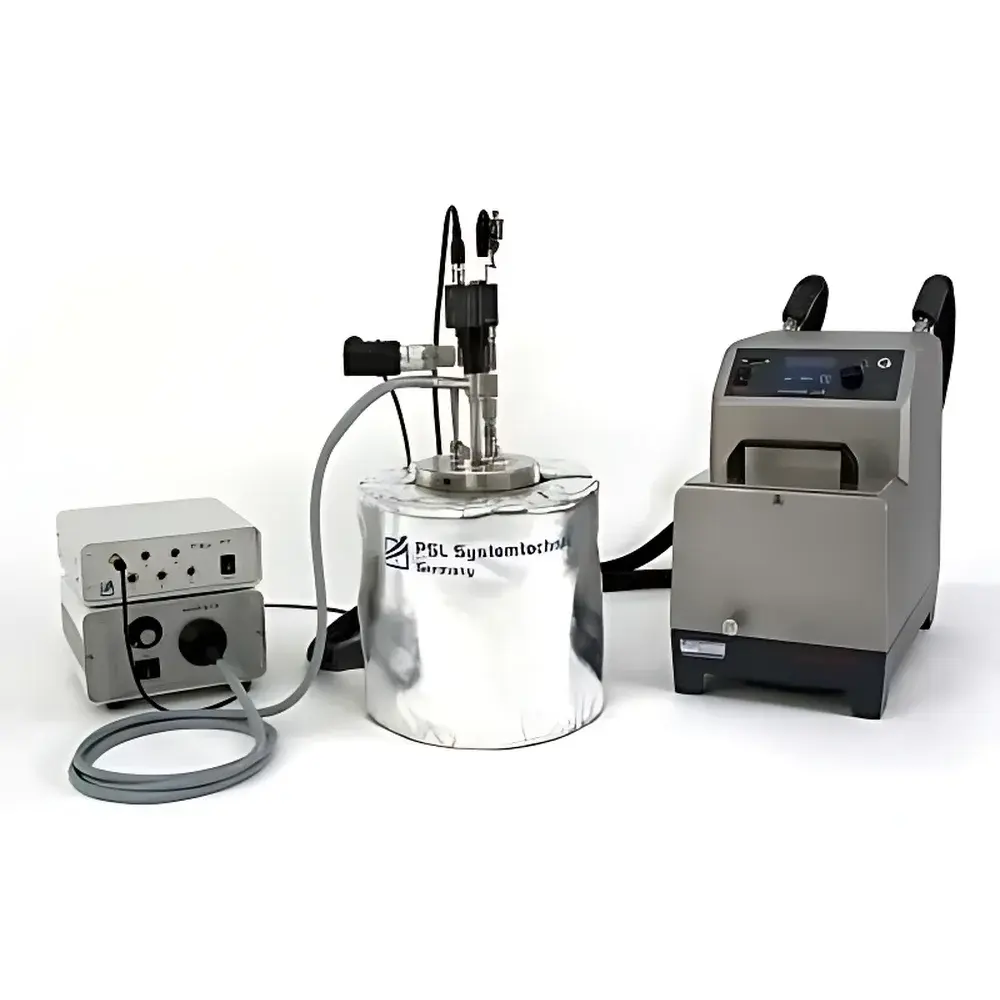
Gas Hydrate Autoclave GHA200
| Origin | Germany |
|---|---|
| Manufacturer Type | Authorized Distributor |
| Origin Category | Imported |
| Model | GHA200 |
| Pricing | Upon Request |
| Pressure Range | 200 bar (2900 psi) / 700 bar (10,000 psi) |
| Pressure Measurement | DMS sensor, ±0.5% FS |
| Liquid Volume Capacity | Max 450 mL, Recommended 200 mL |
| Temperature Range | −5 °C to +50 °C |
| Temperature Sensing | PT100 RTD, ±0.1 °C accuracy |
| Agitator Speed | 0–2000 rpm (adjustable, including off-state) |
| Camera Resolution | 440,000 pixels |
| Optical System | Wide-angle borescope with halogen illumination and fiber-optic light delivery |
| Control Software | Hydrate 2.0, supports concurrent operation of up to eight units |
| Power Supply | 240 V AC, 50/60 Hz, 2.2 kW |
Overview
The Gas Hydrate Autoclave GHA200 is a purpose-engineered high-pressure, temperature-controlled reaction system designed for fundamental and applied research on gas hydrate formation, dissociation, inhibition, and stabilization kinetics. Built upon Couette-type flow geometry and integrated optical access, the GHA200 enables real-time in situ observation of hydrate nucleation, growth morphology, and phase distribution under thermodynamically relevant conditions—specifically targeting methane, ethane, propane, CO₂, and mixed-gas systems representative of natural gas transmission and offshore energy recovery scenarios. Its modular architecture supports both static and dynamic (stirred) experimental protocols, facilitating comparative studies across thermodynamic inhibitors (e.g., methanol, MEG, THF), kinetic inhibitors (e.g., PVCap, PVP), and anti-agglomerants (AAs). The system operates within rigorously defined pressure–temperature (P–T) domains aligned with the three-phase (hydrate–liquid–vapor) equilibrium envelope of common clathrate-forming gases.
Key Features
- Two-tier pressure capability: dual-range configuration supporting both 200 bar (standard screening) and 700 bar (deepwater reservoir simulation) operational envelopes
- High-fidelity metrology: DMS-based pressure transducers calibrated to ±0.5% full scale; Class A PT100 sensors traceable to national standards with ±0.1 °C thermal resolution
- Optical monitoring suite: sapphire viewport coupled with wide-angle borescope (≥90° field-of-view), fiber-coupled halogen illumination, and monochrome CCD camera (440,000-pixel resolution) enabling time-lapse imaging and quantitative morphological analysis
- Integrated mechanical agitation: variable-speed magnetic or mechanical stirrer (0–2000 rpm), programmable ramp profiles, and torque feedback for rheological assessment of slurry behavior during hydrate growth
- Fail-safe engineering: redundant overpressure relief valves, automatic restart logic after power interruption, and biometric-access–compatible physical lockout mechanism limiting cabinet access to authorized personnel only
- Compact footprint (W × D × H ≈ 650 × 720 × 1350 mm) with standardized 240 V AC, 2.2 kW supply—designed for integration into ISO-classified laboratories or mobile test rigs
Sample Compatibility & Compliance
The GHA200 accommodates aqueous electrolyte solutions, polymer-inhibitor formulations, surfactant dispersions, and particle-laden slurries within its 200–450 mL working volume. All wetted components—including the autoclave body, stirrer shaft, and sampling ports—are constructed from ASTM A182 F22 (2.25Cr–1Mo) alloy steel with electropolished internal surfaces to minimize catalytic side reactions and ensure corrosion resistance in acidic or chloride-rich environments. The system conforms to PED 2014/68/EU for pressure equipment and carries CE marking for electromagnetic compatibility (EMC Directive 2014/30/EU). Data acquisition and control functions comply with ALCOA+ principles for data integrity; Hydrate 2.0 software supports 21 CFR Part 11–compliant electronic signatures, audit trails, and role-based user permissions required for GLP/GMP-aligned hydrate inhibitor qualification studies.
Software & Data Management
Hydrate 2.0 is a deterministic, deterministic real-time control platform developed in LabVIEW Real-Time Module, deployed on an embedded industrial PC. It provides synchronized acquisition of pressure, temperature, agitator speed, and image timestamps at configurable intervals (100 ms–5 min). The software implements PID-controlled cooling via external chiller interface (not included) and supports user-defined experiment sequences—including multi-step isothermal holds, linear P–T ramps, and cyclic dissociation–reformation protocols. Raw image streams are stored losslessly in TIFF format with embedded metadata (P, T, t, RPM); batch processing tools enable automated hydrate fraction quantification using threshold-based segmentation. Export options include CSV (for statistical modeling in MATLAB or Python), HDF5 (for machine learning pipelines), and PDF reports compliant with ISO/IEC 17025 documentation requirements.
Applications
- Thermodynamic inhibition assessment per ASTM D7490 and ISO 10400 methodologies
- Kinetic inhibitor performance benchmarking under turbulent flow conditions (Re > 5,000)
- Anti-agglomerant efficacy testing via particle size distribution (PSD) tracking during hydrate growth
- Interfacial tension and contact angle measurements on hydrate–water–gas interfaces using pendant drop analysis
- Long-duration stability testing (>168 h) of synthetic hydrate sediments under simulated seabed P–T conditions
- Validation of predictive thermodynamic models (e.g., CSMGem, Multi-Flash) against experimental phase boundary data
FAQ
What pressure ranges does the GHA200 support, and how are they selected?
The system offers two interchangeable pressure-rated vessels: one rated to 200 bar for routine inhibitor screening, and another to 700 bar for deep-ocean or high-pressure reservoir simulation. Selection is hardware-based—users physically install the appropriate vessel assembly prior to pressurization.
Can the GHA200 be used for continuous-flow hydrate experiments?
No—the GHA200 is configured exclusively for batch-mode operation. For continuous-flow applications, integration with external high-pressure pumps and inline flow cells requires custom engineering and is outside standard scope.
Is Hydrate 2.0 compatible with third-party data analysis platforms?
Yes. All raw datasets export natively to CSV and HDF5 formats. APIs are available under NDA for direct MATLAB, Python (via PyVISA), or DIAdem integration.
What maintenance intervals are recommended for optical components?
The sapphire viewport and borescope lens require cleaning every 10 experimental cycles using IPA and lint-free wipes. Halogen lamp lifetime is rated at 2,000 hours; replacement kits include recalibration certificates.
Does the system meet explosion-proof certification for offshore platform deployment?
The base GHA200 is not ATEX-certified. However, explosion-proof enclosures and intrinsically safe signal conditioning modules can be supplied as optional add-ons subject to site-specific hazard classification review.






