
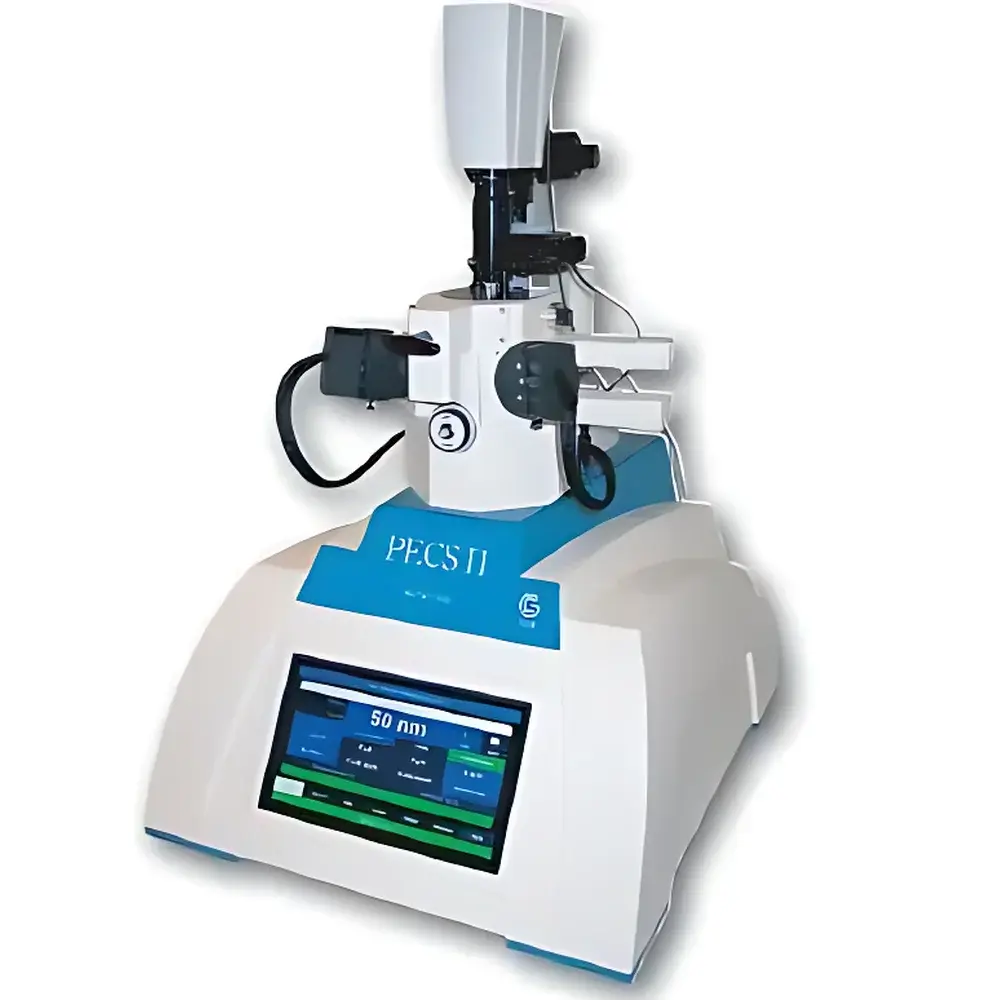
Gatan PECS II 685 Precision Etching and Coating System
| Brand | Gatan |
|---|---|
| Origin | USA |
| Model | PECS II 685 |
| Ion Source | Two rare-earth magnet-equipped Penning ion guns (maintenance-free) |
| Beam Energy Range | 100 eV – 8.0 keV |
| Beam Current Density | 10 mA/cm² (peak) |
| Beam Diameter Control | Via gas flow or discharge voltage |
| Sample Capacity | Ø ≤ 32 mm, H ≤ 15 mm |
| Polishing Angle Adjustment | ±10° per gun, independently adjustable |
| Dual-Beam Modulation | Single- or dual-beam angular modulation |
| Sample Rotation | 1–6 rpm, continuously variable |
| Cooling | Liquid nitrogen-cooled stage |
| Vacuum System | 80 L/s turbomolecular pump + dual-stage diaphragm pump |
| Base Pressure | ≤ 5 × 10⁻⁶ Torr |
| Operating Pressure | ≤ 8 × 10⁻⁵ Torr |
| Vacuum Gauge | Cold-cathode gauge (main chamber), solid-state gauge (foreline) |
| Load Lock | Whisperlok™ airlock technology (< 1 min exchange, no main chamber vent) |
| User Interface | 10-inch color touchscreen with recipe-based operation |
| Compliance | Designed for GLP-compliant lab environments |
Overview
The Gatan PECS II 685 Precision Etching and Coating System is a fully integrated, desktop-scale broad-beam argon ion polishing and sputter coating platform engineered for high-fidelity electron microscopy sample preparation. It operates on the principle of controlled physical sputtering—using two independently steerable, low-energy Penning ion sources to remove surface damage layers via momentum transfer from accelerated Ar⁺ ions, while simultaneously enabling conductive metal film deposition through magnetron sputtering onto the same specimen within a single, uninterrupted ultra-high vacuum environment. This dual-function architecture eliminates atmospheric exposure between polishing and coating steps—a critical requirement for preserving surface-sensitive microstructures, minimizing oxidation artifacts, and ensuring optimal EBSD pattern quality, CL signal fidelity, and EDS quantification accuracy. The system is purpose-built for laboratories requiring reproducible, artifact-free cross-sectional and planar surface preparation for SEM, FIB-SEM, EPMA, and scanning electron probe microanalysis.
Key Features
- Dual independent Penning ion guns equipped with rare-earth permanent magnets—no consumable filaments, zero cathode degradation, and stable beam emission over extended operational lifetimes.
- Ultra-low energy capability down to 100 eV enables final-stage “gentle polishing” of beam-sensitive materials (e.g., oxides, polymers, battery cathodes) without thermal or amorphization-induced artifacts.
- Precision electrostatic focusing electrodes maintain consistent beam diameter across the full 100 eV–8 keV acceleration range, ensuring uniform sputter yield and surface flatness.
- Independent gun alignment and real-time angular adjustment during operation allow dynamic optimization of incidence angle for anisotropic materials or multi-layered interfaces.
- Liquid nitrogen-cooled sample stage actively suppresses ion-beam-induced heating—critical for preserving phase stability in metastable alloys, organic-inorganic hybrids, and thermally labile geological specimens.
- Whisperlok™ vacuum load-lock enables sub-60-second sample exchange without breaking main chamber vacuum, preserving base pressure integrity and minimizing hydrocarbon contamination risk.
- Integrated 10-inch industrial-grade touchscreen interface supports full parameter control, real-time process monitoring, and secure recipe storage—including beam energy, current, angle, rotation speed, gas flow, and dwell time—with timestamped execution logs.
Sample Compatibility & Compliance
The PECS II 685 accommodates a wide spectrum of conductive and non-conductive specimens, including but not limited to: polycrystalline metals and alloys (Al, Ti, Zr, Ni-based superalloys), ceramic composites, geological thin sections (quartz, feldspar, olivine), semiconductor heterostructures, battery electrode cross-sections (NMC, LFP, Si-anodes), polymer blends, and biological mineralized tissues. Its design conforms to standard laboratory safety and operational protocols aligned with ISO/IEC 17025 requirements for testing laboratories. While not certified as medical device hardware, its parameter traceability, recipe-based operation, and internal logging functionality support compliance with GLP and GMP documentation frameworks where sample preparation is part of regulated analytical workflows (e.g., failure analysis in aerospace or semiconductor QA/QC).
Software & Data Management
The embedded control firmware provides deterministic, non-volatile storage of all operational parameters—including beam settings, vacuum history, cooling status, and user ID—enabling full experimental reproducibility. Recipes are encrypted and version-stamped; each run generates a machine-readable log file (.csv) containing timestamps, setpoints, and real-time sensor feedback (pressure, temperature, beam current). No external PC dependency is required for routine operation, though optional Ethernet connectivity allows remote diagnostics and integration into centralized lab information management systems (LIMS) via MODBUS TCP or custom API endpoints. All interface languages—including English, Chinese, Japanese, and German—are pre-installed and selectable without firmware reload.
Applications
- EBSD-ready surface preparation: Producing atomically flat, strain-free surfaces essential for high-index pattern acquisition and reliable grain orientation mapping in metals, ceramics, and geological samples.
- Cross-sectional polishing of multilayer devices: Enabling nanoscale interface resolution in photovoltaic stacks, MEMS structures, and advanced packaging interconnects without delamination or preferential sputtering.
- Charge mitigation for insulating specimens: In-situ sputter deposition of ultra-thin (2–5 nm) Pt, Au, or Cr films immediately following polishing—eliminating drift, charging, and beam-induced migration during high-resolution SEM imaging.
- Failure analysis of coated systems: Preparing intact interface regions in PVD/CVD coatings, thermal barrier layers, and corrosion-resistant overlays without introducing artificial intermixing.
- Geological microstructure preservation: Maintaining original crystallographic contrast in metamorphic rocks and meteoritic sections where conventional mechanical polishing induces smearing or preferential dissolution.
FAQ
Can the PECS II 685 perform both ion polishing and sputter coating in one vacuum cycle?
Yes. The system executes sequential or simultaneous ion milling and sputter deposition without venting, using either the same ion guns (for Ar⁺ milling) or redirected beams onto metallic or carbon targets mounted on the dual-target turret.
What is the minimum beam energy achievable—and why is it significant?
The lower limit is 100 eV. This enables ultra-low-damage finishing of beam-sensitive phases such as LiCoO₂, perovskite solar absorbers, or hydrated clays, where higher energies induce decomposition or preferential sputtering.
How does Whisperlok™ differ from conventional airlocks?
Unlike gate-valve-based load locks requiring pump-down cycles, Whisperlok™ uses differential pumping and conductance-limited transfer to isolate the main chamber—achieving <1 minute exchange while maintaining base pressure below 5×10⁻⁶ Torr.
Is liquid nitrogen refilling automated?
No. The cryostage uses a manual-fill Dewar with level sensor feedback displayed on the touchscreen; typical hold time exceeds 8 hours at −160°C under continuous operation.
Are calibration certificates provided for ion beam parameters?
Gatan supplies factory-traceable beam current and energy calibration reports with each instrument shipment. Periodic verification kits (Faraday cup + energy analyzer) are available as optional accessories.





