
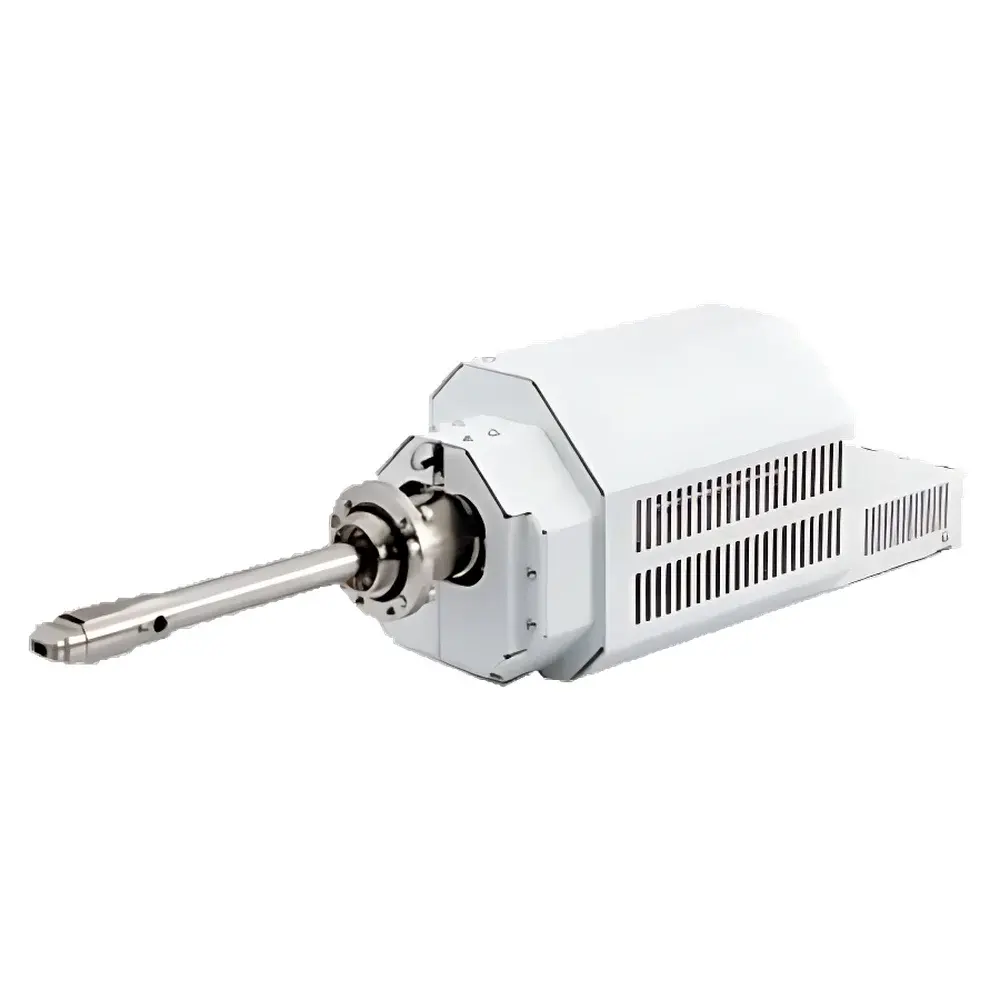
Gather-X Energy Dispersive Spectrometer by JEOL
| Brand | JEOL |
|---|---|
| Origin | Japan |
| Model | Gather-X |
| Mounting Type | Side-entry (inclined insertion) |
| Energy Resolution | ≤129 eV (Mn-Kα), ≤59 eV (C-Kα) |
| Peak-to-Background Ratio | 20,000:1 |
| Maximum Count Rate | >500,000 cps |
| Elemental Detection Range | Li to U |
| Detector Active Area | 100 mm² |
| Window Type | Windowless |
Overview
The Gather-X Energy Dispersive Spectrometer (EDS), developed by JEOL Ltd. (Japan Electron Optics Laboratory), is a high-performance, side-entry EDS system engineered for integration with the JSM-IT800 series of field-emission scanning electron microscopes (FE-SEM). Designed around silicon drift detector (SDD) technology and optimized for ultra-high sensitivity and spatial fidelity, the Gather-X operates on the fundamental principle of X-ray energy dispersion: incident electron beam interaction with a specimen generates characteristic X-rays, which are collected and resolved by the SDD based on photon energy—enabling quantitative and qualitative elemental identification at sub-micron to nanoscale lateral resolutions. Its windowless architecture eliminates absorption losses for low-energy X-rays, significantly enhancing detection efficiency for light elements (Li–F), while maintaining robust performance across the full detectable range (Li–U). The system is calibrated to meet ISO 16573:2014 standards for SEM-EDS compositional analysis and supports traceable, reproducible quantification in compliance with ASTM E1508 and ISO 22309.
Key Features
- Windowless SDD design enabling enhanced low-Z sensitivity—critical for Li, Be, B, C, N, and O detection in battery materials, polymers, and geological phases.
- High energy resolution (≤59 eV at C-Kα, ≤129 eV at Mn-Kα) achieved through cryogen-free Peltier cooling and advanced pulse processing electronics.
- Peak-to-background ratio exceeding 20,000:1 ensures superior spectral contrast and improved detection limits—particularly advantageous for minor/trace element mapping in heterogeneous samples.
- Maximum real-time count rate >500,000 cps supports high-speed, high-fidelity elemental mapping without significant dead-time distortion or spectral pile-up.
- 100 mm² large-area detector increases solid angle of collection, improving count statistics and reducing acquisition time for statistically robust point analysis and line scans.
- Side-entry (inclined insertion) mechanical configuration minimizes interference with SEM stage motion and accommodates extended working distances and tilt angles up to ±70°.
Sample Compatibility & Compliance
The Gather-X is compatible with standard and high-tilt SEM sample holders, including multi-axis stages and in-situ heating/cooling platforms. Its optimized geometry allows simultaneous operation with backscattered electron (BSE) and secondary electron (SE) detectors without signal shadowing. For conductive and non-conductive specimens—including battery cathodes/anodes, catalyst nanoparticles, thin-film stacks, and biological TEM lamellae—the system supports charge compensation via low-vacuum mode or low-kV beam conditions (≤5 kV). All analytical workflows adhere to GLP-compliant data integrity requirements; spectral acquisition metadata—including beam parameters, dwell time, live time, and detector status—is automatically embedded and timestamped per spectrum, satisfying FDA 21 CFR Part 11 audit trail prerequisites when used with JEOL’s certified SmartSEM software suite.
Software & Data Management
Controlled via JEOL’s SmartSEM EDS platform, the Gather-X supports synchronized acquisition with SEM imaging, real-time spectrum display, and automated peak identification using a library of >1,200 reference spectra (including oxide, nitride, and carbide standards). Quantitative analysis employs ZAF and φ(ρz) matrix correction models, with optional standards-based calibration for certified reference materials (CRMs). Mapping modes include point-by-point, line-scan, and full-frame acquisition with pixel-level spectral storage (HyperMap™ format), enabling post-acquisition re-extraction of spectra from any region of interest. Raw spectral data (.eds, .emsa) and processed reports (.pdf, .xlsx) are exportable in vendor-neutral formats compliant with NIST SP 800-53 and ISO/IEC 17025 documentation protocols.
Applications
- Advanced battery R&D: In situ and ex situ analysis of Li distribution in NMC, LFP, and solid-state electrolyte interfaces—leveraging C-Kα resolution to resolve carbon coating homogeneity and SEI layer chemistry.
- Nanomaterial characterization: High-resolution elemental mapping of Ag nanoparticles (~20 nm) with bias-assisted charge control to suppress beam-induced migration and improve spatial fidelity.
- Metallurgy & failure analysis: Phase identification in multiphase alloys (e.g., Al-Si-Mg-Cu systems), inclusion analysis in steel, and corrosion product stratigraphy on coated substrates.
- Geosciences: Trace element zoning in zircon and monazite for geochronology; light-element quantification (O, F, Cl) in melt inclusions and hydrous minerals.
- Life sciences: Elemental co-localization in freeze-fractured or cryo-FIB-prepared biological sections—enabled by windowless detection of Na, Mg, P, S, and Ca at physiological concentrations.
FAQ
Is the Gather-X compatible with non-JEOL SEM platforms?
Yes—via third-party interface modules (e.g., Oxford Instruments AZtecLink or EDAX TEAM™), though full hardware synchronization and bias-assisted mapping require native JEOL SmartSEM integration.
What vacuum requirements does the windowless detector impose?
The detector operates under ultra-high vacuum (UHV) conditions (<1×10⁻⁷ Pa) and requires interlocked differential pumping between the SEM chamber and detector housing to maintain detector integrity.
Can the system perform low-voltage EDS (≤3 kV) for surface-sensitive analysis?
Yes—optimized electron optics and low-noise preamplification enable stable spectral acquisition down to 2 kV, with appropriate adjustments to take-off angle and beam current to preserve resolution and count rate.
Does the Gather-X support automated phase identification?
Yes—when combined with JEOL’s PhaseMap™ module, it performs unsupervised clustering of EDS spectra and correlates results with BSE intensity and crystallographic orientation data from integrated EBSD.
How is detector calibration maintained over time?
Automated daily calibration routines verify Mn-Kα and C-Kα peak positions and resolution; drift correction is applied in real time using internal reference channels and stored calibration coefficients traceable to NIST SRM 2100a.




