
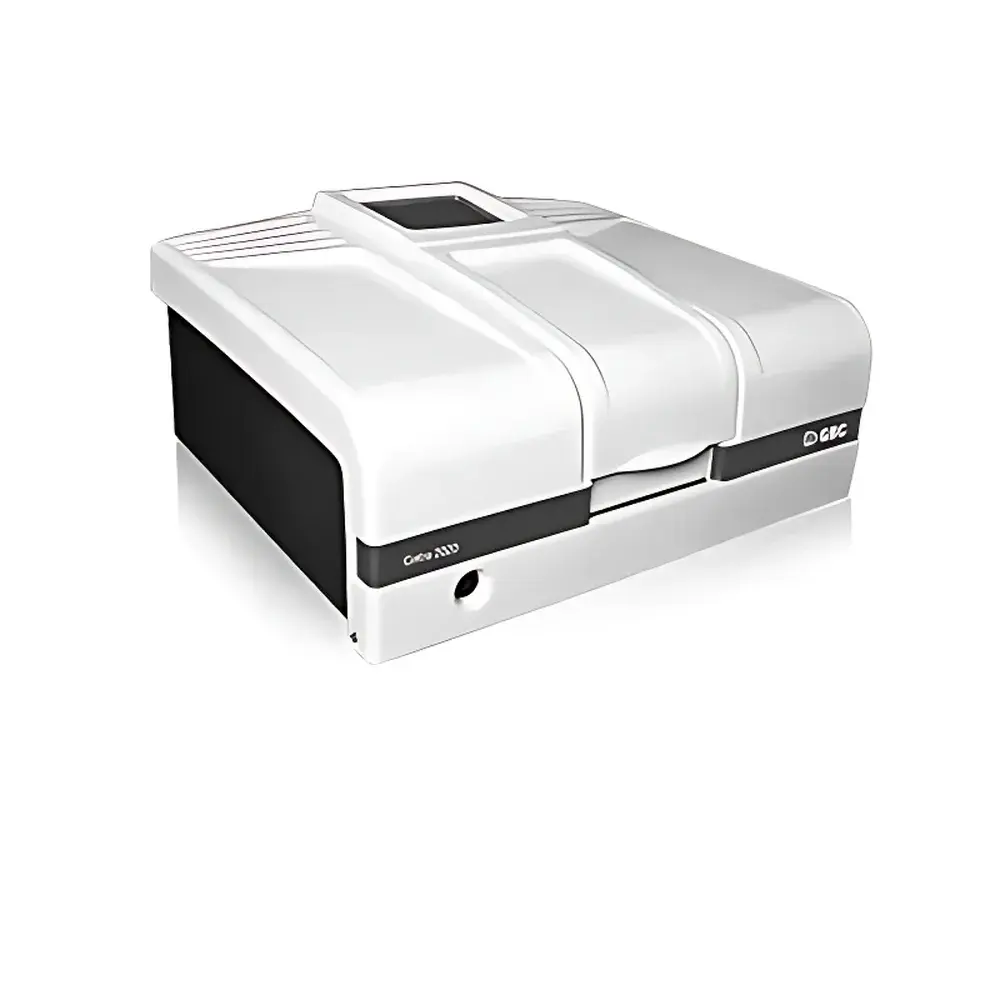
GBC Cintra3030 UV-Visible Spectrophotometer
| Brand | GBC |
|---|---|
| Origin | Australia |
| Model | Cintra3030 |
| Optical Design | Dual-beam |
| Detector Type | Photodiode Array (PDA) |
| Wavelength Range | 190–1100 nm |
| Spectral Bandwidth | Adjustable from 0.2 nm to 5.0 nm |
| Wavelength Accuracy | ±0.2 nm |
| Stray Light | <0.0005% T at 220 nm and 340 nm |
| Automation Level | Motorized wavelength scanning and slit control |
| Compliance | ASTM E275, ISO 6223, USP <857>, FDA 21 CFR Part 11 ready (with optional audit trail module) |
Overview
The GBC Cintra3030 UV-Visible Spectrophotometer is a research-grade dual-beam spectrophotometer engineered for high-sensitivity quantitative and qualitative analysis in academic, pharmaceutical, and industrial laboratories. Built upon GBC’s legacy of precision optical instrumentation developed in Melbourne, Australia, the Cintra3030 employs a Czerny-Turner monochromator architecture with motorized grating drive and thermally stabilized optics to deliver exceptional photometric stability and spectral fidelity. Its core measurement principle relies on Beer-Lambert law-based absorbance quantification across the ultraviolet and visible spectrum (190–1100 nm), with real-time correction enabled by simultaneous reference and sample beam monitoring. Unlike single-beam systems, the true dual-beam design compensates for source drift, detector aging, and environmental fluctuations—critical for extended kinetic studies or regulatory-compliant batch testing.
Key Features
- Variable slit width (0.2–5.0 nm) enabling user-selectable trade-offs between spectral resolution and signal-to-noise ratio
- High-performance photodiode array (PDA) detector with 1024-element linear array and on-chip integration for rapid full-spectrum acquisition (≤1 s per scan)
- Thermally regulated optical bench minimizing wavelength drift (<0.005 nm/°C) and ensuring long-term photometric repeatability (RSD <0.002 A at 1.0 A over 8 hours)
- Automated wavelength calibration using internal holmium oxide and didymium filters traceable to NIST standards
- Integrated cuvette autoloader support (optional) compatible with 10 mm, 5 mm, and micro-volume cells (down to 50 µL)
- Front-panel touchscreen interface with embedded Linux OS and USB/Ethernet connectivity for standalone operation or network integration
Sample Compatibility & Compliance
The Cintra3030 accommodates standard quartz, glass, and plastic cuvettes (10 mm pathlength), as well as specialized accessories including temperature-controlled Peltier cells (−10°C to +110°C), fiber-optic probes, and integrating spheres for diffuse reflectance. It meets international performance verification requirements outlined in ASTM E275 (Standard Test Methods for Absorbance Accuracy), ISO 6223 (Spectrophotometers — Performance Verification), and USP (Spectrophotometric Absorbance Measurements). When configured with the validated Cintra Software Suite and optional 21 CFR Part 11 compliance module, the system supports electronic signatures, audit trails, role-based access control, and IQ/OQ documentation templates aligned with GLP and GMP environments.
Software & Data Management
Cintra Software (v6.5+) provides a modular, workflow-driven interface compliant with laboratory informatics standards. Core modules include Quantitative Analysis (single/multi-point calibration, curve fitting with polynomial, quadratic, or cubic regression), Kinetic Mode (time-resolved absorbance monitoring with configurable sampling intervals from 0.1 s to 1 h), DNA/RNA Analysis (A260/A280 ratio, concentration, purity assessment), and Colorimetry (CIE L*a*b*, ΔE calculations). All data are stored in vendor-neutral .csv and .jdx formats; raw spectral files retain metadata (date/time, operator ID, instrument serial number, calibration status). The software supports LIMS integration via ASTM E1384-compliant HL7 messaging and includes built-in report generation with customizable templates for regulatory submissions.
Applications
The Cintra3030 is routinely deployed in applications demanding high photometric accuracy and spectral flexibility: determination of molar absorptivity coefficients for novel chromophores; validation of cleaning efficacy in biopharmaceutical manufacturing (residual protein detection at 280 nm); quantification of nucleic acid integrity in CRISPR editing workflows; spectral deconvolution of overlapping peaks in dye mixtures; and stability-indicating assays per ICH Q5C guidelines. Its low stray light (<0.0005% T) enables reliable measurements up to 4.5 Abs, while sub-nanometer resolution supports fine-structure analysis in transition metal complexes and organic semiconductor thin films.
FAQ
What is the maximum absorbance range supported with verified linearity?
The instrument demonstrates photometric linearity within ±0.005 A up to 4.5 Abs (at 254 nm, using neutral density filters traceable to NIST SRM 2031).
Can the Cintra3030 be integrated into an automated lab environment?
Yes—via Ethernet TCP/IP or RS-232, it supports SCPI command set for remote control and is compatible with major robotic liquid handlers through TTL-triggered start/stop signals.
Is method transfer possible between Cintra models?
Method parameters (wavelength, slit width, scan speed, baseline correction) are fully portable across the Cintra platform; however, spectral resolution limits differ between models due to optical design variations.
Does the system require annual recalibration by GBC-certified engineers?
While not mandatory, GBC recommends biannual performance verification using certified reference materials (e.g., Holmium Oxide filter, potassium dichromate solution) to maintain compliance with ISO/IEC 17025 accreditation requirements.
What warranty and service options are available internationally?
Standard coverage includes 24 months parts-and-labor warranty; extended service contracts (up to 5 years) include preventive maintenance, on-site calibration, and priority technical support with SLA-governed response times.
Related Products





