
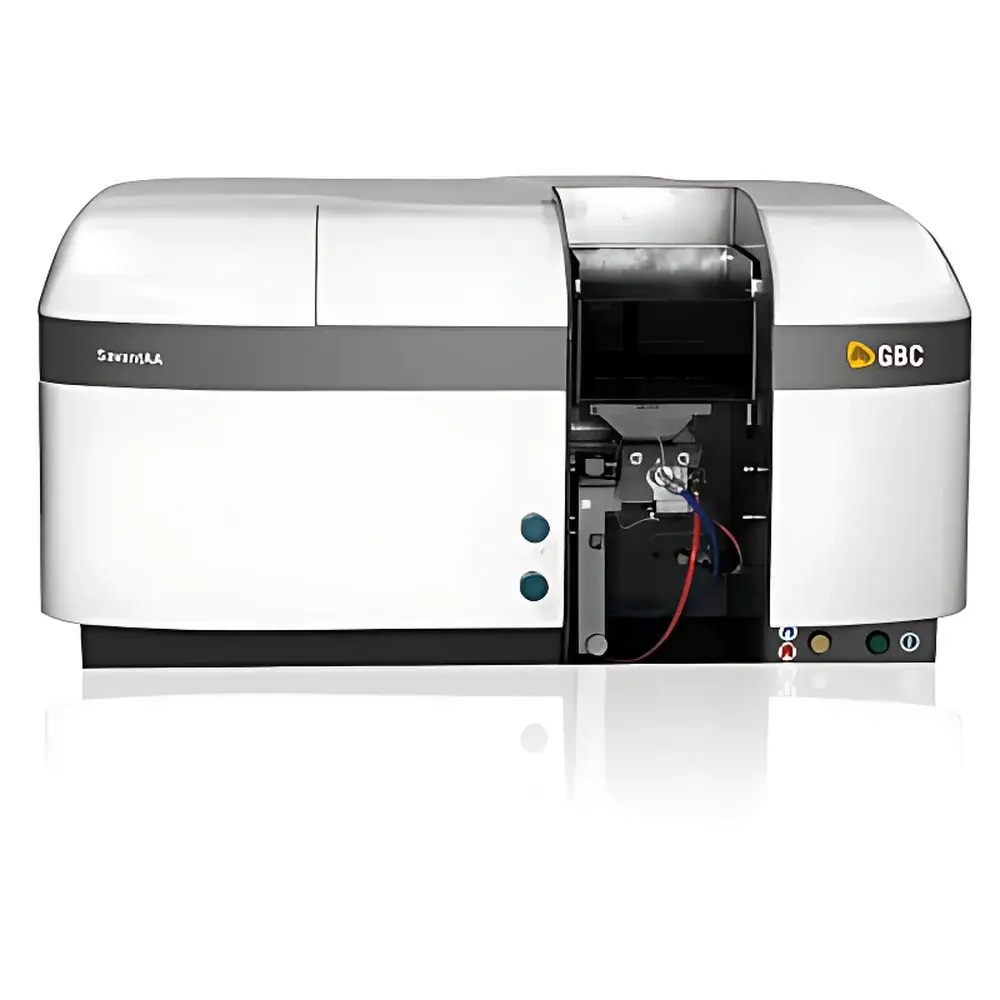
GBC SavantAA Atomic Absorption Spectrometer
| Brand | GBC |
|---|---|
| Origin | Australia |
| Model | SavantAA |
| Instrument Type | Flame and Graphite Furnace AAS |
| Monochromator | Plane Grating |
| Optical System | Double-Beam |
| Detector | Photomultiplier Tube (PMT) |
| Background Correction | Deuterium Lamp |
| Resolution | 0.1 nm |
| Sensitivity | >0.9 Abs for 5 mg/L Cu solution |
| Repeatability (RSD) | 0.45% |
| Detection Limit | ≤0.003 ppm for Cu |
| Lamp Holder | 8-position Automatic with Auto-Alignment |
| Wavelength Selection | Automatic |
| Slit Width | 0.1–2.0 nm (0.1 nm increments) |
| Slit Height | Adjustable (Standard & Reduced) |
| Gas Control | Fully Automated with Safety Interlocks |
| D₂ Lamp Lifetime | Up to 10× Longer Than Conventional Lamps |
| Lamp Identification | Encoded HCL & EDL Recognition (Standard on SavantAA Σ, Optional on SavantAA) |
| EDL Power Supply | 10 V Optimized Design (1 Standard on SavantAA & SavantAA Si |
Overview
The GBC SavantAA Atomic Absorption Spectrometer is a high-performance, dual-mode analytical instrument engineered for trace metal quantification in environmental, clinical, pharmaceutical, geological, and industrial laboratories. Operating on the fundamental principle of atomic absorption spectroscopy—where ground-state free atoms in a flame or graphite furnace absorb characteristic radiation emitted by element-specific hollow cathode lamps (HCLs) or electrodeless discharge lamps (EDLs)—the SavantAA delivers exceptional sensitivity, precision, and long-term stability. Its double-beam optical architecture compensates for source intensity fluctuations and detector drift, ensuring robust baseline integrity across extended measurement sequences. The system integrates asymmetric beam modulation—a proprietary timing strategy that extends sample beam dwell time relative to reference beam—thereby reducing high-frequency noise and minimizing susceptibility to chopper-induced artifacts. This design, combined with hyper-pulse deuterium background correction, enables accurate absorbance measurements even in complex matrices with significant spectral or structured background interference.
Key Features
- Double-beam optical system with plane grating monochromator (0.1 nm resolution) and photomultiplier tube detection for enhanced signal-to-noise ratio and long-term photometric stability.
- Asymmetric modulation technology optimizes duty cycle between sample and reference beams, suppressing electronic and optical noise without compromising analytical throughput.
- Hyper-pulse background correction using a high-intensity deuterium lamp ensures precise, real-time spectral background subtraction at each wavelength setting.
- Eight-position automatic lamp turret with motorized alignment and encoded lamp recognition—supporting both HCLs and EDLs—enables rapid, error-free lamp selection and optimal spectral line positioning.
- Automated wavelength scanning and slit width adjustment (0.1–2.0 nm in 0.1 nm steps), with selectable slit height modes to balance resolution and radiant energy throughput.
- Integrated gas control module featuring fail-safe interlocks for acetylene, nitrous oxide, and argon supply lines—compliant with EN ISO 15001 and OSHA 1910.101 standards.
- Durable 10 V EDL power supply optimized for thermal efficiency and signal stability; standard on SavantAA & SavantAA Si, expandable to four units for multi-element EDL operation.
- Extended-life deuterium lamp (rated ≥1,000 hours), engineered for consistent spectral output and reduced maintenance frequency.
Sample Compatibility & Compliance
The SavantAA supports both flame (air-acetylene, nitrous oxide-acetylene) and graphite furnace atomization modes, accommodating liquid samples ranging from ultrapure reagents to digested biological tissues, wastewater, soil extracts, and high-salinity brines. Optional accessories—including the System 5000 graphite furnace, HG3000 hydride generation system, MC3000 mercury concentrator, SDS720 high-speed autosampler, and PS720 programmable dilutor—extend its applicability to regulated workflows per EPA Method 200.7, 200.9, 7060A, ISO 8288, and ASTM D1688. The instrument’s firmware and data handling architecture support audit trails, electronic signatures, and user access control—fully compliant with FDA 21 CFR Part 11 and GLP/GMP documentation requirements when deployed with validated software configurations.
Software & Data Management
Controlled via GBC’s AAWinPro software, the SavantAA provides intuitive method development, sequence programming, QC charting (Levey-Jennings, Shewhart), and automated calibration curve fitting (linear, quadratic, cubic). Raw absorbance data, peak area/height integration, and background-corrected results are stored in vendor-neutral ASCII or CSV formats. All instrument parameters—including lamp current, slit width, burner height, gas flow rates, and furnace temperature ramp profiles—are logged with timestamps and user IDs. Software validation packages—including IQ/OQ documentation templates and traceable calibration protocols—are available for regulated environments requiring formal verification.
Applications
The SavantAA is routinely employed for regulatory compliance testing in drinking water (EPA 200.7), wastewater effluent (ISO 11885), food safety (AOAC 972.25), clinical toxicology (serum Zn/Cu/Fe assays), and catalyst residue analysis in petrochemical feedstocks. Its sub-part-per-trillion detection capability for elements such as Cd, Pb, As, and Hg—when coupled with hydride generation or cold vapor techniques—meets stringent limits set by EU WFD, US FDA, and WHO guidelines. In research settings, it supports speciation studies when interfaced with HPLC or SEC separation modules.
FAQ
What atomization modes does the SavantAA support?
The instrument operates in both flame and graphite furnace configurations, with optional hydride generation and cold vapor mercury analysis modules.
Is the SavantAA compliant with 21 CFR Part 11?
Yes—when configured with AAWinPro software and appropriate administrative controls (e.g., role-based access, electronic signatures, and audit trail logging), it meets core Part 11 requirements for electronic records and signatures.
Can the SavantAA perform simultaneous multi-element analysis?
No—it is a sequential AAS system; however, rapid lamp switching (≤2 sec), automated wavelength selection, and high-speed autosampling enable efficient multi-element batch analysis.
What is the typical detection limit for lead (Pb) in graphite furnace mode?
Using standard platform furnace conditions and Zeeman background correction (available via optional upgrade), Pb detection limits are typically ≤0.5 pg, equivalent to ≤0.01 µg/L in a 20 µL injection.
Does GBC provide application support and method validation assistance?
Yes—GBC’s global applications laboratory offers pre-validated methods, training workshops, and on-site method transfer support aligned with ISO/IEC 17025 and CLIA requirements.
Related Products





