
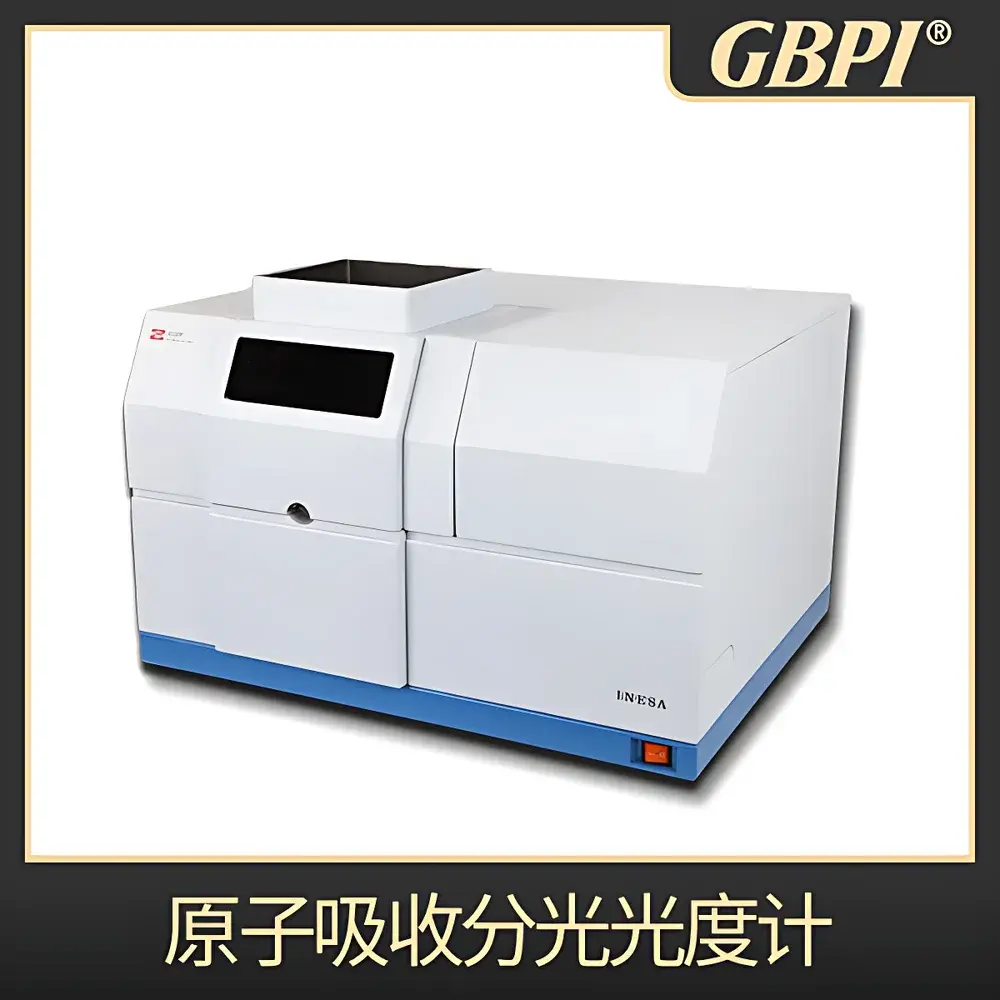
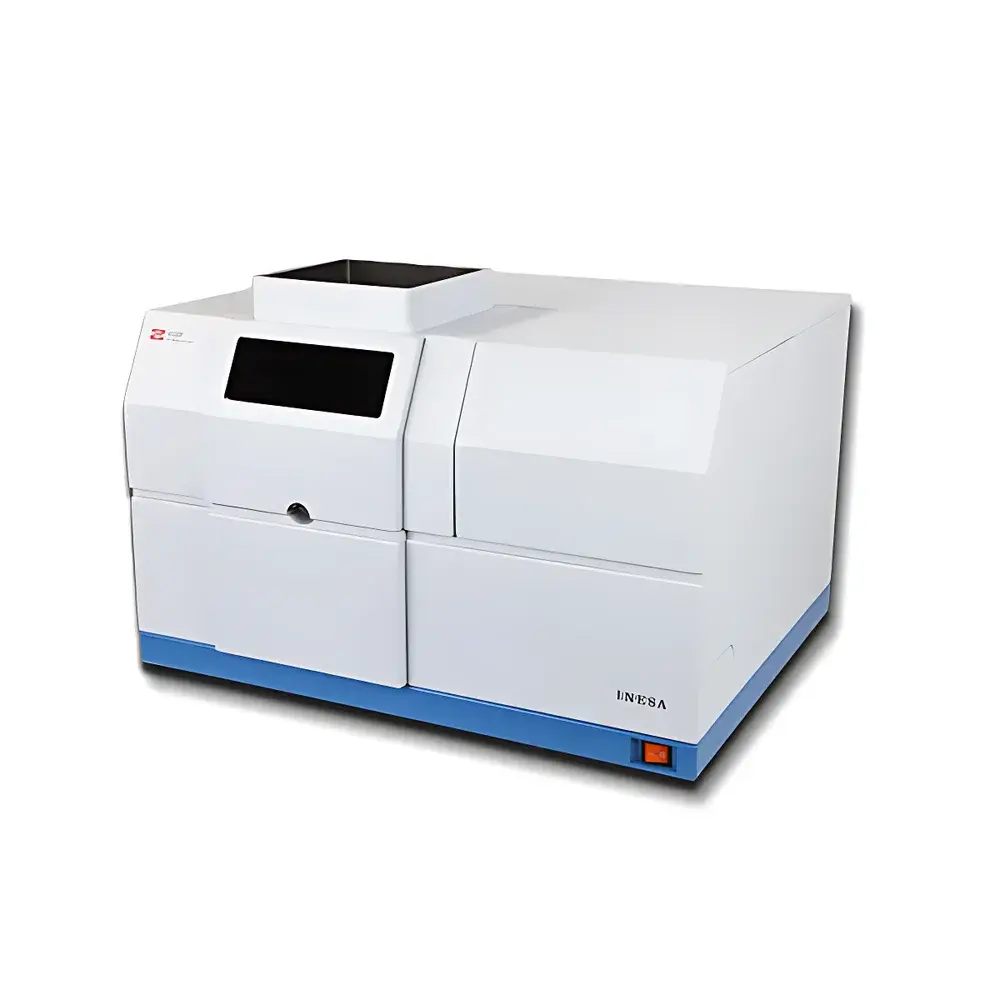
GBPI 4510F Atomic Absorption Spectrophotometer
| Brand | GBPI |
|---|---|
| Origin | Guangdong, China |
| Manufacturer Type | Direct Manufacturer |
| Origin Category | Domestic (China) |
| Model | 4510F |
| Automation Level | Fully Automated |
| Lamp Holder | Rotating 4-Lamp Turret |
| Wavelength Range | 190–900 nm |
| Wavelength Accuracy | ±0.3 nm |
| Wavelength Repeatability | ≤0.15 nm |
| Absorbance Range | –0.1 to 2.5 A |
| Spectral Bandwidth | 0.1 / 0.2 / 0.4 / 1.0 nm (selectable) |
| Baseline Stability | ≤0.005 A/30 min (Cu) |
| D₂ Background Correction | ≥50× at 1 A background signal |
| Self-Reversal Background Correction | Supported |
| Flame System | Acetylene-Air, 100 mm Burner Head |
| Nebulizer Chamber | Polypropylene-Coated |
| Characteristic Concentration (Cu) | ≤0.02 µg/mL per 1% absorption |
| RSD of Measurement | ≤0.5% |
| Detection Limit (Cu) | ≤0.006 µg/mL |
| Safety Interlocks | Gas pressure monitoring, flame-out detection, power interruption cutoff, burner head recognition |
| Optional Accessories | 4510GF Graphite Furnace Module, AS4020 Graphite Furnace Autosampler, AS800 Chiller Unit, Hydride Generation System |
Overview
The GBPI 4510F Atomic Absorption Spectrophotometer is a fully PC-controlled, dual-mode analytical instrument engineered for trace elemental quantification in environmental, pharmaceutical, food safety, clinical, and industrial quality control laboratories. It operates on the principle of atomic absorption spectroscopy (AAS), where ground-state free atoms in a gaseous state absorb light at element-specific wavelengths. The instrument supports both flame atomization (FAAS) and optional graphite furnace atomization (GFAAS), enabling detection limits down to sub-ppt levels for refractory elements. Its optical architecture employs a high-efficiency Czerny-Turner monochromator with aberration-corrected optics and a sealed, purged optical path to minimize stray light and ensure long-term photometric stability. The system integrates a rotating four-lamp turret with automatic lamp selection and alignment, eliminating manual reconfiguration between multi-element analyses.
Key Features
- Fully automated operation via dedicated Windows-based workstation software—enabling method setup, sequence programming, real-time data acquisition, and report generation.
- Dual-atomization capability: seamless mechanical and software-switching between flame and graphite furnace modes without hardware disassembly.
- Advanced background correction: simultaneous D₂ continuum and self-reversal (SR) techniques, delivering accurate compensation for complex matrix interferences (e.g., molecular absorption, light scattering).
- Robust flame safety architecture: integrated gas pressure sensors, flame-monitoring photodiodes, and burner-head identification logic ensure fail-safe shutdown during abnormal conditions (e.g., flame extinction, gas supply interruption, or misaligned burner).
- Precision wavelength control: stepper-motor-driven grating with closed-loop position feedback ensures ≤0.15 nm repeatability across the full 190–900 nm spectral range.
- Modular expandability: designed to accept factory-integrated accessories including the 4510GF graphite furnace, AS4020 autosampler, AS800 recirculating chiller, and hydride generation systems for As, Se, Hg, Sb, Bi, and Te speciation.
Sample Compatibility & Compliance
The 4510F accommodates aqueous solutions, acid-digested environmental samples (EPA Method 200.7, 200.9), biological digests (AOAC 999.10), and food extracts compliant with ISO 6471 and GB/T 5009 series standards. Its flame system supports routine analysis of alkali metals, alkaline earths, and transition elements (e.g., Ca, Mg, Fe, Zn, Cu, Mn) at µg/L–mg/L concentrations. With the optional graphite furnace configuration, it meets USP , ASTM D4294 (for oil analysis), and China’s JJG 694–2015 verification requirements. All operational parameters—including lamp current, slit width, integration time, and background correction mode—are logged with timestamps and user IDs, supporting GLP/GMP-compliant audit trails per FDA 21 CFR Part 11 when paired with validated software configurations.
Software & Data Management
The GBPI AAS Workstation provides a unified interface for instrument control, calibration curve fitting (linear, quadratic, log-log), QC charting (Levey-Jennings, Shewhart), and compliance reporting. Raw absorbance/time traces, peak area/height integration, and background-subtracted signals are stored in vendor-neutral CSV and XML formats. Audit trail functionality records all parameter changes, calibration events, and result modifications with operator ID and timestamp. Data export modules support direct integration into LIMS platforms via ODBC drivers. Software validation documentation (IQ/OQ protocols) is available upon request for regulated environments.
Applications
- Environmental monitoring: quantification of heavy metals (Pb, Cd, Cr, Ni) in wastewater, soil leachates, and airborne particulate matter (PM2.5/PM10) following EPA 7000B and ISO 11885.
- Pharmaceutical QA/QC: residual catalyst metal testing (Pd, Pt, Rh) in active pharmaceutical ingredients per ICH Q2(R2) guidelines.
- Food and beverage safety: Na, K, Ca, Mg profiling in dairy products; toxic element screening (As, Cd, Pb) in rice, infant formula, and dietary supplements per EU Commission Regulation (EU) No 1881/2006.
- Clinical toxicology: blood and urine analysis for Cu, Zn, Fe, and Se status assessment using standardized reference materials (NIST SRM 955c, Seronorm Trace Elements).
- Materials science: impurity profiling in high-purity reagents, catalysts, and battery-grade Li compounds (ASTM D7260).
FAQ
Is the 4510F compliant with international regulatory standards for laboratory instrumentation?
Yes—the system supports GLP/GMP workflows when configured with audit-trail-enabled software and validated accessories. It meets core performance criteria referenced in ISO 7519, ASTM E1993, and JJG 694–2015.
Can the instrument be upgraded from flame-only to flame-graphite furnace configuration post-purchase?
Yes—mechanical and electrical interfaces for the 4510GF graphite furnace module are pre-installed. Retrofit requires only accessory installation and software license activation.
What sample introduction options are supported beyond standard nebulization?
Hydride generation (HG-AAS) and cold vapor (CV-AAS) modules are available as factory-validated options for As, Se, Hg, Sb, Bi, and Te analysis.
Does the workstation support multi-user permission levels and electronic signatures?
Yes—role-based access control (administrator, analyst, reviewer) and 21 CFR Part 11-compliant electronic signature modules are available under validated software deployment.
What maintenance intervals are recommended for optimal long-term performance?
Lamp alignment verification every 6 months; monochromator purge gas filter replacement annually; burner head cleaning after every 500 flame runs; graphite tube replacement per manufacturer-specified lifetime (typically 200–500 firings depending on matrix).




