
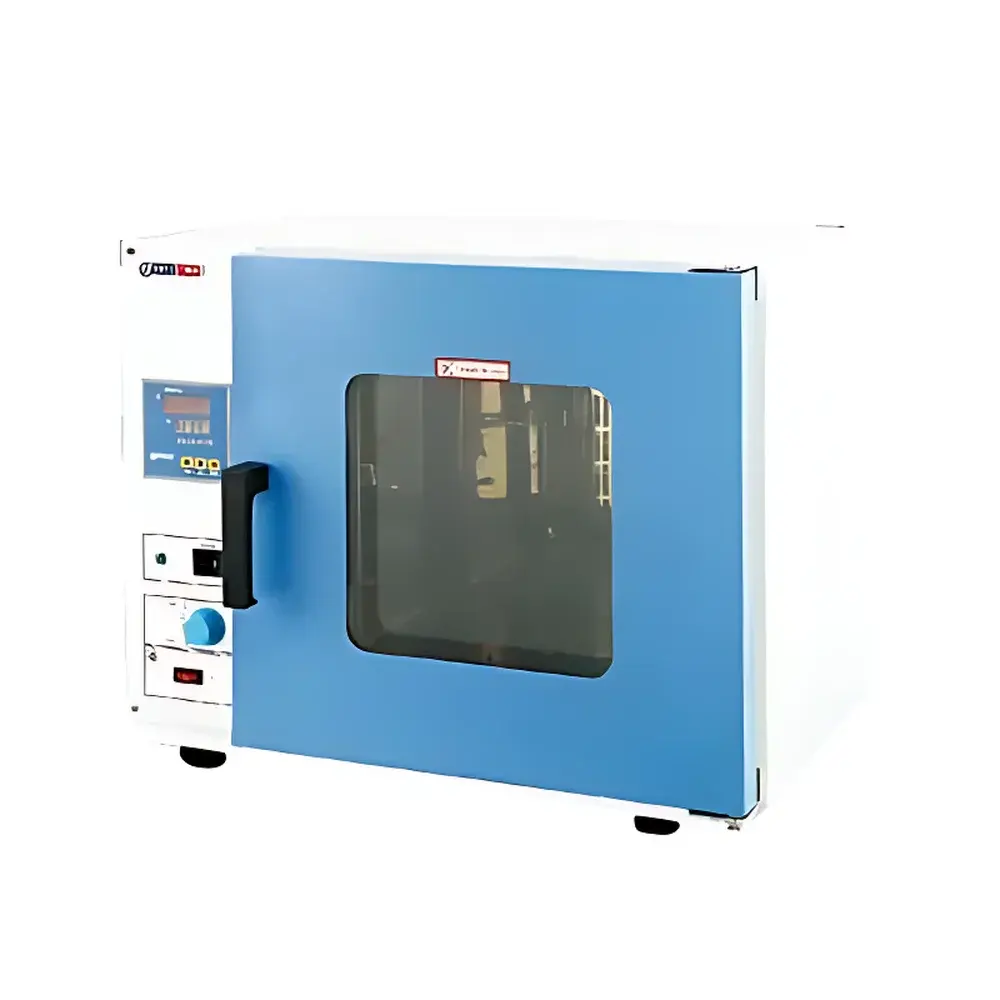
GBPI 9023 Forced-Air Drying Oven
| Brand | GBPI |
|---|---|
| Origin | Guangdong, China |
| Manufacturer Type | Direct Manufacturer |
| Country of Origin | China |
| Model | 9023 |
| Pricing | Available Upon Request |
| Temperature Range | RT +10°C to 300°C |
| Temperature Uniformity | ≤ ±3°C |
| Temperature Fluctuation | ≤ ±0.5°C |
| Sensor | Pt100 Platinum Resistance Thermometer |
| Display | LED Digital |
| Exterior | Powder-Coated Cold-Rolled Steel with Anti-Rust Treatment |
| Interior | SUS304 Brushed Stainless Steel |
| Insulation | High-Performance Glass Wool |
| Heating Element | Nickel-Chromium Alloy Wire |
| Circulation Fan | Centrifugal Blower |
| Safety Protections | Over-Temperature Cut-Off, Fan Overheat Protection |
| Shelf Load Capacity | 5 kg per shelf |
| Internal Dimensions (D×W×H) | 300 × 300 × 275 mm |
Overview
The GBPI 9023 Forced-Air Drying Oven is an engineered laboratory thermal processing instrument designed for precise, repeatable, and contamination-controlled drying, baking, sterilization, and sample conditioning tasks. It operates on the principle of forced convection—using a centrifugal blower to circulate heated air uniformly across the chamber—thereby minimizing thermal gradients and accelerating heat transfer compared to natural convection ovens. This architecture ensures consistent thermal exposure critical for applications such as moisture content determination (per ASTM D2240, ISO 293), polymer film conditioning (ASTM D883), pharmaceutical stability testing (ICH Q1A), and GC/MS sample preparation where residual solvent removal must be both complete and non-degradative. The oven’s operational envelope spans from ambient +10°C to 300°C, supporting low-temperature desiccation through high-temperature wax melting and dry-heat sterilization protocols.
Key Features
- High-reliability microprocessor-based temperature controller with PID algorithm, delivering stable setpoint maintenance within ±0.5°C fluctuation and uniformity ≤±3°C across the entire working volume.
- Robust chamber construction: interior lined with SUS304 brushed stainless steel—electropolished-welded and argon-shielded for corrosion resistance and ease of decontamination; exterior fabricated from anti-rust treated cold-rolled steel with durable epoxy-polyester powder coating.
- Optimized thermal insulation using high-density, low-conductivity super glass wool (thermal conductivity <0.04 W/m·K at 25°C), minimizing energy consumption and external surface temperature rise.
- Dual safety architecture: independent over-temperature cut-off circuit (mechanical backup) and real-time fan motor temperature monitoring prevent thermal runaway during extended unattended operation.
- LED digital display with intuitive keypad interface supports time-based operation via built-in timer (0–999 minutes), enabling automated shutdown and process repeatability in GLP-compliant workflows.
Sample Compatibility & Compliance
The GBPI 9023 accommodates a broad range of sample formats—including Petri dishes, weighing boats, aluminum pans, glass vials, and ceramic crucibles—within its 24.6 L internal volume (300 × 300 × 275 mm). Its inert stainless-steel chamber and absence of organic gasketing materials make it suitable for residue-free processing of analytical standards, reference materials, and QC samples. The unit complies with general electrical safety requirements per IEC 61010-1 and meets essential environmental protection criteria under RoHS Directive 2011/65/EU. While not certified for Class II biological safety or explosion-proof use, it is routinely deployed in ISO/IEC 17025-accredited laboratories for sample preconditioning prior to gravimetric analysis, Karl Fischer titration, and thermogravimetric assay.
Software & Data Management
The GBPI 9023 operates as a standalone instrument with no embedded data logging or network connectivity. However, its analog-compatible 0–5 V or 4–20 mA output (optional accessory) enables integration into centralized Lab Information Management Systems (LIMS) or SCADA platforms for audit-trail recording. For full 21 CFR Part 11 compliance—including electronic signatures, user access control, and immutable audit logs—external validation-ready data loggers (e.g., Omega OM-DAQPRO-5300 series) are recommended and routinely qualified alongside the oven in GMP environments.
Applications
- Moisture loss-on-drying (LOD) assays per USP & Ph. Eur. general chapters and 2.2.32.
- Pre-conditioning of polymer films, composites, and packaging substrates prior to tensile, peel, or barrier testing (ASTM D882, D3330).
- Drying of filter papers, silica gel, and desiccants used in environmental air sampling protocols (EPA Method TO-17).
- Baking of glassware and metal components for trace-metal analysis to eliminate organic carryover.
- Heat treatment of calibration standards and reference materials requiring thermal stabilization before metrological use.
FAQ
Is the GBPI 9023 compliant with FDA 21 CFR Part 11 for electronic records?
No—the base model lacks embedded software, user authentication, or electronic signature capability. Full Part 11 compliance requires third-party validated data acquisition hardware and procedural SOPs.
Can this oven be used for dry-heat sterilization of surgical instruments?
It meets minimum temperature requirements (160–180°C for 2 hours), but lacks EN 285-compliant cycle validation, door interlocks, and chamber pressure monitoring required for medical device sterilization.
What is the maximum load per shelf, and does it include dynamic loading during airflow?
Rated capacity is 5 kg static load per shelf; dynamic airflow imposes negligible additional stress due to balanced centrifugal fan design and rigid shelf supports.
Does the oven support ramp-soak programming?
No—only single-setpoint operation with timer-based hold duration. Multi-step thermal profiles require external programmable controllers.
Are calibration certificates and IQ/OQ documentation available?
Yes—GBPI provides optional factory calibration reports traceable to NIM (China National Institute of Metrology) and customizable IQ/OQ protocols aligned with ISO/IEC 17025 and GAMP5 guidelines.



