
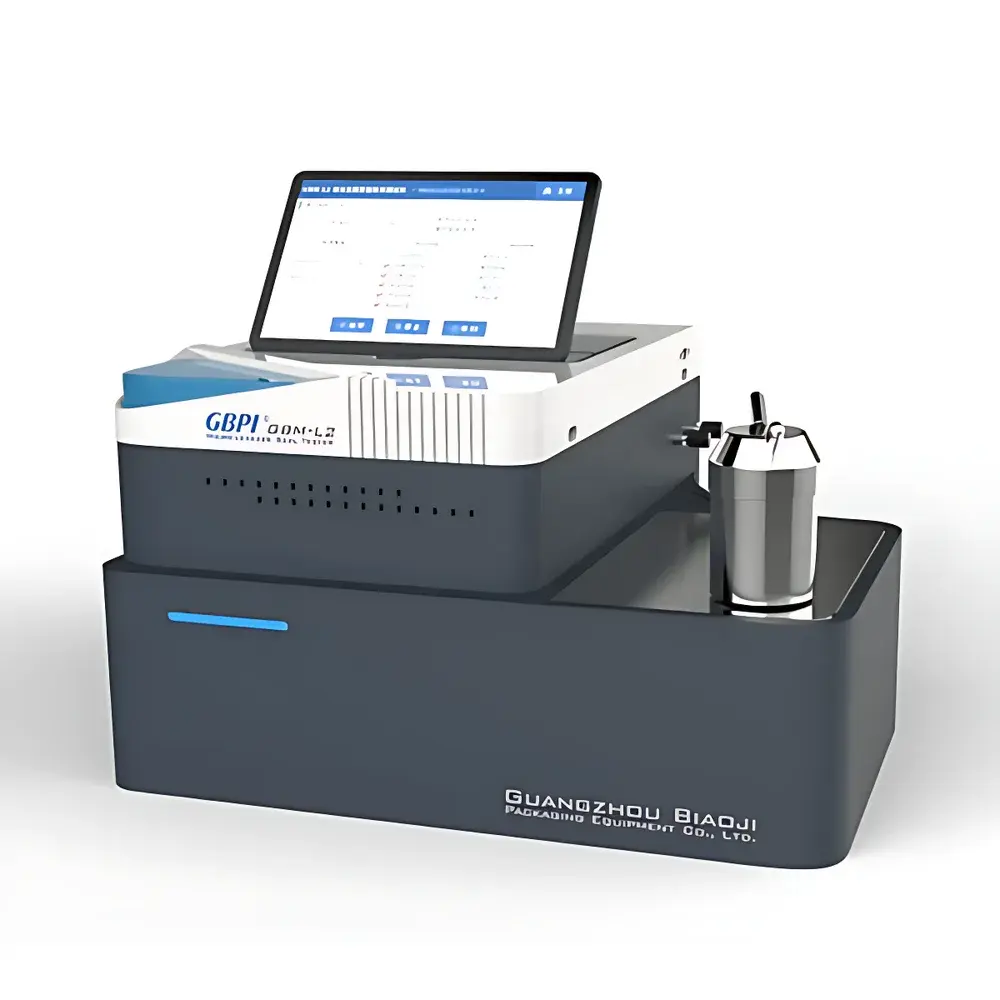
GBPI AUTO GBM-L2 Dual-Pressure Micro-Leak Integrity Tester
| Brand | GBPI (Guangzhou Biaoji) |
|---|---|
| Origin | Guangdong, China |
| Manufacturer Type | OEM/ODM Manufacturer |
| Region Classification | Domestic (China) |
| Model | AUTO GBM-L2 |
| Pricing | Upon Request |
| Absolute Pressure Range | 0–300 kPa |
| Differential Pressure Range | −2 to +2 kPa |
| Detection Sensitivity | 1–3 µm |
| Equilibration/Test Time | 1–3600 s |
| Vacuum Purge Time | 1–3600 s |
| Set Flow Rate | 0–3 mL/min |
| Sensor Configuration | Dual-sensor (absolute + differential pressure) |
| Test Chamber | Custom-engineered per sample geometry |
| Compliance Standards | ASTM F2338-09(2013), YY/T 0681.18–2020, USP <1207.2>, ASTM F2095 |
Overview
The GBPI AUTO GBM-L2 Dual-Pressure Micro-Leak Integrity Tester is an engineered solution for non-destructive, quantitative leak detection in sterile and hermetically sealed primary packaging used across pharmaceutical, biotechnology, food, and chemical industries. It operates on two complementary physical principles—vacuum decay and pressure decay—enabling reliable assessment of container closure integrity (CCI) regardless of internal headspace conditions. Unlike single-mode instruments, the AUTO GBM-L2 resolves a critical limitation in lyophilized product testing: false-negative results arising from residual vacuum inside vials, which suppresses measurable pressure rise during conventional vacuum decay testing. By intelligently switching between or synchronizing both test modes, the system delivers unambiguous pass/fail determinations with traceable metrological confidence.
Key Features
- Dual-pressure methodology: Simultaneous or sequential execution of vacuum decay (ASTM F2338-compliant) and pressure decay (ASTM F2095-compliant) protocols ensures robustness across diverse package types—including lyophilized vials, ampoules, pre-filled syringes, ophthalmic bottles, HDPE containers, IV bags, and flexible pouches.
- High-fidelity dual-sensor architecture: Integrated absolute pressure sensor (0–300 kPa, ±0.1% FS accuracy) and differential pressure sensor (±2 kPa, ±0.1% FS) enable real-time monitoring of minute pressure transients, supporting quantitative estimation of leak aperture size within the 1–3 µm range.
- Stable, low-noise pneumatic system: Equipped with a high-efficiency imported vacuum pump (3 L/s pumping speed, ≤50 dB(A) operational noise, ultimate vacuum <1 Pa) and a precision mass flow controller (0.001 mL/min resolution) for controlled gas injection and method verification via calibrated micro-leak simulation.
- GMP-aligned human-machine interface: 11-inch industrial-grade capacitive touchscreen with intuitive workflow navigation, multi-level user authentication (administrator/operator/auditor), and full audit trail functionality compliant with Annex 11 and FDA 21 CFR Part 11 requirements.
- Modular test chamber design: Fully customizable cavity geometry—including nested fixtures for mixed-size vial batches—ensures optimal seal contact, minimal dead volume, and consistent test repeatability (RSD ≤0.8% under controlled environmental conditions: 20–30°C, RH ≤80%, non-condensing).
Sample Compatibility & Compliance
The AUTO GBM-L2 accommodates rigid and semi-rigid containers with standard closures (rubber stoppers, aluminum seals, crimp caps) as well as flexible packaging formats requiring specialized clamping. Validated use cases include glass and polymer-based systems such as serum vials (2–30 mL), ampoules (1–25 mL), pre-filled syringes (0.5–5 mL), dropper bottles, and IV containers. All hardware and software components are designed and verified to meet ISO 9001 quality management standards. The instrument’s test algorithms and data handling procedures align with regulatory expectations outlined in USP “Package Integrity Evaluation – Sterile Products”, EU Annex 1 (2022), and PIC/S PI 041-1 for CCI validation. Method suitability documentation supports qualification per ICH Q5C and process validation per FDA Guidance for Industry: Container Closure Systems for Packaging Human Drugs and Biologics.
Software & Data Management
Firmware-controlled test sequencing ensures deterministic execution of user-defined protocols—including vacuum purge duration, stabilization time, test duration, and pressure ramp profiles. Raw sensor data (time-stamped absolute and differential pressure values) are stored in encrypted binary format with SHA-256 hash integrity checks. Export options include CSV and PDF reports containing metadata (operator ID, timestamp, chamber ID, calibration status, environmental logs), statistical summaries (mean ΔP, slope, R²), and automated pass/fail classification based on configurable thresholds. Audit trails record all user actions—including parameter edits, report generation, and login/logout events—with immutable timestamps and digital signatures. System backups support networked NAS storage and comply with ALCOA+ principles (Attributable, Legible, Contemporaneous, Original, Accurate, Complete, Consistent, Enduring, Available).
Applications
- Final container release testing for aseptically filled and terminally sterilized injectables
- CCI verification during stability studies (real-time and accelerated)
- Root cause analysis of sterility failures in manufacturing investigations
- Qualification of stopper-crimp combinations and reconstitution needle puncture effects
- Comparative evaluation of alternative closure systems (e.g., rubber vs. synthetic elastomers)
- Process validation support for lyophilization cycle development and stoppering parameters
FAQ
What regulatory standards does the AUTO GBM-L2 support?
The instrument implements test logic aligned with ASTM F2338-09(2013), ASTM F2095, YY/T 0681.18–2020, and USP . Its software architecture satisfies data integrity requirements under FDA 21 CFR Part 11 and EU Annex 11.
Can the system detect leaks smaller than 1 µm?
While the validated sensitivity range is 1–3 µm under standard operating conditions, detection capability depends on test duration, temperature stability, and package geometry. Extended equilibration times (>1800 s) may improve resolution for ultra-fine defects—but require protocol-specific justification and risk assessment.
Is custom chamber design included in the base configuration?
Yes. Each AUTO GBM-L2 delivery includes one application-specific test chamber engineered to match the client’s primary packaging dimensions and sealing interface. Additional chambers or nested configurations are available as optional accessories.
How often must the pressure sensors be recalibrated?
GBPI recommends annual traceable calibration against NIST-traceable reference standards. Field verification using zero-span checks and certified leak standards is advised before each daily operation.
Does the system support integration with LIMS or MES platforms?
Yes—via configurable TCP/IP API and OPC UA-compatible data export modules. Integration packages include HL7 and ASTM E1384-compliant message structures for seamless laboratory informatics connectivity.





