
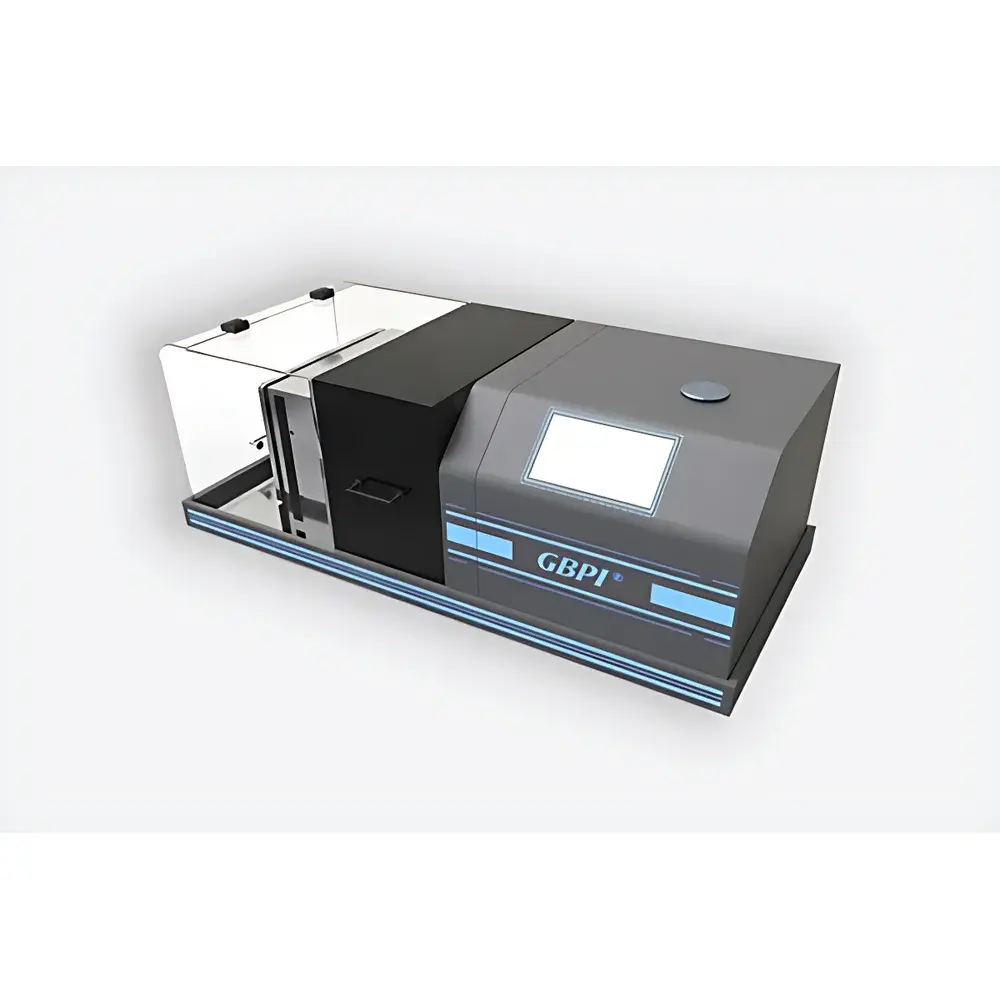
GBPI GB-B20010 Synthetic Blood Penetration Tester for Medical Face Masks
| Brand | GBPI |
|---|---|
| Model | GB-B20010 |
| Origin | Guangdong, China |
| Manufacturer Type | Direct Manufacturer |
| Pressure Points | 3 kPa, 5 kPa, 7 kPa, 14 kPa, 20 kPa |
| Specimen Size | 75 mm × 75 mm |
| Pressurized Area | 28.27 cm² |
| Power Supply | AC 220 V, 50 Hz, 100 W |
| Air Source | Compressed Air |
| Pressure Regulation | Adjustable, with Analog Pressure Gauge |
| Clamping Torque | 13.5 N·m |
| Retention Mesh | Stainless Steel, Open Area ≥50%, Deflection ≤5 mm at 20 kPa |
| Timer | Digital, ±1 s Accuracy |
| Compliance | GB 19083–2010 |
Overview
The GBPI GB-B20010 Synthetic Blood Penetration Tester is a purpose-built instrument engineered for quantitative evaluation of the resistance of medical face mask materials to synthetic blood penetration under controlled hydrostatic pressure. It operates on the principle of static pressure challenge—applying calibrated, sustained pneumatic pressure via compressed air to a standardized specimen mounted in a sealed test chamber, followed by visual assessment of fluid breakthrough across the material surface. Designed specifically to meet the performance verification requirements outlined in GB 19083–2010 “Technical Requirements and Test Methods for Medical Protective Masks”, this tester delivers repeatable, operator-independent results essential for regulatory conformance, quality control, and R&D validation in medical PPE manufacturing and third-party testing laboratories.
Key Features
- Pneumatic pressure generation system capable of delivering and maintaining precise test pressures up to 20 kPa (±1 kPa), with five discrete setpoints (3, 5, 7, 14, and 20 kPa) aligned with GB 19083–2010 classification tiers.
- Analog pressure gauge with direct-reading scale for real-time monitoring and manual fine-tuning of applied pressure—no external calibration hardware required during routine operation.
- Stainless steel test chamber featuring a rigid, corrosion-resistant design and integrated sealing mechanism to ensure leak-free pressurization and containment of synthetic blood during testing.
- Custom-fabricated retention mesh with ≥50% open area and mechanical rigidity verified to deflect ≤5 mm under maximum 20 kPa load—ensuring uniform force distribution while preventing localized stress concentration or mesh deformation-induced artifacts.
- High-torque clamping assembly (13.5 N·m) guarantees consistent, reproducible specimen fixation across all test cycles, minimizing slippage-related variability in effective pressurized area.
- Digital electronic timer with ±1 second accuracy enables strict adherence to exposure duration protocols defined in GB 19083–2010, supporting traceable time-stamped test records.
- Self-contained architecture requiring only standard AC 220 V / 50 Hz power and an externally supplied clean, dry compressed air source—no vacuum pumps, hydraulic systems, or specialized utilities needed.
Sample Compatibility & Compliance
The GB-B20010 accommodates square specimens measuring 75 mm × 75 mm, with a defined pressurized circular area of 28.27 cm² (Ø 60 mm). This geometry conforms precisely to the dimensional specifications mandated in GB 19083–2010 Annex B. The instrument supports both single-layer and multi-layer nonwoven, melt-blown, spunbond, and laminated mask substrates—including electrostatically charged filtration media. All wetted components are constructed from 316 stainless steel or chemically inert polymers compatible with synthetic blood simulants (e.g., ASTM F1819-compliant red-dyed glycerol/water mixtures). While GB 19083–2010 remains the primary compliance benchmark, the test methodology is technically comparable to ISO 22609:2004 (Medical devices — Evaluation of medical face masks — Resistance to penetration by synthetic blood) and provides foundational data relevant to ASTM F2100 Level 3 barrier performance claims.
Software & Data Management
The GB-B20010 is a hardware-only, manually operated instrument with no embedded microprocessor or digital interface. All operational parameters—including pressure selection, timing initiation, and visual pass/fail determination—are executed directly by the operator. As such, it does not generate electronic data logs, lacks audit trail capability, and is not compliant with FDA 21 CFR Part 11 or EU Annex 11 requirements for computerized systems. However, its mechanical simplicity ensures high reliability, minimal maintenance, and full transparency in result derivation—making it suitable for GLP-aligned environments where paper-based test records, signed technician logs, and calibrated analog instrumentation meet internal QA and regulatory audit expectations.
Applications
- Final product release testing of surgical masks and medical protective masks per GB 19083–2010 Class I/II/III requirements.
- Raw material qualification for melt-blown polypropylene, electret-treated nonwovens, and composite laminates used in barrier layer development.
- Process validation support for hot-air bonding, ultrasonic sealing, and pleating operations affecting mask front-face integrity.
- Comparative benchmarking of alternative barrier technologies (e.g., nanofiber coatings, hydrophobic finishes) under standardized pressure conditions.
- Educational use in biomedical engineering and textile science curricula to demonstrate fluid barrier mechanics and pressure-driven permeation phenomena.
FAQ
What synthetic blood formulation is recommended for use with this tester?
GB 19083–2010 specifies a synthetic blood simulant composed of red dye, glycerol, and water, with viscosity and surface tension matching human blood at 37 °C. ASTM F1819 provides detailed preparation guidance.
Is calibration certification included with the instrument?
The unit ships with factory-verified pressure gauge calibration and torque wrench verification documentation. Users must perform periodic in-house verification using NIST-traceable pressure standards and torque calibrators per ISO/IEC 17025 requirements.
Can the tester be used for evaluating gowns or drapes?
No—the fixture geometry, specimen size, and pressure application method are optimized exclusively for flat, rigidly clamped mask panels per GB 19083–2010. Textile standards for gowns (e.g., ISO 16603) require different test configurations.
Does the instrument comply with international regulatory submissions (e.g., FDA 510(k), CE marking)?
The GB-B20010 itself is not a medical device; it is a test apparatus. Its use supports conformity assessment to GB 19083–2010, which may serve as technical evidence in broader regulatory dossiers—but final certification responsibility rests with the mask manufacturer’s notified body or regulatory authority.
What maintenance is required?
Routine cleaning of the stainless steel chamber and mesh after each test cycle; annual inspection of O-rings and pressure hose integrity; biannual verification of gauge linearity and timer accuracy using certified reference equipment.




