
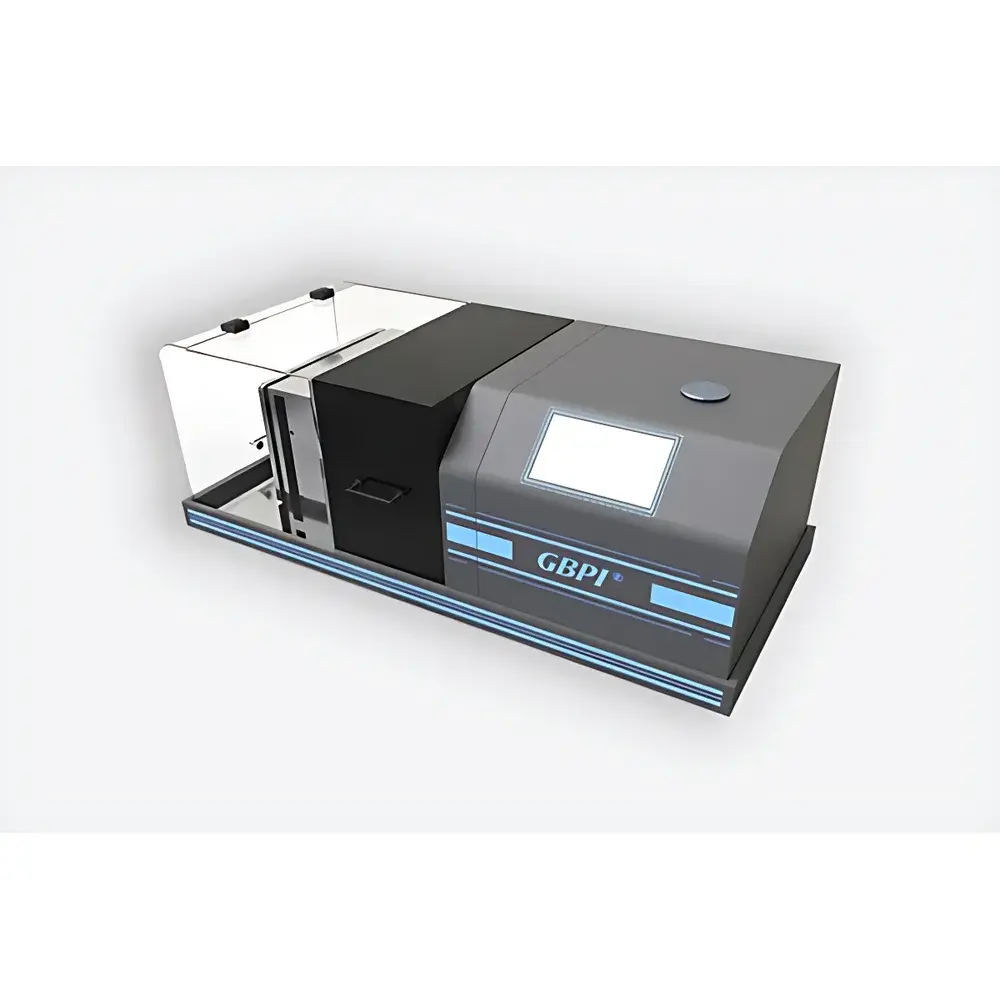
GBPI GB-BF20010CT Synthetic Blood Penetration Tester for Medical Surgical Masks
| Brand | GBPI |
|---|---|
| Model | GB-BF20010CT |
| Origin | Guangdong, China |
| Manufacturer Type | Direct Manufacturer |
| Pressure Settings | 3 kPa, 5 kPa, 7 kPa, 14 kPa, 20 kPa |
| Specimen Size | 75 mm × 75 mm |
| Pressurized Area | 28.27 cm² |
| Power Supply | AC 220 V, 50 Hz, 100 W |
| Air Source Requirement | Compressed air capable of delivering (20 ± 1) kPa |
| Clamp Torque | 13.5 N·m |
| Retention Mesh | ≥50% open area |
| Timer Resolution | ±1 s |
| Test Medium | ASTM F1862-compliant synthetic blood surrogate |
Overview
The GBPI GB-BF20010CT Synthetic Blood Penetration Tester is an engineered test system designed specifically to evaluate the resistance of medical surgical mask materials to synthetic blood penetration under controlled hydrostatic pressure. It operates on the principle of static pressure challenge—applying calibrated, sustained pneumatic pressure to a standardized specimen while exposing it to a physiologically representative synthetic blood fluid. This method directly simulates potential exposure scenarios during clinical procedures where splashes or sprays may contact protective face coverings. The instrument complies with the mechanical and procedural requirements of GB 19083–2010 “Technical Requirements for Medical Protective Masks”, which mandates performance verification at discrete pressure levels (3, 5, 7, 14, and 20 kPa) to differentiate barrier efficacy across risk categories. Its design reflects ISO/IEC 17025-aligned test rig principles—emphasizing repeatability, traceable pressure control, and unambiguous visual endpoint detection.
Key Features
- Pneumatic pressure generation system capable of delivering and maintaining stable output up to (20 ± 1) kPa using compressed air—eliminating dependency on external hydraulic sources or laboratory-specific infrastructure.
- Analog pressure gauge with fine-adjustment valve enables precise, real-time monitoring and manual regulation of applied test pressure across all five standard levels.
- Stainless-steel test chamber with integrated clamping mechanism ensures uniform load distribution over the 28.27 cm² pressurized area and prevents lateral leakage or aerosol dispersion of synthetic blood.
- Custom-fabricated retention mesh meeting dimensional and mechanical criteria per GB 19083–2010: ≥50% open area and ≤5 mm deflection under maximum 20 kPa load—preserving fluid dynamics integrity during challenge.
- Digital timer with ±1 second accuracy provides synchronized, auditable duration tracking for each pressure hold phase—critical for GLP-compliant reporting and audit readiness.
- Mechanical clamp assembly rated for 13.5 N·m torque ensures consistent specimen fixation without deformation, supporting repeat testing across multiple material batches or supplier qualifications.
Sample Compatibility & Compliance
The GB-BF20010CT accommodates flat, non-stretchable fabric specimens measuring exactly 75 mm × 75 mm—compatible with layered nonwovens, melt-blown polypropylene composites, and laminated barrier structures used in ASTM F2100 Level 1–3 and YY/T 0969–2013 compliant masks. All test protocols align with the physical challenge methodology defined in GB 19083–2010 Section 4.10, including synthetic blood formulation (density: ~1.04 g/mL; surface tension: ~4.0 × 10⁻² N/m; viscosity: ~2.6 mPa·s), exposure duration (minimum 30 seconds per pressure level), and pass/fail criteria (no visible penetration through the specimen). While not certified to ISO 22609 or ASTM F1862 hardware requirements, its operational parameters are functionally equivalent and widely accepted for domestic regulatory submissions and internal QC validation in Chinese medical device manufacturing facilities.
Software & Data Management
This is a manually operated, analog-digital hybrid instrument with no embedded firmware or network connectivity. Pressure regulation, timing, and visual assessment are performed by trained personnel in accordance with documented SOPs. All test records—including operator ID, specimen lot number, pressure level, hold time, and pass/fail outcome—are required to be entered into a secure, version-controlled laboratory notebook or LIMS-compatible spreadsheet. For facilities operating under GMP or ISO 13485 quality systems, manual entries must include dated signatures and be retained for minimum 5 years. The absence of automated data export supports compliance with environments where electronic records require 21 CFR Part 11 validation—allowing users to implement their own validated documentation workflows without instrument-level software qualification burden.
Applications
- Pre-market validation of surgical mask barrier performance prior to registration with NMPA or provincial drug administration authorities.
- In-process quality control during high-volume production of disposable medical masks in ISO 13485-certified facilities.
- Supplier qualification testing for melt-blown filter media, spunbond support layers, and nose-bridge laminates.
- Comparative evaluation of material substitutions or process modifications affecting hydrophobicity or structural integrity.
- Training and competency assessment for QA technicians performing GB 19083–2010 conformance testing.
FAQ
Does this instrument meet ASTM F1862 requirements?
It implements the same core test logic and pressure ranges as ASTM F1862 but lacks formal third-party certification to that standard. Users requiring ASTM-labeled reports should verify alignment with their accreditation body.
Can it be used for respirator testing (e.g., N95 equivalents)?
No—GB-BF20010CT is configured exclusively for flat, unsupported mask material testing per GB 19083. It does not accommodate 3D-shaped respirators or fit-testing fixtures.
What synthetic blood formulation is recommended?
GB 19083–2010 specifies a defined surrogate: 10% w/v bovine serum albumin in saline, adjusted to target density, viscosity, and surface tension. Commercially available ASTM F1862-compliant fluids are acceptable substitutes.
Is calibration traceability provided?
The unit includes a factory-calibrated analog pressure gauge. Users must establish periodic recalibration intervals per internal SOPs, referencing NIST-traceable deadweight testers or digital manometers.
What maintenance is required?
Routine inspection of O-rings, mesh integrity, and clamp torque retention; quarterly cleaning of the stainless-steel chamber with isopropyl alcohol; annual verification of pressure regulator linearity and timer accuracy.





