
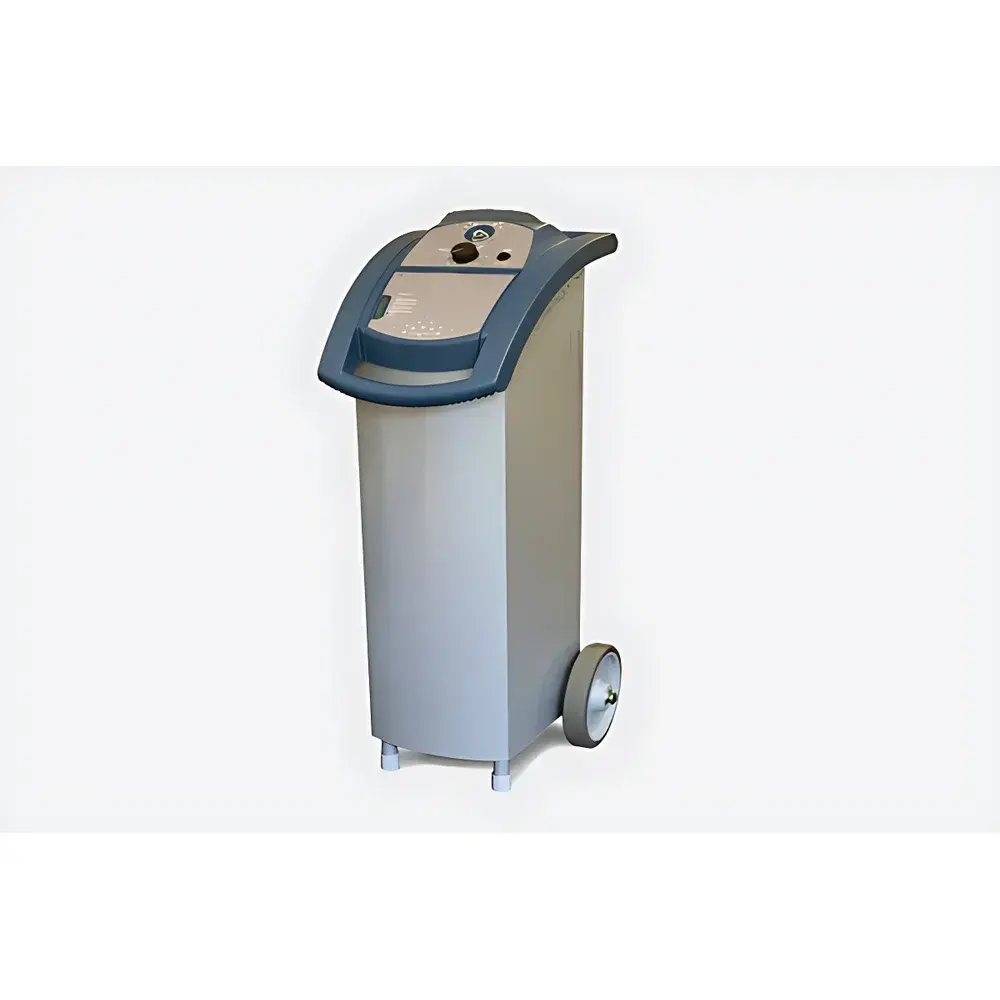
GBPI GB-D100A Mobile Dry-Fog Disinfection and Sterilization System
| Brand | GBPI |
|---|---|
| Origin | Guangdong, China |
| Manufacturer Type | Direct Manufacturer |
| Country of Origin | China |
| Model | GB-D100A |
| Quotation | Upon Request |
| Aerosol Output Capacity | 2–6 L/h (adjustable) |
| Aerosol Flow Rate | 65 L/min |
| Aerosol Particle Size | 2–10 µm |
| Built-in Tank Capacity | 20 L |
| Optional External Tank Capacity | 50 L |
| Manual Spray Wand (optional) | 110 mm |
| Dimensions (W×D×H) | 510 × 600 × 860 mm |
| Power Supply | 220 V AC, 750 W |
| Compliance | GB 150.4–2011, GB/T 9706.1–2007, WS/T 367–2012 |
Overview
The GBPI GB-D100A Mobile Dry-Fog Disinfection and Sterilization System is an engineered solution for large-volume environmental decontamination, operating on the principle of compressed-air-driven aerosol generation. Unlike conventional wet-spray or ultrasonic nebulizers, this system produces a stable, non-condensing dry fog composed of discrete particles in the 2–10 µm aerodynamic diameter range—optimized for airborne pathogen inactivation while minimizing surface deposition and moisture accumulation. The device leverages Coanda-effect-enhanced nozzle dynamics to generate rotational shear forces that atomize liquid disinfectant into fine, respirable aerosols with high spatial dispersion efficiency. Designed for use in unoccupied or intermittently occupied environments, it delivers uniform bioburden reduction across complex architectural volumes—including ceiling voids, HVAC ductwork interfaces, and under-furniture zones—without requiring manual wiping or post-treatment ventilation beyond standard air exchange protocols.
Key Features
- Integrated dry-fog generation module with no external compressed air source required—self-contained air compression system ensures operational independence and field deployment flexibility.
- Adjustable aerosol output rate (2–6 L/h) paired with precise timing control (1–120 min programmable cycles), enabling dose calibration per cubic meter based on room volume, ceiling height, and pathogen load assumptions.
- Dual-tank architecture: 20 L internal reservoir plus optional 50 L external tank connection via quick-coupling fluid lines, supporting continuous operation during extended decontamination protocols.
- 7-inch capacitive touchscreen HMI with real-time status indicators (e.g., pressure, flow, timer, fault codes), intuitive parameter entry, and multilingual UI support (English, Spanish, Arabic).
- Optional dual-nozzle configuration increases volumetric coverage rate by up to 85% compared to single-nozzle mode—validated for spaces exceeding 1,200 m³ using ISO 14644-1 Class 5 cleanroom airflow modeling principles.
- Ergonomic manual spray wand (110 mm extension) with trigger-actuated flow modulation, permitting targeted treatment of high-touch surfaces or shadowed zones not fully penetrated by ambient fog diffusion.
Sample Compatibility & Compliance
The GB-D100A is compatible with EPA-registered hospital-grade disinfectants, hydrogen peroxide-based formulations (≤7.5% w/w), and quaternary ammonium compounds meeting ASTM E2197–22 efficacy requirements for airborne virus and bacterial spore inactivation. All operational parameters comply with Chinese national standards GB 150.4–2011 (pressure vessel safety), GB/T 9706.1–2007 (medical electrical equipment safety), and WS/T 367–2012 (healthcare disinfection technical specifications). While not certified to UL 61010–1 or IEC 62366–1 out-of-the-box, the system’s mechanical and electrical architecture permits third-party certification pathways for CE marking or FDA 510(k) submission when integrated into validated healthcare facility disinfection SOPs.
Software & Data Management
The embedded firmware supports event-logged operation with timestamped records of start/stop times, total runtime, cumulative dispensed volume, and error flags—all exportable via USB 2.0 to CSV format. Audit trail functionality meets GLP-aligned data integrity expectations, including operator ID input (via alphanumeric keypad), session lockout after three failed authentication attempts, and write-protection for historical logs. Remote monitoring is available through optional RS-485 Modbus RTU interface, enabling integration into BMS platforms for centralized facility-wide disinfection scheduling and compliance reporting.
Applications
This system is deployed in settings where rapid, repeatable, and residue-free microbial load reduction is critical: isolation wards and negative-pressure rooms in tertiary hospitals; pre-flight cabin decontamination in international airports; classroom and dormitory sanitation in universities during outbreak response; baggage handling zones in rail terminals; and pharmaceutical manufacturing clean corridors undergoing periodic bio-decontamination. It is particularly effective against enveloped viruses (e.g., SARS-CoV-2), vegetative bacteria (e.g., Staphylococcus aureus, Pseudomonas aeruginosa), and fungal conidia (e.g., Aspergillus niger) when used with appropriate chemical agents and validated exposure durations.
FAQ
Does the GB-D100A require external compressed air?
No—it incorporates an integrated oil-free diaphragm compressor rated for continuous duty at 6 bar maximum output pressure.
Can the system be validated for ISO 14644-1 cleanroom applications?
Yes—when operated with hydrogen peroxide vapor-compatible formulations and coupled with particle counters and biological indicators (e.g., Geobacillus stearothermophilus spores), full cycle validation per ISO 14644-3 Annex B is achievable.
What is the recommended maintenance interval?
Compressor filter replacement every 500 operating hours; nozzle inspection and ultrasonic cleaning every 100 cycles or quarterly—whichever occurs first.
Is remote firmware update supported?
Firmware updates are performed locally via USB drive; over-the-air (OTA) capability is not implemented due to cybersecurity constraints in regulated healthcare networks.
How is residual disinfectant managed post-cycle?
The dry-fog formulation fully volatilizes within 15–30 minutes depending on ambient temperature and relative humidity; no wipe-down or forced exhaust is mandated unless local occupational health guidelines specify otherwise.



