
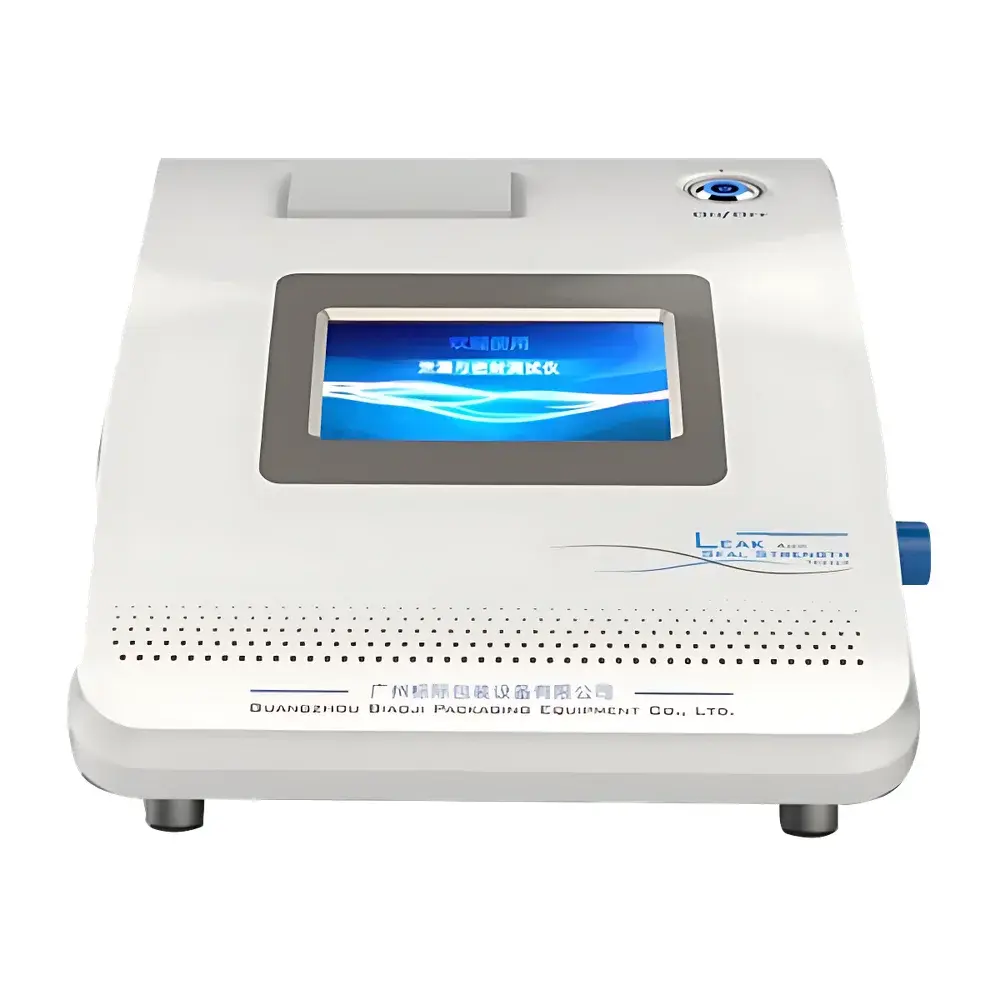
GBPI GB-DK Headspace Oxygen Analyzer with CO₂ Option
| Brand | GBPI |
|---|---|
| Model | GB-DK |
| Measurement Principle | Fluorescence-based Optical O₂ Detection & NDIR CO₂ Detection |
| Measuring Gases | O₂ (standard), CO₂ (optional) |
| O₂ Range | 0–25% vol |
| CO₂ Range | 0–100% vol |
| O₂ Accuracy | ±0.2% vol |
| CO₂ Accuracy | ±2% vol |
| Minimum Sample Volume | ≥3 mL (at 101.3 kPa) |
| Sampling Method | Vacuum-assisted needle puncture |
| Dimensions | 350 × 330 × 200 mm (L×W×H) |
| Weight | 5 kg |
| Power Supply | 220 VAC ±10%, 50 Hz / 120 VAC ±10%, 60 Hz |
| Compliance | Designed per Annex 11 (EU GMP), FDA 21 CFR Part 11, and ISO 11607-2 requirements for packaging integrity validation |
Overview
The GBPI GB-DK Headspace Oxygen Analyzer is a compact, CE-marked benchtop instrument engineered for precise, non-destructive (via controlled puncture) quantification of residual oxygen (O₂) and optional carbon dioxide (CO₂) concentrations in the headspace of sealed primary packaging—such as flexible pouches, rigid plastic containers, glass vials, aluminum blisters, and pre-filled syringes. It operates on two complementary physical principles: fluorescence quenching for O₂ measurement (ISO 8536-6 compliant methodology) and non-dispersive infrared (NDIR) absorption for CO₂ detection. Unlike electrochemical sensors, the optical O₂ sensor exhibits no oxygen consumption during measurement, ensuring long-term stability, zero drift over extended operation, and immunity to background gas interference (e.g., N₂, Ar, or CO₂). The system is purpose-built for quality assurance in modified atmosphere packaging (MAP), pharmaceutical container-closure integrity testing (CCIT), lyophilized product shelf-life prediction, and regulatory compliance workflows under GMP, USP , and ISO 11607-2.
Key Features
- Optical fluorescence O₂ sensor with ±0.2% vol accuracy and >24-month calibration stability—no sensor replacement required within typical QC lab service intervals.
- NDIR-based CO₂ module (optional) delivering ±2% vol accuracy across 0–100% range; factory-calibrated against certified reference gases traceable to NIST standards.
- Vacuum-assisted sampling architecture ensures consistent draw volume (≥3 mL at standard pressure) and eliminates cross-contamination between samples.
- Integrated ARM-based embedded control system with 7-inch capacitive touchscreen interface—no external PC required for routine operation.
- Comprehensive user access control: configurable roles (Administrator, Operator, Reviewer, Auditor) with password-protected privilege escalation and session timeout enforcement.
- Full audit trail functionality compliant with 21 CFR Part 11 and EU Annex 11: all method edits, result modifications, user logins, and instrument events are timestamped, immutable, and exportable in CSV or PDF.
- Onboard thermal printer supports real-time report generation with customizable templates—including batch ID, sample ID, operator signature field, and GLP-compliant metadata.
Sample Compatibility & Compliance
The GB-DK accommodates a broad spectrum of primary packaging formats without modification: flexible laminated pouches (e.g., retort, vacuum-sealed food), rigid HDPE/PP bottles, Type I borosilicate glass vials (2–50 mL), aluminum collapsible tubes, and polymer-based pre-filled syringe barrels. Its puncture probe design meets ISO 8536-6 mechanical safety requirements for medical packaging testing. All firmware and software modules are validated per ICH Q9/Q10 principles and support full lifecycle documentation for FDA pre-approval inspections and EMA GMP audits. Instrument qualification packages (IQ/OQ/PQ protocols) are provided upon request, aligned with ASTM F2338-22 (for CCIT) and USP guidance.
Software & Data Management
The embedded operating system supports method-driven workflows with up to 99 programmable test profiles—each defining gas type(s), sampling duration, alarm thresholds, and reporting fields. Data is stored locally in encrypted SQLite databases with automatic daily backup to USB drives. Optional Ethernet/Wi-Fi connectivity enables seamless integration into laboratory information management systems (LIMS) or enterprise MES platforms via HL7 or RESTful API. Electronic signatures are implemented per ALCOA+ principles: each result requires dual authorization (operator + reviewer) for release. Raw sensor voltage outputs, time-stamped concentration curves, and environmental logs (ambient T/P) are retained for root-cause analysis and trending.
Applications
- Residual O₂ verification in MAP-packed fresh produce, cooked meats, and dairy products to validate barrier performance and predict microbial shelf life.
- Head-space O₂ monitoring in lyophilized biologics and sterile injectables (e.g., monoclonal antibodies, vaccines) to assess stopper integrity and oxidation risk.
- CO₂ quantification in carbonated beverage containers and fermented food packaging to confirm fill consistency and seal efficacy.
- QC release testing for pharmaceutical blister packs per USP and ISO 15378:2017 requirements.
- Stability study support: longitudinal headspace tracking across accelerated and real-time storage conditions.
- Root-cause investigation of package failure modes—correlating O₂ ingress rates with seal defects identified via dye penetration or vacuum decay tests.
FAQ
Does the GB-DK require daily calibration?
No. The optical O₂ sensor is factory-calibrated and maintains accuracy for ≥12 months under normal use; annual verification using certified 0.5% and 21% O₂ reference gases is recommended.
Can it analyze headspace from rigid containers like glass vials without leakage?
Yes. The puncture needle features a self-sealing silicone gasket and adjustable depth stop, minimizing post-test leakage and preserving sample integrity for subsequent testing.
Is CO₂ measurement mandatory, or can the unit operate with O₂ only?
O₂ is standard; CO₂ is fully optional and installed as a field-upgradable module—no hardware retrofitting required.
How does the system comply with 21 CFR Part 11?
It implements electronic signatures, role-based access, audit trails with tamper-proof hashing, and secure data export—all validated during installation qualification (IQ) and operational qualification (OQ).
What is the minimum headspace volume required for reliable measurement?
As low as 3 mL at ambient pressure; for sub-3 mL cavities (e.g., small-diameter syringes), optional micro-sampling adapters are available.






