
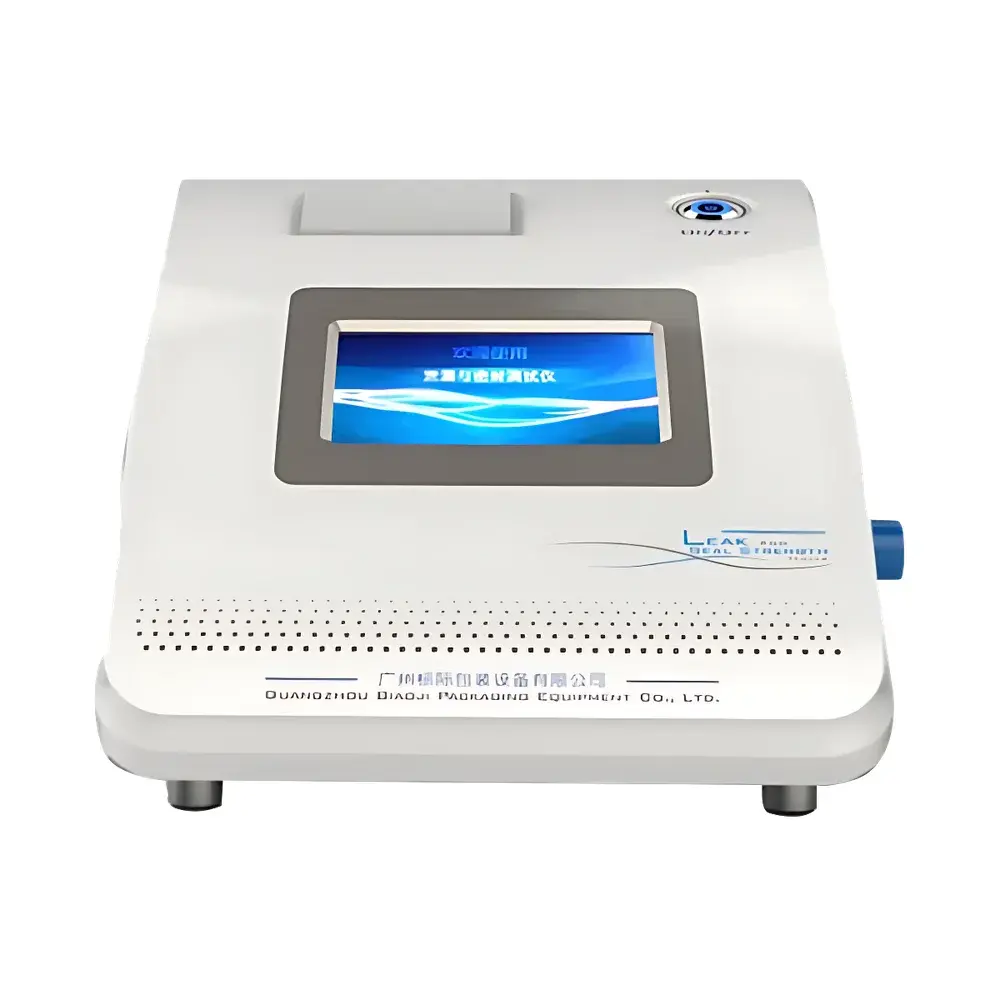
GBPI GB-DK1E Headspace Oxygen Analyzer for Vials and Pharmaceutical Packaging
| Brand | GBPI |
|---|---|
| Model | GB-DK1E |
| Measurement Principle | Fluorescence-based Optical O₂ Detection & NDIR CO₂ Detection (optional) |
| Gas Range | O₂ 0–25% (±0.2% accuracy), CO₂ 0–100% (±2% accuracy) |
| Sampling Volume | ≥5 mL (O₂), ≥20 mL (CO₂) |
| Dimensions | 350 × 330 × 200 mm |
| Weight | 5 kg |
| Power | 220 VAC ±10%, 50 Hz / 120 VAC ±10%, 60 Hz |
| Compliance | Designed per GMP Annex 11 & FDA 21 CFR Part 11 requirements for computerized systems |
| Operating Environment | Lab, QC, warehouse, or inline packaging environments |
Overview
The GBPI GB-DK1E Headspace Oxygen Analyzer is a dedicated analytical instrument engineered for precise, non-destructive (via controlled puncture) quantification of residual oxygen (O₂) in the headspace of sealed pharmaceutical primary packaging—particularly Type I glass vials (e.g., serum vials, lyophilized drug vials, and pre-filled syringe cartridges) and other rigid or semi-rigid containers used in sterile drug manufacturing. Unlike ambient air measurement devices, this analyzer employs fluorescence quenching technology for O₂ detection—a method recognized for its high selectivity, long-term stability, and immunity to interference from water vapor, CO₂, or common excipients. When configured with the optional NDIR (non-dispersive infrared) CO₂ sensor, it enables dual-gas analysis critical for modified atmosphere packaging (MAP) validation and inert gas purge efficacy assessment. The instrument operates on a vacuum-assisted sampling principle: a sterile stainless-steel needle penetrates the elastomeric stopper under controlled pressure differential, drawing headspace gas into the optical sensing chamber. Real-time analog signals from the sensors are digitized and processed via an embedded ARM-based control system, delivering traceable, repeatable O₂ concentration values in %v/v with sub-0.2% absolute accuracy—meeting the stringent sensitivity requirements of USP , ISO 11607-2, and ICH Q5C stability protocols.
Key Features
- Fluorescence-based optical O₂ sensor with zero cross-sensitivity to CO₂, humidity, or nitrogen—ensuring metrological integrity across diverse formulation matrices.
- Optional integrated NDIR CO₂ module enabling simultaneous dual-gas headspace analysis for MAP process qualification and lyophilization cycle validation.
- ARM-powered embedded operating system with 7-inch capacitive touchscreen interface—eliminating external PCs and reducing validation scope for GxP environments.
- Role-based user management (Administrator, Operator, Reviewer, Auditor) aligned with FDA 21 CFR Part 11 and EU Annex 11 requirements for electronic records and signatures.
- Full audit trail functionality: timestamped logging of all system events, method changes, calibration actions, test executions, and user logins—exportable in CSV or PDF format.
- Configurable reporting engine supporting customizable templates, automatic PDF generation, and direct thermal printing via integrated mini-printer.
- Robust mechanical design featuring needle guard sleeves, pressure-relief valves, and auto-shutdown on sensor over-range—protecting sensor longevity and operator safety during high-throughput QC workflows.
Sample Compatibility & Compliance
The GB-DK1E is validated for use with standard 2R–30R West or Daikyo rubber-stoppered vials (including crimp-sealed and flip-off types), as well as aluminum-sealed blister cavities, ampoules, and flexible pouches requiring puncture-compatible sampling. It complies with ISO/IEC 17025 principles for testing laboratory competence and supports IQ/OQ/PQ documentation packages for regulated pharmaceutical facilities. Its firmware architecture satisfies ALCOA+ data integrity criteria (Attributable, Legible, Contemporaneous, Original, Accurate, Complete, Consistent, Enduring, Available) and facilitates integration into LIMS or MES platforms via RS-232, USB, or optional Ethernet modules. All calibration procedures follow traceable NIST-certified gas standards, and sensor drift is monitored via automated zero/span verification routines prior to each test sequence.
Software & Data Management
The onboard software is developed in accordance with Annex 11’s “Computerized Systems” guidance, incorporating electronic signature enforcement, password complexity policies, session timeout controls, and immutable data storage. Each test record contains metadata including sample ID, operator ID, environmental temperature/pressure, sensor response curves, raw voltage outputs, and calculated O₂ concentration with uncertainty estimation. Data export options include encrypted PDF reports with digital signatures, CSV files compatible with statistical process control (SPC) tools, and structured XML for ingestion into enterprise quality systems. Audit logs retain full history for ≥10 years without manual intervention—supporting regulatory inspections under FDA, EMA, PMDA, and NMPA frameworks.
Applications
- Residual oxygen verification in lyophilized biologics vials post-capping and post-annealing.
- Validation of nitrogen or argon purge efficiency during vial filling and stoppering operations.
- Stability study support: correlation of headspace O₂ levels with oxidation-sensitive API degradation kinetics.
- Comparative evaluation of stopper composition (bromobutyl vs. chlorobutyl) and capping torque effects on seal integrity.
- Release testing for sterile injectables packaged under inert atmospheres per USP and Ph. Eur. 3.2.1.
- Root cause analysis of container closure integrity failures using O₂ ingress rate modeling.
FAQ
Does the GB-DK1E require daily calibration?
No—sensor stability allows calibration at defined intervals (e.g., per shift or per 24 hours), verified via built-in zero/span checks using certified reference gases.
Can it analyze headspace from frozen vials?
Yes, provided samples are equilibrated to room temperature before puncture to avoid condensation-induced sensor interference.
Is the needle penetration depth adjustable?
Yes—the pneumatic actuator supports programmable insertion force and dwell time to accommodate varying stopper hardness and thickness specifications.
What is the minimum required headspace volume for accurate O₂ reading?
As low as 0.5 mL, though ≥2 mL is recommended for statistical confidence; the instrument compensates for dead volume via internal algorithmic correction.
Does GBPI provide 21 CFR Part 11 compliance documentation?
Yes—validated installation qualification (IQ), operational qualification (OQ), and vendor-supplied risk assessment reports are included with the system.





