
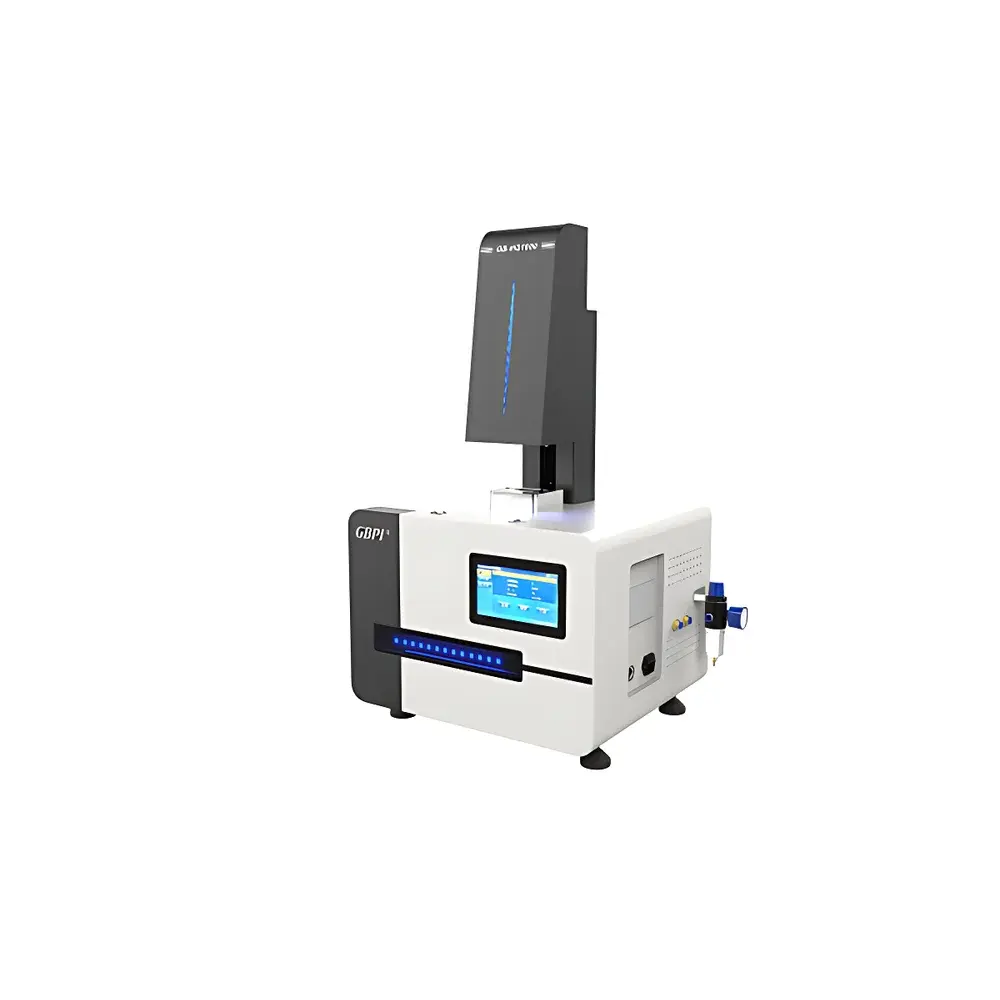
GBPI GB-HQ1000 Medical Face Mask Exhalation Valve Integrity Tester
| Brand | GBPI |
|---|---|
| Origin | Guangdong, China |
| Manufacturer Type | Direct Manufacturer |
| Regional Classification | Domestic (China) |
| Model | GB-HQ1000 |
| Instrument Category | Resistance-Based Particle Counter |
| Power Supply | 220 V, 50 Hz |
| Display | Integrated HD Touchscreen |
| Vacuum Pump Flow Rate | 2 L/min |
| Buffer Chamber Capacity | 5 L |
| Pressure Sensor Range | −1000 Pa to 0 Pa (Accuracy: ±1%, Resolution: 1 Pa) |
| Flow Meter Range | 0–100 mL/min (Accuracy: ±1%, Resolution: 0.1 mL/min) |
| Compliance Standard | GB 2626–2019 |
Overview
The GBPI GB-HQ1000 Medical Face Mask Exhalation Valve Integrity Tester is a purpose-built physical property testing instrument engineered for quantitative evaluation of exhalation valve sealing performance in disposable and reusable respirators and medical face masks. It operates on the principle of controlled negative-pressure differential testing: a calibrated vacuum is applied across the valve assembly while measuring real-time leakage flow rate and pressure decay characteristics. This method directly assesses functional integrity under simulated breathing conditions—specifically mimicking exhalation phase dynamics where valve opening, seating, and resealing behavior determine user protection efficacy. Unlike generic particle counters or filtration testers, the GB-HQ1000 isolates valve-specific leakage pathways independent of filter media performance, enabling compliance verification per GB 2626–2019 Clause 6.3.2 (Exhalation Valve Air Tightness). Its architecture integrates pneumatic control, high-stability vacuum generation, and trace-level flow metrology into a single benchtop platform designed for routine QC laboratories in medical device manufacturing, regulatory testing centers, and ISO 17025-accredited facilities.
Key Features
- Integrated high-precision differential pressure sensor (−1000 Pa to 0 Pa, ±1% full-scale accuracy, 1 Pa resolution) for real-time monitoring of valve seat pressure drop during vacuum hold phases.
- Dual-mode flow measurement system with 0–100 mL/min range, ±1% accuracy and 0.1 mL/min digital resolution, enabling detection of sub-1 mL/min leakage critical to valve resealing validation.
- Stable vacuum generation via built-in oil-free diaphragm pump delivering consistent 2 L/min evacuation rate, paired with a 5 L buffer chamber to minimize pressure transients and ensure test repeatability.
- Dedicated specimen holder with ergonomic clamping mechanism, accommodating flat and contoured mask geometries while maintaining uniform sealing interface around the valve perimeter.
- Onboard 7-inch HD capacitive touchscreen interface supporting guided test protocols, parameter configuration, live data visualization (pressure vs. time, flow vs. time), and pass/fail auto-judgment per GB 2626–2019 thresholds.
- Embedded thermal line printer for immediate hardcopy output of test reports including date/time stamp, operator ID, sample ID, measured leakage volume, pressure stability duration, and compliance status.
Sample Compatibility & Compliance
The GB-HQ1000 accommodates all commercially available medical and industrial respirators equipped with mechanical exhalation valves—including N95, KN95, FFP2, surgical masks with one-way valves, and reusable elastomeric half-masks. Test fixtures support both circular and oval valve configurations up to Ø65 mm. The system is fully aligned with the mandatory requirements of GB 2626–2019 “Respiratory Protective Devices – Non-powered Air-purifying Particulate Respirators”, specifically Section 6.3.2 for exhalation valve air tightness: maximum allowable leakage must not exceed 30 mL/min at −250 Pa test pressure after 10 s stabilization. While GB 2626–2019 is the primary referenced standard, the instrument’s metrological traceability (via CNAS-accredited internal calibration procedures), documented uncertainty budgets, and audit-ready data logs support alignment with broader quality frameworks including ISO 13485, FDA 21 CFR Part 820, and GLP-compliant validation protocols.
Software & Data Management
Firmware v3.2 includes embedded test sequence logic compliant with GB 2626–2019 test cycles: automatic pressure ramping to target vacuum level (e.g., −250 Pa), 10-second stabilization window, followed by 60-second leakage quantification period. All raw sensor data (pressure, flow, timestamp) are stored locally in CSV format with ISO 8601 timestamps. Optional USB export enables integration into LIMS or ELN systems. Audit trail functionality records user login/logout events, parameter changes, and report generation actions—supporting 21 CFR Part 11 readiness when deployed with external identity management. Firmware updates are delivered via encrypted USB key; no cloud connectivity or remote access capabilities are implemented, preserving data sovereignty and network security in regulated environments.
Applications
- Final product release testing of valve-equipped respirators prior to sterilization and packaging.
- Design verification and iterative valve material selection (e.g., silicone vs. thermoplastic elastomer seat hardness impact on resealing hysteresis).
- Supplier qualification audits for exhalation valve component manufacturers.
- Root cause analysis of field failures related to valve adhesion, particulate ingress-induced jamming, or temperature-dependent seal relaxation.
- Supporting technical documentation for CE marking (under Regulation (EU) 2016/425 PPE) and NMPA registration dossiers in China.
FAQ
What standards does the GB-HQ1000 explicitly support?
It is configured and validated for GB 2626–2019 exhalation valve air tightness testing. Its measurement uncertainty profile also permits adaptation to ASTM F2299 (for qualitative valve leak screening) and ISO 16900-3 Annex C (respirator valve leakage assessment) with minor protocol adjustments.
Is calibration traceable to national standards?
Yes—GBPI’s internal calibration laboratory is accredited under CNAS (No. CNAS L8202), and pressure/flow sensors are calibrated annually against NIM-traceable reference standards. Calibration certificates include expanded uncertainty (k=2) statements.
Can the instrument test valves on reusable elastomeric respirators?
Yes, provided the valve housing geometry fits within the clamping range and the mask body allows stable mounting without deformation-induced false leakage. Fixture adapters for common 3M, Honeywell, and MSA valve footprints are available as optional accessories.
Does the system meet cybersecurity requirements for regulated labs?
The GB-HQ1000 operates as an air-gapped embedded system with no wireless interfaces, no internet connectivity, and no remote administration ports—fully satisfying IEC 62443-3-3 SL1 and FDA Cybersecurity Guidance for non-networked medical device testers.



