
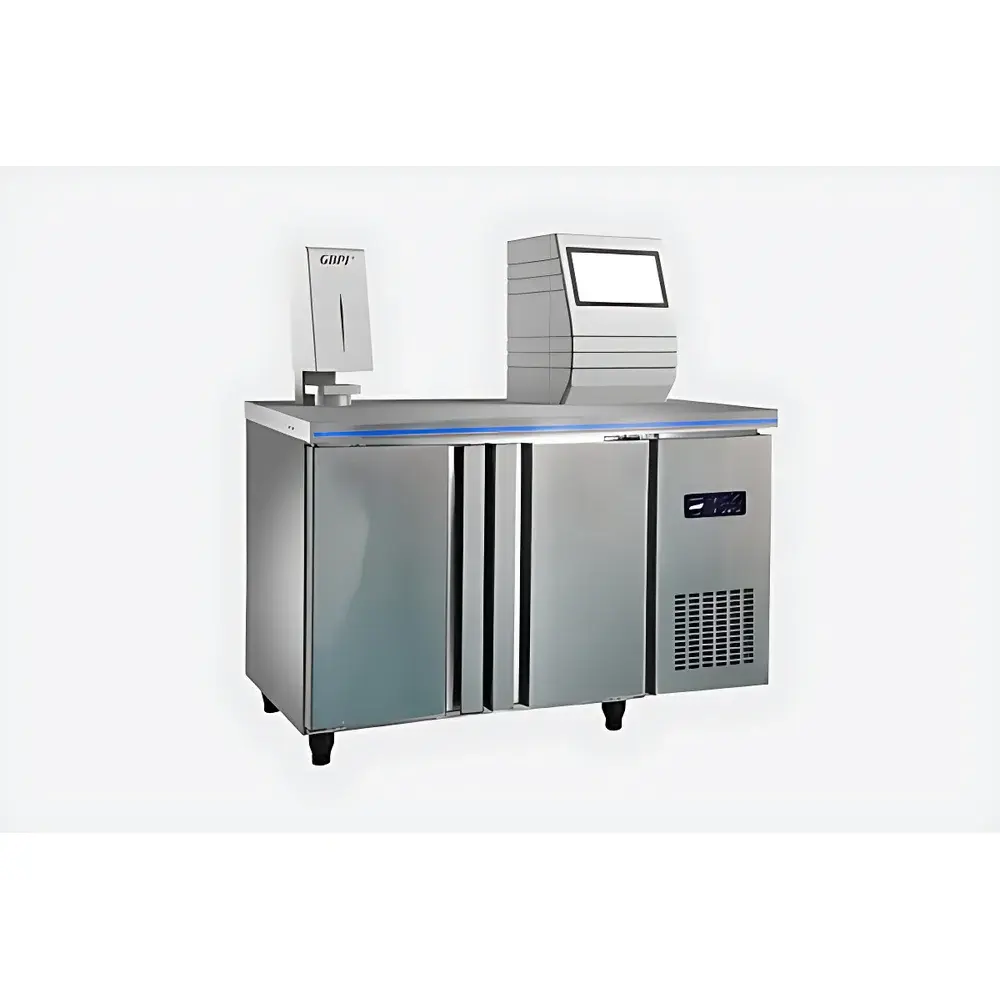
GBPI GB-KF30010AD Particle Filtration Efficiency Tester for Meltblown Nonwovens
| Brand | GBPI |
|---|---|
| Origin | Guangdong, China |
| Manufacturer | GBPI Packaging Instruments Co., Ltd. |
| Model | GB-KF30010AD |
| Compliance Standards | GB/T 32610–2016, GB 2626–2006, GB 19082–2009, GB 19083–2010, GB 24539–2009, YY 0469–2011, YY/T 0969–2013, EN 1822–3:1998 (principle), ASTM F2299/F2101 (referenced methodology) |
| Filtration Efficiency Range | 0–99.999% |
| Flow Rate Control | 20–100 L/min (±1.5% FS) |
| Pressure Drop Measurement Range | 0–1000 Pa (±1.0% FS) |
| Test Aerosol Size Channels | 0.3 µm, 0.5 µm, 5.0 µm |
| Aerosol Sources | DEHS (dioctyl sebacate) and 2% NaCl solution |
| Test Area | 100 cm² (standard, configurable per mask geometry) |
| Power Supply | AC 220 V, 50 Hz |
| Max Power Consumption | <1500 W |
| Dimensions (W×D×H) | 130 × 75 × 157 cm |
| Weight | 250 kg |
Overview
The GBPI GB-KF30010AD Particle Filtration Efficiency Tester is a precision-engineered instrument designed for quantitative evaluation of particulate filtration performance in meltblown nonwoven fabrics—particularly those used in surgical masks, N95/N99 respirators, and medical protective textiles. It operates on the principle of aerosol challenge testing under controlled, constant-flow conditions, measuring both upstream and downstream particle concentrations via laser-based optical particle counting. The system implements dual-aerosol capability (oil-based DEHS and salt-based NaCl), enabling compliance with both oil-mist resistance (e.g., GB 2626–2006) and sodium chloride penetration (e.g., YY 0469–2011) test protocols. Its architecture integrates ISO/IEC 17025-aligned measurement traceability, with flow calibration traceable to national standards, pressure transducers certified to Class 0.5 accuracy, and particle counters validated per ISO 21501–4. Designed for regulatory-grade testing environments, the GB-KF30010AD meets the physical and metrological requirements of national standard laboratories, medical device QA/QC departments, and textile certification bodies.
Key Features
- Cold-generation aerosol generator supporting both DEHS (for oil aerosol tests) and 2% NaCl solution (for salt aerosol tests), with integrated solution reservoir and programmable output stability (±3% CV over 30 min)
- Electrostatic neutralizer (bipolar corona discharge type) upstream of the test chamber to ensure particles are in Boltzmann equilibrium prior to filtration assessment
- Hermetically sealed aerosol pathway with double O-ring flange joints and negative-pressure containment—validated for zero detectable leakage (<1×10⁻⁶ mbar·L/s He leak rate) during operation
- Pneumatic clamping system with force-limited actuation (max 150 N) and mechanical safety interlock preventing test initiation unless sample is fully seated and sealed
- Dual-channel real-time particle counting using calibrated laser particle counters (0.3–10 µm detection range, 0.1 fL sample volume per pulse, 95% counting efficiency at 0.3 µm)
- Integrated differential pressure transducer (0–1000 Pa, ±0.5% full scale) with temperature compensation and digital linearization
- Touchscreen HMI (10.1″ capacitive, IP65-rated) paired with dedicated Windows-based control software featuring audit trail, user role management, and electronic signature support
- Automated calculation engine compliant with ISO 16890 Annex C and ASTM F2299–17 methodologies for filtration efficiency (η = [1 − Cdown/Cup] × 100%) and pressure drop reporting
Sample Compatibility & Compliance
The GB-KF30010AD accommodates flat-sheet filter media—including glass fiber, polypropylene (PP) meltblown webs, and laminated or coated variants (e.g., electret-charged PP, PTFE-coated substrates)—within a standardized 100 cm² test area. Custom fixtures allow adaptation to irregular mask geometries while maintaining uniform flow distribution across the active surface. All mechanical and electrical components conform to IEC 61010–1 (Safety Requirements for Electrical Equipment for Measurement, Control, and Laboratory Use). The system supports full GLP/GMP documentation workflows, including 21 CFR Part 11–compliant data integrity features: time-stamped raw data logs, operator authentication, change history tracking, and immutable PDF report generation. Test procedures align with GB/T 32610–2016 (daily-use masks), GB 2626–2006 (respiratory protection), YY 0469–2011 (surgical masks), and reference international methods including EN 1822–3:1998 (single-filter testing) and ASTM F2101 (bacterial filtration efficiency).
Software & Data Management
The proprietary GBPI FilterTest Suite v4.2 runs on an embedded industrial PC (Intel Core i5, 8 GB RAM, SSD storage) and provides end-to-end test lifecycle control—from method selection and parameter configuration to real-time curve visualization and statistical summary. Raw sensor data (flow, pressure, particle counts per channel) is acquired at 10 Hz and stored in encrypted SQLite databases with SHA-256 hashing. Each test record includes metadata such as operator ID, calibration certificate IDs, environmental conditions (temperature/humidity logged via integrated sensors), and instrument firmware version. Export options include CSV (for LIMS integration), XML (for ELN systems), and PDF/A-1b (archival format with embedded digital signatures). Audit trails meet ISO/IEC 17025:2017 clause 7.10.2.3 requirements for result verification and traceability.
Applications
- Quantitative validation of filtration efficiency (FE) and pressure drop (ΔP) for meltblown nonwovens during R&D and process optimization
- Batch release testing of medical face masks per YY 0469–2011 and GB 19083–2010
- Respirator certification against GB 2626–2006 classification thresholds (KN90/KN95/KN100)
- Comparative analysis of electret decay under humidity aging or thermal stress protocols
- Filter media qualification for cleanroom garments, isolation gowns, and surgical drapes per GB 24539–2009
- Third-party conformity assessment by CNAS-accredited testing laboratories
FAQ
Does the GB-KF30010AD support automated calibration verification?
Yes—the system includes built-in verification routines for flow meters and pressure transducers using NIST-traceable reference instruments; calibration status is displayed on the HMI and logged automatically.
Can test reports be generated in English for export-oriented clients?
Yes—software language is switchable between Chinese and English; all report templates, annotations, and metadata fields are fully localized.
Is the aerosol generator compatible with alternative test agents such as paraffin oil or latex spheres?
No—the generator is validated exclusively for DEHS and aqueous NaCl; substitution requires re-validation per ISO/IEC 17025 and is not supported out-of-the-box.
What maintenance intervals are recommended for the particle counter optics?
Optical windows require cleaning every 200 test cycles or quarterly (whichever occurs first); GBPI supplies certified cleaning kits and SOPs aligned with ISO 21501–4 Annex B.
How is data integrity ensured during power interruption?
The system employs UPS-backed write-caching and journaling file system (ext4 with journal checksums), guaranteeing no data loss or corruption during unexpected shutdowns.






