
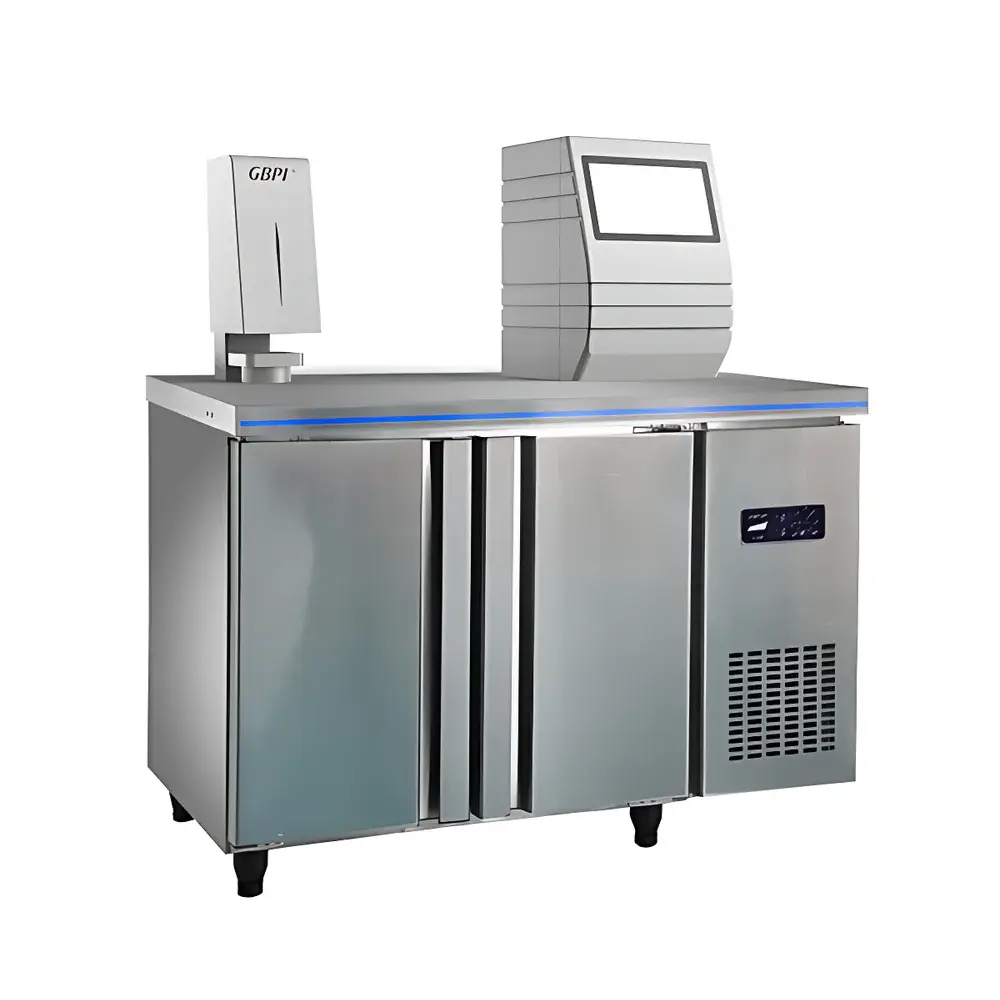
GBPI GB-KF30010AG Particle Filtration Efficiency Tester for Meltblown Nonwovens
| Brand | GBPI |
|---|---|
| Origin | Guangdong, China |
| Manufacturer Type | Direct Manufacturer |
| Country of Origin | China |
| Model | GB-KF30010AG |
| Price Range | USD 42,000 – 70,000 |
| Filtration Efficiency Range | 0–99.999% |
| Flow Rate Control Range | 20–100 L/min |
| Pressure Drop Measurement Range | 0–1000 Pa |
| Test Aerosol Particle Sizes | 0.3 µm, 0.5 µm, 5.0 µm |
| Aerosol Sources | DEHS (oil-based) and 2% NaCl (salt-based) |
| Standard Test Area | 100 cm² (customizable per mask geometry) |
| Dimensions | 130 × 75 × 157 cm |
| Weight | 250 kg |
| Power Consumption | <1500 W |
| Power Supply | AC 220 V, 50 Hz |
Overview
The GBPI GB-KF30010AG Particle Filtration Efficiency Tester is a precision-engineered instrument designed specifically for quantitative evaluation of particulate filtration performance in meltblown nonwoven materials—particularly those used in surgical masks, N95/N99 respirators, and medical protective textiles. It operates on the principle of controlled aerosol challenge coupled with real-time particle counting upstream and downstream of the test specimen, enabling calculation of filtration efficiency (%) via the standard ratio: E = (1 − Cdown/Cup) × 100. The system conforms to core regulatory measurement paradigms defined in YY 0469–2011 (Surgical Masks), GB 2626–2006 (Respiratory Protective Devices), and GB/T 32610–2016 (Daily-Use Protective Masks), while incorporating methodological rigor aligned with EN 1822–3:1998 (High-Efficiency Air Filters – Part 3: Determination of Local Filtration Efficiency of Filter Media). Its architecture supports both salt-based (NaCl) and oil-based (DEHS) aerosols—critical for distinguishing between mechanical and electrostatic capture mechanisms in electret-filter media.
Key Features
- Cold-generation aerosol generator capable of stable, reproducible output of both NaCl (2% aqueous solution) and DEHS particles—enabling dual-mode filtration assessment per ISO 16890 and ASTM F2299 protocols.
- Integrated bipolar ionizer for neutralizing electrostatic charge on aerosol particles prior to challenge—ensuring measurement reflects intrinsic filter media performance rather than charge-enhanced capture.
- Hermetically sealed aerosol pathway with leak-tight gasketed chamber design, meeting ISO 14644–1 Class 5 cleanroom integrity requirements to safeguard operator safety during high-concentration challenges.
- Pneumatic clamping system with force-limiting actuation and mechanical interlock—preventing accidental exposure during specimen loading/unloading and ensuring uniform compression across the 100 cm² test area.
- Dual-channel laser particle counter (0.3–5.0 µm detection range) with NIST-traceable calibration, providing simultaneous upstream/downstream concentration measurement at flow rates from 20 to 100 L/min.
- Automated pressure drop monitoring via calibrated differential pressure transducer (0–1000 Pa full scale), supporting resistance-to-airflow characterization in accordance with GB 19083–2010 and EN 149:2001+A1:2009.
- Embedded industrial PC with touchscreen HMI and dedicated test software featuring automated sequence control, real-time data visualization, and audit-ready electronic records.
Sample Compatibility & Compliance
The GB-KF30010AG accommodates flat-sheet specimens—including glass fiber filters, polypropylene (PP) meltblown webs, and laminated or coated nonwovens—as well as finished face masks mounted in standardized fixtures. It supports testing of single-layer and multi-layer structures under constant-flow conditions, with adjustable clamp geometry to match common mask dimensions (e.g., 175 × 95 mm). All operational parameters and reporting outputs comply with mandatory Chinese national standards: GB/T 32610–2016 (daily-use masks), GB 2626–2006 (industrial respirators), GB 19082–2009 (medical gowns), GB 19083–2010 (medical protective masks), and YY 0469–2011 (surgical masks). The system’s data acquisition architecture satisfies GLP-compliant record retention requirements, including time-stamped raw counts, calculated efficiencies, pressure differentials, and environmental metadata (temperature, RH).
Software & Data Management
The embedded test software provides full lifecycle data handling—from method definition and parameter validation through execution, post-processing, and export. Each test run generates a structured XML log containing instrument configuration, calibration status, aerosol generation settings, particle count timestamps, and statistical summaries (mean, SD, CV%). Export options include CSV (for LIMS integration), PDF reports (with digital signature support), and Excel-compatible datasets. Audit trail functionality logs all user actions—including login/logout events, parameter modifications, and report generation—with immutable timestamps. Software architecture adheres to principles compatible with FDA 21 CFR Part 11 compliance when deployed in regulated environments, provided network authentication and electronic signature policies are implemented at the institutional level.
Applications
- Quality control of meltblown PP web production lines—monitoring batch-to-batch consistency in filtration efficiency at 0.3 µm (most penetrating particle size).
- Development and validation of electret-charged nonwovens—quantifying decay of electrostatic contribution after isopropanol treatment or humidity aging per ASTM F2101.
- Regulatory submission testing for NMPA (China), CE marking (EU), and FDA 510(k) pathways—generating evidence compliant with ISO 13485 quality management systems.
- Comparative analysis of filtration media alternatives—e.g., nanofiber-coated substrates vs. conventional meltblown, or biodegradable polymer variants.
- Training and proficiency testing in national metrology institutes, CDC laboratories, and third-party textile certification bodies (e.g., SGS, BV, CTI).
FAQ
Does the system support both NaCl and DEHS aerosols without hardware modification?
Yes—the aerosol generator includes interchangeable nebulizer modules and solvent-resistant fluid paths, allowing rapid switching between salt and oil aerosols with validated repeatability (CV < 3% across 10 consecutive runs).
Can test results be exported directly into a LIMS environment?
Yes—CSV and XML exports contain all required metadata fields (sample ID, operator, timestamp, instrument ID, calibration due date) and conform to ASTM E1467–05 data exchange conventions.
Is the 0.3 µm channel traceable to NIST SRM 1963?
The integrated laser particle counter is factory-calibrated using PSL spheres certified to NIST SRM 1963; certificate of calibration is supplied with each unit and valid for 12 months.
What maintenance intervals are recommended for the vacuum pump and aerosol generator?
Vacuum pump oil should be replaced every 500 operating hours; aerosol generator nebulizers require ultrasonic cleaning after every 200 test cycles or upon visible residue accumulation.
Does the system meet electromagnetic compatibility (EMC) requirements for laboratory use in China?
Yes—it complies with GB/T 18268.1–2010 (IEC 61326–1:2012), including radiated emissions ≤30 dBµV/m at 3 m and immunity to 3 V/m RF fields (80 MHz–2.7 GHz).




