
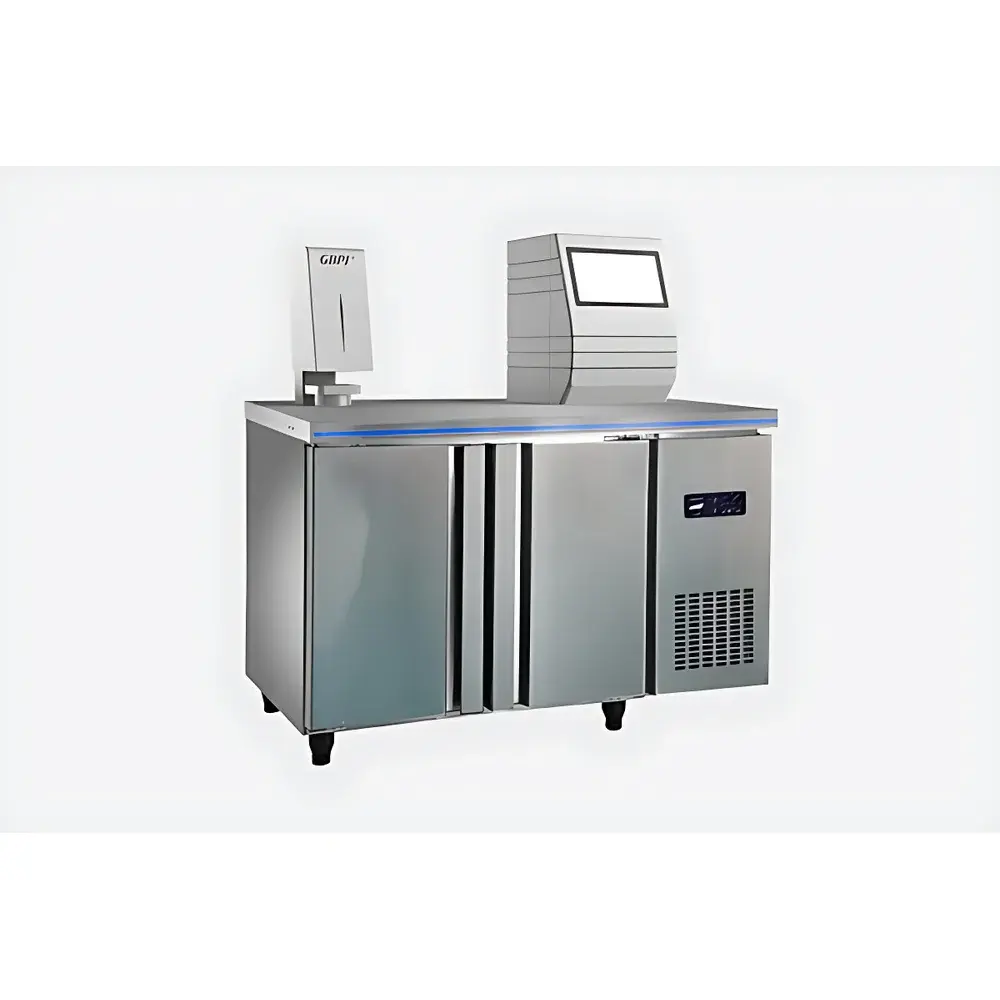
GBPI GB-KF30010AR Aerosol Filtration Efficiency Tester for Meltblown Nonwovens
| Brand | GBPI |
|---|---|
| Model | GB-KF30010AR |
| Origin | Guangdong, China |
| Manufacturer Type | Direct Manufacturer |
| Regional Classification | Domestic (China) |
| Price Range | USD 42,000 – 70,000 |
| Filtration Efficiency Range | 0–99.999% |
| Flow Rate Control Range | 20–100 L/min |
| Pressure Drop Measurement Range | 0–1000 Pa |
| Test Particle Sizes | 0.3 µm, 0.5 µm, 5.0 µm |
| Aerosol Sources | DEHS (oil-based) and 2% NaCl (salt-based) |
| Standard Test Area | 100 cm² (customizable per mask geometry) |
| Dimensions | 130 × 75 × 157 cm |
| Weight | 250 kg |
| Power Consumption | <1500 W |
| Power Supply | AC 220 V, 50 Hz |
Overview
The GBPI GB-KF30010AR Aerosol Filtration Efficiency Tester is an engineered solution for quantitative assessment of particulate filtration performance in meltblown nonwoven media—particularly those used in surgical masks, N95/N99 respirators, and medical protective textiles. It operates on the principle of aerosol challenge testing under controlled, constant-flow conditions, measuring both upstream and downstream particle number concentrations via laser particle counting to calculate filtration efficiency (FE) as a function of particle size. The system adheres to the core physical measurement paradigm defined in ISO 16890, EN 1822-3:1998 (for single-layer filter media), and ASTM F2299/F2101, while maintaining full compliance with Chinese national standards including GB/T 32610–2016, GB 2626–2006, GB 19083–2010, YY 0469–2011, and YY/T 0969–2013. Its dual-aerosol capability (DEHS for oil-based challenge and NaCl for salt-based challenge) enables evaluation across both hydrophobic and hydrophilic filtration mechanisms, supporting regulatory validation for Class I/II/III medical devices and PPE certification pathways.
Key Features
- Cold-generation aerosol system delivering stable, monodisperse or polydisperse challenges using either DEHS or 2% NaCl solution—enabling repeatable, traceable particle generation without thermal degradation.
- Integrated electrostatic neutralizer (Bipolar ionizer) upstream of the test chamber to condition aerosols to Boltzmann equilibrium charge distribution, ensuring standardized particle behavior per ISO 8503-3 and EN 1822 requirements.
- Hermetically sealed, leak-tested aerosol pathway with negative-pressure containment design—minimizing operator exposure and meeting OSHA and IEC 61010-1 safety requirements for laboratory aerosol handling.
- Pneumatic clamping fixture with mechanical interlock and force-limiting actuation—ensuring consistent sample loading pressure (±2 kPa) and eliminating manual variability during repeated tests.
- Dual-channel, real-time laser particle counter (0.3–5.0 µm detection range, ±5% counting efficiency at 0.3 µm) synchronized with mass flow controllers calibrated to ISO/IEC 17025-accredited reference standards.
- Embedded industrial PC with touch-enabled HMI interface and deterministic real-time control loop (100 ms sampling interval), supporting automated sequence execution per multi-step test protocols.
Sample Compatibility & Compliance
The GB-KF30010AR accommodates flat-sheet specimens—including glass fiber filters, polypropylene (PP) meltblown webs, and laminated or coated nonwovens—as well as finished facepiece geometries when mounted on custom fixtures. Standardized 100 cm² test area aligns with GB/T 32610 and ISO 16890; optional adapter kits support circular, rectangular, and contoured mask samples per EN 149 and ASTM F2100. All hardware and firmware comply with electromagnetic compatibility (EMC) per IEC 61326-1, electrical safety per IEC 61010-1, and software validation documentation supports FDA 21 CFR Part 11-compliant audit trails when deployed in GLP/GMP environments. Calibration certificates for flow meters, pressure transducers, and particle counters are provided with NIST-traceable references.
Software & Data Management
The proprietary GBPI FilterTest Suite v3.2 provides full lifecycle data governance: protocol definition (including dwell time, flow ramping, multi-size step sequencing), real-time visualization of differential pressure, upstream/downstream counts, and calculated FE curves, plus automated pass/fail flagging against user-defined thresholds. Raw data exports to CSV, PDF, and XML formats include metadata tags for instrument ID, operator ID, calibration expiry, environmental conditions (T/RH logged via integrated sensor), and digital signatures. Audit trail functionality records all parameter changes, test starts/stops, and report generations with timestamped, immutable entries—meeting ISO/IEC 17025 clause 7.10 and EU Annex 11 requirements for regulated laboratories.
Applications
- Validation of meltblown layer efficacy in surgical and KN95/N95 respirators per YY 0469 and GB 2626.
- Comparative analysis of electret decay under humidity/temperature stress per ISO 15797 accelerated aging protocols.
- Raw material qualification for PP resin suppliers and spunbond-meltblown-laminated (SMS) fabric producers.
- Regulatory submission support for CFDA (NMPA), CE marking (under PPE Regulation EU 2016/425), and FDA 510(k) dossiers.
- R&D screening of novel nanofiber coatings, antimicrobial treatments, and electrostatic enhancement strategies.
FAQ
What aerosol generation methods does the GB-KF30010AR support?
It utilizes cold-nebulization for both DEHS (di-ethyl-hexyl-sebacate) and aqueous NaCl solutions—eliminating thermal artifacts and enabling precise control over geometric mean diameter (GMD) and count median diameter (CMD).
Is the system compliant with international regulatory submissions?
Yes—its measurement architecture, uncertainty budgeting, and software validation framework meet technical requirements for ISO/IEC 17025 accreditation and support evidence packages for NMPA, FDA, and Notified Body reviews.
Can the tester evaluate layered composites or finished masks?
Standard configuration supports flat-sheet testing; optional mask-holding fixtures enable full-facepiece evaluation per EN 149:2001+A1:2009 Annex B and ASTM F2299 annexes.
What maintenance intervals are recommended for critical subsystems?
Aerosol generator nozzles require ultrasonic cleaning every 50 hours; particle counter zero-check and flow meter recalibration are advised quarterly; full system performance verification is required annually per ISO/IEC 17025 clause 6.5.
Related Products





