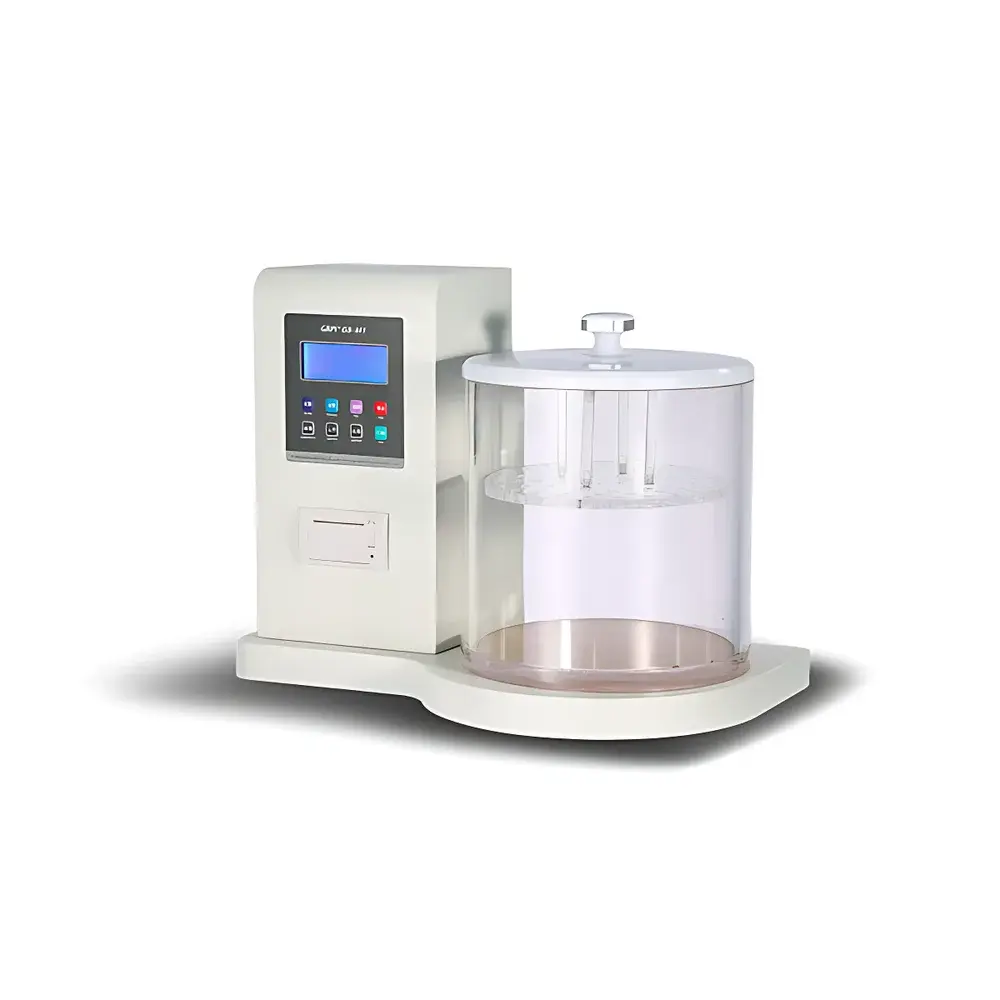
GBPI GB-M1A Seal Integrity Tester for Flexible Packaging
| Brand | GBPI |
|---|---|
| Model | GB-M1A |
| Origin | Guangdong, China |
| Manufacturer Type | Direct Manufacturer |
| Country of Origin | China |
| Price Range | USD 1,400 – 4,200 (FOB) |
| Vacuum Range | 0 to −95 kPa |
| Vacuum Accuracy | ±1 kPa |
| Vacuum Hold Time | 0.1–9999.9 s |
| Test Chamber Dimensions | Ø300 × 350 mm |
| Effective Vacuum Chamber Size | Ø270 × 270 mm |
| Compressed Air Pressure | 0.7–0.8 MPa |
| Air Consumption | 20 L/min |
| Power Supply | AC 220 V, 50 Hz |
| Rated Power | 100 W |
| Operating Temperature | 10–40 °C |
| Instrument Dimensions (Controller) | 580 × 345 × 440 mm (L×W×H) |
| Net Weight | 12 kg |
Overview
The GBPI GB-M1A Seal Integrity Tester is a precision-engineered instrument designed to evaluate the integrity of heat-sealed, crimped, or adhesive-bonded closures on flexible packaging—particularly plastic pouches, sachets, and blister lidding. It operates on the principle of vacuum decay testing: a sealed package is placed inside a transparent vacuum chamber, evacuated to a user-defined negative pressure, and held for a programmable duration; any detectable rise in chamber pressure during the hold phase indicates leakage through compromised seals. This method aligns with internationally recognized deterministic leak detection protocols and serves as a critical non-destructive quality control step in packaging validation workflows. The GB-M1A is explicitly validated against two foundational standards: GB/T 15171–1994 (Chinese national standard for seal strength and integrity of flexible packaging) and ASTM D3078–2002 (reapproved 2013), which defines the bubble emission test for flexible barrier materials under vacuum. Its design prioritizes repeatability, operator safety, and integration into regulated manufacturing environments—including those governed by ISO 22000, HACCP, and FDA-regulated food and pharmaceutical packaging lines.
Key Features
- Pneumatically actuated vacuum system using clean, dry compressed air (0.7–0.8 MPa input), eliminating reliance on oil-lubricated vacuum pumps and reducing maintenance overhead.
- Full automation sequence: automatic vacuum draw-down, precise hold-time control (0.1–9999.9 seconds), timed venting, and pneumatic repositioning—minimizing operator intervention and inter-test variability.
- High-resolution digital vacuum control with ±1 kPa accuracy across the full 0 to −95 kPa range, ensuring compliance with tight tolerances specified in GB/T 15171 and ASTM D3078.
- Integrated 4.3-inch LCD interface displaying real-time vacuum level, elapsed hold time, status indicators, and error codes—enabling immediate operational feedback without external software.
- Built-in thermal line printer generating timestamped test reports directly at the point of use; each report includes test parameters, pass/fail designation, and date/time stamp for traceability.
- Manual override capability: operators may pause, abort, or initiate vacuum cycles manually—a necessity during qualification runs, troubleshooting, or low-volume R&D testing.
- Modular vacuum chamber (Ø300 × 350 mm internal volume) with reinforced acrylic lid and silicone gasket sealing, supporting rapid sample loading and visual leak observation via bubble formation.
Sample Compatibility & Compliance
The GB-M1A accommodates a broad spectrum of flexible packaging formats including stand-up pouches, three-side sealed bags, aluminum-laminated sachets, and medical device peel-packs—provided dimensional constraints (max Ø270 × 270 mm active chamber footprint) are observed. It supports both qualitative assessment (visual bubble detection per ASTM D3078) and semi-quantitative interpretation (leak rate estimation based on pressure rise kinetics). All mechanical and electrical components comply with IEC 61000-6-2 (immunity) and IEC 61000-6-4 (emission) standards. The instrument’s construction adheres to IP20 ingress protection rating and meets CE marking requirements for machinery safety (2006/42/EC). For regulated industries, audit-ready documentation—including factory calibration certificates (optional), IQ/OQ templates, and electronic record retention guidance—is available upon request to support GLP, GMP, and 21 CFR Part 11-aligned validation.
Software & Data Management
While the GB-M1A operates as a standalone unit with embedded firmware, its test data architecture supports regulatory traceability: printed reports include unique identifiers (date, time, operator ID if entered), vacuum setpoint, hold duration, and outcome. Optional RS-232 or USB-to-serial interfaces enable connection to laboratory information management systems (LIMS) or MES platforms for automated data ingestion. Firmware updates are delivered via SD card, maintaining version control and change history logs. Data export functionality supports CSV formatting for statistical process control (SPC) analysis in JMP, Minitab, or Excel—facilitating Cp/Cpk calculation and trend monitoring across production shifts.
Applications
- Final packaging release testing in food manufacturing (e.g., snack bags, coffee pouches, frozen meal trays).
- Pre-sterilization seal verification for Class II and III medical devices packaged in Tyvek®/PET-foil composites.
- QC screening of pharmaceutical blister cards and Alu-Alu cold-form foil packs prior to stability storage.
- Process development and seal parameter optimization (temperature, dwell time, pressure) in packaging line trials.
- Supplier qualification audits where objective, standardized seal performance evidence is contractually mandated.
- Root cause analysis of field complaints related to moisture ingress, oxidation, or microbial contamination.
FAQ
What compressed air specifications are required for reliable operation?
A clean, dry, oil-free air supply delivering 0.7–0.8 MPa (7–8 bar) at ≥20 L/min is mandatory. A 2.5 HP compressor with integrated filtration (particulate, oil, and moisture removal) is recommended.
Is the vacuum chamber compatible with aggressive solvents or high-temperature sterilization?
No—the chamber is constructed from impact-resistant acrylic and silicone elastomers rated for ambient temperature use only (10–40 °C); it is not autoclavable or chemically resistant to halogenated solvents.
Can test results be exported digitally for electronic batch records?
Yes—via optional serial communication interface and custom script integration, raw vacuum decay curves and summary metrics can be logged to networked servers compliant with 21 CFR Part 11 audit trail requirements.
Does the instrument require annual recalibration?
Per ISO/IEC 17025 guidelines, vacuum sensor calibration should be verified annually using a NIST-traceable reference manometer; GBPI provides certified calibration services and documentation.
What is the expected service life under continuous QC lab usage?
With routine maintenance (gasket inspection, filter replacement, air line drying), the GB-M1A demonstrates >8 years of operational reliability in ISO-certified quality laboratories performing ≥50 tests/day.