
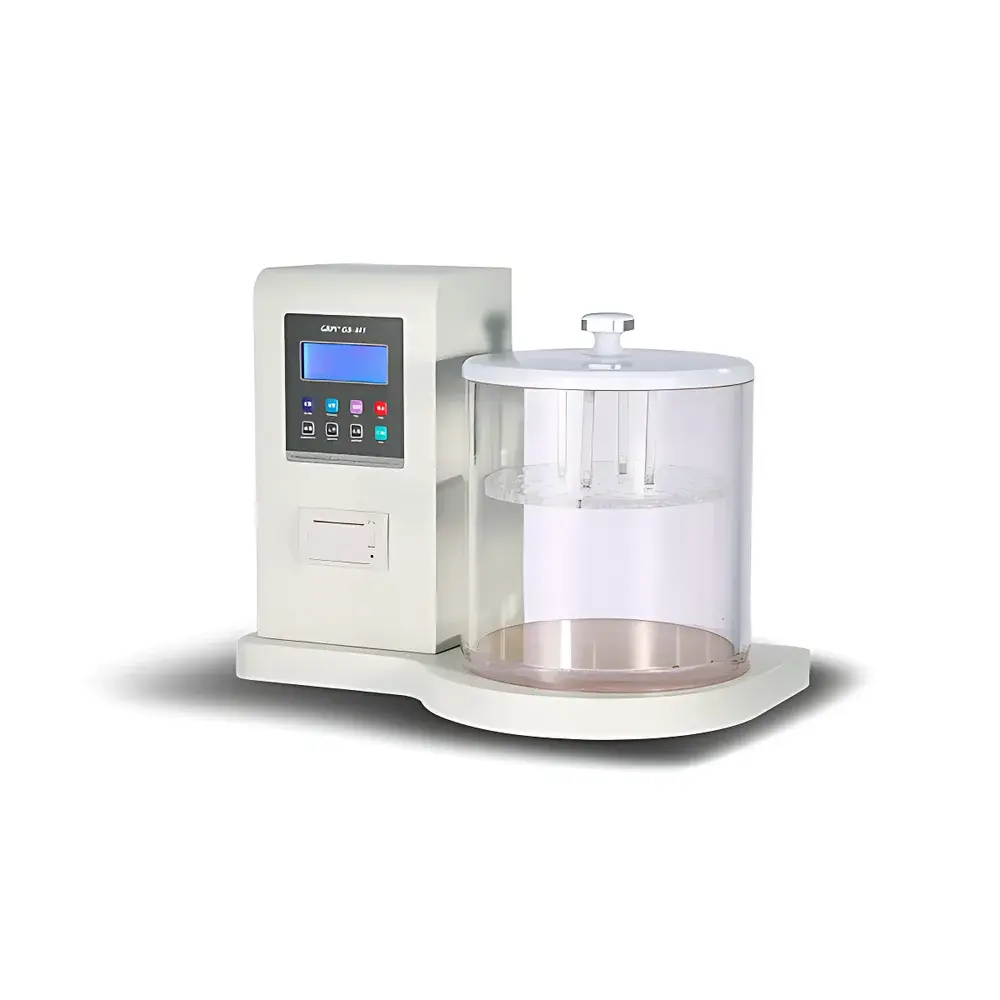
GBPI GB-M1E Seal Integrity Tester for Food Packaging
| Brand | GBPI |
|---|---|
| Model | GB-M1E |
| Origin | Guangdong, China |
| Manufacturer Type | Direct Manufacturer |
| Country of Origin | China |
| Price Range | USD 4,200 – 7,000 (FOB Guangzhou) |
| Vacuum Range | 0 to –90 kPa |
| Vacuum Accuracy | ±1 kPa |
| Vacuum Hold Time | 0.1–9999.9 s |
| Test Chamber Dimensions (Effective) | Ø270 × 270 mm |
| Vacuum Chamber Volume (Standard) | Ø300 × 300 mm (cylindrical) |
| Compressed Air Supply | 0.6–0.8 MPa |
| Air Consumption | 20 L/min |
| Power Supply | 220 V AC, 50 Hz |
| Control Unit Dimensions | 580 × 350 × 440 mm (L×W×H) |
| Net Weight | 10.2 kg |
| Rated Power | 100 W |
| Display | LCD with real-time parameter and status feedback |
| Operating Modes | Fully automatic cycle (vacuum draw → hold → vent → return), manual pause, and manual abort |
Overview
The GBPI GB-M1E Seal Integrity Tester is an engineered solution for quantitative assessment of package seal integrity in rigid and flexible packaging systems—primarily used for evaluating heat-sealed plastic pouches, blister packs, trays, and laminated containers. It operates on the principle of vacuum decay testing: a sealed package is placed inside a calibrated vacuum chamber; the chamber is evacuated to a user-defined negative pressure; the system monitors pressure stability over a programmable dwell time. Any measurable pressure rise during the hold phase indicates leakage through compromised seals, microchannels, or material defects. This method conforms to internationally recognized physical test standards—including ASTM D3078-2002 (reapproved 2013), which defines the bubble emission test under vacuum, and GB/T 15171-1994, China’s national standard for soft package seal strength evaluation. Designed for routine QC laboratories in food, pharmaceutical, personal care, and medical device manufacturing, the GB-M1E delivers repeatable, operator-independent results without requiring destructive sample preparation.
Key Features
- Electro-pneumatic architecture utilizing regulated compressed air (0.6–0.8 MPa) for reliable, low-maintenance actuation of vacuum valve sequencing and chamber venting.
- High-resolution vacuum control with ±1 kPa accuracy across the full 0 to –90 kPa range, enabling precise differentiation between marginal and non-compliant seals.
- Programmable vacuum hold duration from 0.1 seconds to 9999.9 seconds—supporting both rapid screening and extended dwell protocols required by regulatory validation studies.
- Full-cycle automation: auto-initiate vacuum draw, maintain set vacuum level for defined duration, release vacuum, and purge chamber with ambient air—all without manual intervention.
- Intuitive 4.3-inch LCD interface displaying real-time vacuum value, elapsed hold time, cycle status, and error codes; supports multi-language UI configuration (English default).
- Built-in thermal printer generates traceable, date- and time-stamped test reports compliant with basic GLP documentation requirements—no external software required.
- Modular vacuum chamber design: standard Ø300 × 300 mm cylindrical stainless-steel chamber (effective test zone Ø270 × 270 mm); optional custom chambers available for oversized or irregularly shaped packages.
Sample Compatibility & Compliance
The GB-M1E accommodates a broad spectrum of package geometries, including flat pouches (up to 300 mm width), stand-up pouches, aluminum-plastic blisters, thermoformed trays, and PE/PP-laminated composite containers. Its open-top chamber design allows easy loading of filled or empty packages—critical for post-fill seal verification. The instrument meets mechanical and electrical safety requirements per IEC 61010-1 and complies with electromagnetic compatibility (EMC) directives applicable to laboratory equipment. While not inherently 21 CFR Part 11 compliant out-of-the-box, its audit-ready printed reports support retrospective data review in FDA-regulated environments when integrated into documented SOPs. Validation documentation (IQ/OQ) and metrological calibration certificates are available upon request to satisfy internal quality system requirements per ISO 9001, ISO 13485, or ICH Q5C.
Software & Data Management
The GB-M1E operates as a standalone unit with embedded firmware—no PC connection or proprietary software installation is required for basic operation. All test parameters (target vacuum, hold time, pass/fail threshold logic) are stored in non-volatile memory and retain settings after power cycling. The thermal printer outputs include: test ID (user-entered), date/time stamp, vacuum setpoint, actual achieved vacuum, hold duration, observed pressure drift (if any), and PASS/FAIL conclusion. For labs requiring electronic data archiving, optional RS232 or USB-to-serial adapters enable ASCII-formatted data export to LIMS or Excel-based tracking systems. Firmware updates are delivered via SD card and support enhanced logging granularity and configurable alarm thresholds.
Applications
- Food packaging: verification of seal integrity in retort pouches, vacuum-packed meat trays, snack bags, and frozen meal containers prior to distribution.
- Pharmaceutical primary packaging: non-destructive leak testing of blister cards, sachets, and HDPE bottles with induction-sealed caps per USP <1207> guidance.
- Medical device packaging: validation of sterile barrier integrity for Class II and III devices packaged in Tyvek®-poly laminate pouches.
- Quality assurance auditing: periodic in-line or lab-based seal performance trending using statistical process control (SPC) charts derived from printed report data.
- R&D support: comparative evaluation of new sealing parameters (temperature, dwell time, pressure) during packaging line qualification.
FAQ
What compressed air specifications are required for stable operation?
A clean, dry, oil-free air supply at 0.6–0.8 MPa (6–8 bar) and minimum flow rate of 20 L/min is mandatory. An inline three-stage filter (particulate, coalescing, adsorption) is strongly recommended to prevent pneumatic valve contamination.
Can the GB-M1E detect sub-micron leaks?
No. As a vacuum decay tester, it detects gross and medium-level leaks (typically >10 µm equivalent orifice). For micro-leak detection (<1 µm), helium mass spectrometry or high-sensitivity pressure decay systems are required.
Is calibration traceable to national standards?
Yes—optional NIST-traceable calibration certificate is available for the integrated pressure transducer, issued by GBPI’s ISO/IEC 17025-accredited metrology lab.
Does the instrument support multiple user profiles with password protection?
Not in base configuration. User access control and parameter locking require firmware upgrade and external PC-based management software (sold separately).
What maintenance is required for long-term reliability?
Routine inspection of O-rings, cleaning of chamber interior with isopropyl alcohol, and annual verification of vacuum sensor linearity using certified reference gauges.





