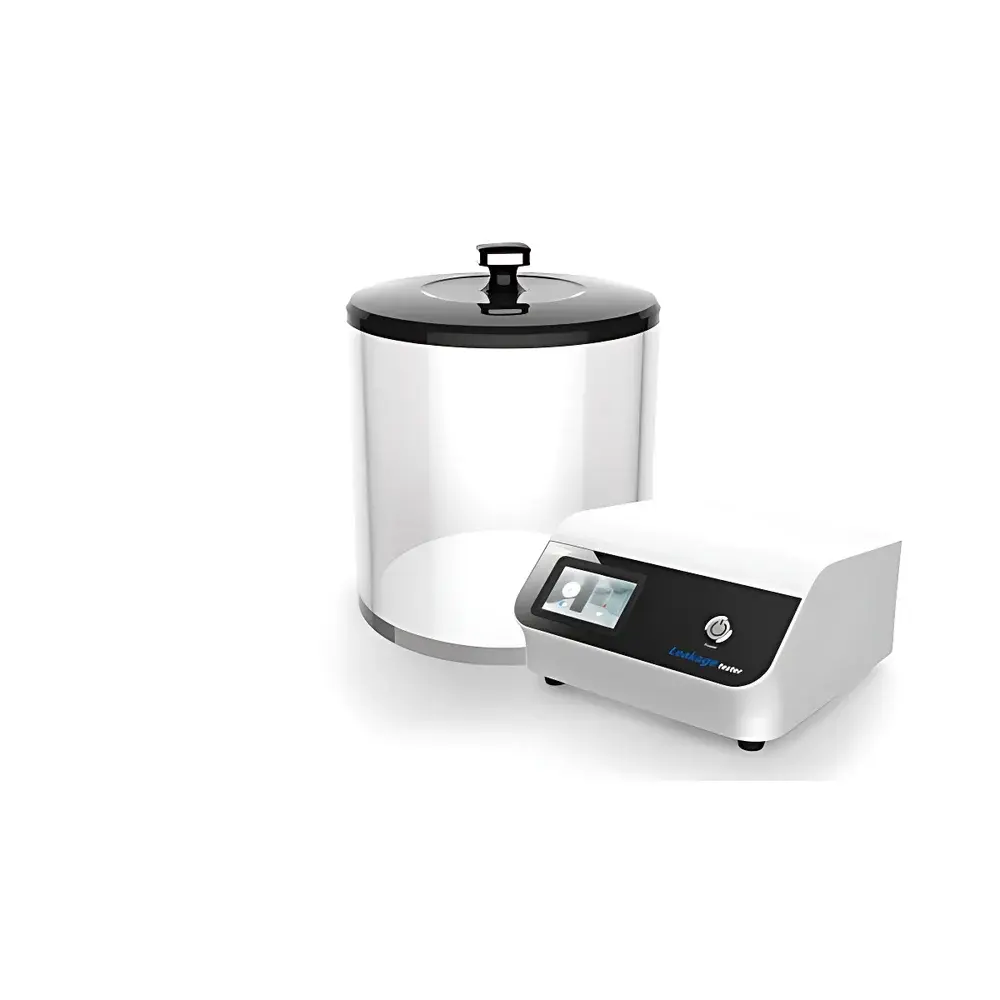
GBPI GB-M2B Leak Integrity Tester for Pharmaceutical Packaging
| Brand | GBPI (Guangzhou Biaoji) |
|---|---|
| Origin | Guangdong, China |
| Manufacturer Type | Direct Manufacturer |
| Country of Origin | China |
| Model | GB-M2B |
| Price Range | USD 1,400 – 4,300 |
| Vacuum Range | 0 to −95 kPa |
| Vacuum Accuracy | ±1% of reading |
| Vacuum Hold Time | 0.1–60 min |
| Compressed Air Pressure | 0.4–0.6 MPa (4–6 kgf/cm²) |
| Air Consumption | 20 L/min |
| Power Supply | 220 V, 50 Hz |
| Instrument Dimensions | 317 × 305 × 170 mm |
| Vacuum Chamber Options | Ø300 × 300 mm (small), Ø450 × 350 mm (medium) |
| Net Weight | 12 kg |
| Operating Temperature | 10–40 °C |
Overview
The GBPI GB-M2B Leak Integrity Tester is an automated, vacuum-based instrumentation system engineered for quantitative assessment of seal integrity in rigid and flexible pharmaceutical packaging—primarily blister packs, pouches, sachets, bottles, and vials sealed with aluminum foil or laminated films. It operates on the principle of vacuum decay testing, a non-destructive, deterministic method standardized under GB/T 15171–1994 and ASTM D3078–2002 (reapproved 2013). During operation, the test specimen is placed inside a sealed vacuum chamber; a controlled negative pressure is applied and held for a user-defined duration. Any measurable pressure rise during the hold phase—detected via high-stability pressure transducers—indicates leakage through compromised seals, microchannels, or material defects. This method provides direct functional validation of package barrier performance, supporting critical quality decisions prior to stability studies, regulatory submissions, and commercial release.
Key Features
- Automated vacuum cycle control: fully programmable vacuum ramp rate, target vacuum level (0 to −95 kPa), hold time (0.1–60 minutes), and venting sequence
- Pneumatic actuation using regulated compressed air (0.4–0.6 MPa), eliminating reliance on mechanical pumps and reducing maintenance requirements
- High-accuracy vacuum sensing with ±1% full-scale reading error tolerance, traceable to NIST-traceable calibration protocols
- Backlit LCD interface displaying real-time vacuum profile, elapsed time, status flags, and fault diagnostics
- Manual override capability: pause/resume and emergency abort functions for operator intervention during test execution
- Dual-chamber compatibility: interchangeable vacuum chambers (Ø300 × 300 mm and Ø450 × 350 mm) accommodate diverse sample geometries—from unit-dose blisters to multi-compartment trays
- Compact benchtop footprint (317 × 305 × 170 mm) and lightweight design (12 kg) facilitate integration into QC labs, packaging development suites, and GMP-compliant cleanroom environments
Sample Compatibility & Compliance
The GB-M2B accommodates a broad range of primary pharmaceutical packaging formats, including cold-form blister cards, push-through packs (PTP), peelable lidding foils, HDPE/PP bottles with induction-sealed caps, and sterile barrier systems per ISO 11607-1. Its methodology aligns with essential regulatory expectations: it satisfies the “leak test” requirement outlined in USP “Packaging—Integrity Evaluation”, supports Annex 1 (EU GMP) risk-based container-closure integrity verification, and enables objective evidence generation for FDA 21 CFR Part 211.94 and ICH Q5C stability protocol compliance. While not inherently 21 CFR Part 11 compliant, the instrument’s deterministic output (pass/fail based on defined vacuum decay thresholds) supports audit-ready documentation when paired with laboratory notebook entries or validated electronic records systems.
Software & Data Management
The GB-M2B operates as a standalone hardware platform with embedded firmware—no proprietary software installation required. All test parameters and outcomes are displayed and retained locally on the device LCD. For traceability, users may manually record vacuum profiles, hold times, pass/fail determinations, and environmental conditions (ambient temperature/humidity) in structured logbooks aligned with GLP/GMP documentation practices. Optional external data logging—via RS232 or analog voltage output—is available for integration with LIMS or SCADA platforms. Calibration certificates, maintenance logs, and standard operating procedures (SOPs) should be maintained per ISO/IEC 17025 requirements to ensure ongoing metrological validity.
Applications
- Validation of sealing parameters (temperature, dwell time, pressure) during packaging line qualification (IQ/OQ/PQ)
- Comparative evaluation of seal strength across different film structures or adhesive formulations
- Post-abuse integrity testing following drop, compression, or vibration challenges per ISTA 3A or ASTM D4169
- Stability study support: periodic seal checks at accelerated and real-time storage intervals
- Root cause analysis of sterility failures linked to container-closure system breaches
- Supplier qualification of preformed packaging components (e.g., blister cavities, foil laminates)
FAQ
Does the GB-M2B meet FDA or EMA regulatory expectations for container-closure integrity testing?
Yes—when operated within its validated range and integrated into a documented quality system, it fulfills the scientific and procedural requirements for deterministic leak detection referenced in USP , EU Annex 1, and ICH guidelines.
Can the instrument detect sub-micron leaks?
Vacuum decay testing is sensitive to gross and medium-level leaks (typically ≥10 µm equivalent hole diameter); for sub-micron detection, complementary methods such as helium mass spectrometry or laser-based headspace analysis are recommended.
Is calibration traceable to international standards?
Yes—pressure transducers are calibrated using NIST-traceable deadweight testers or certified reference instruments; annual recalibration is advised per ISO/IEC 17025.
What maintenance is required?
Routine inspection of O-rings, vacuum chamber seals, and air filter elements every 200 operational hours; no lubrication or pump oil changes are needed due to pneumatic actuation.
Can test results be exported digitally?
The base model outputs analog or serial signals for external logging; digital export requires third-party DAQ integration—no native USB or Ethernet interface is included.