
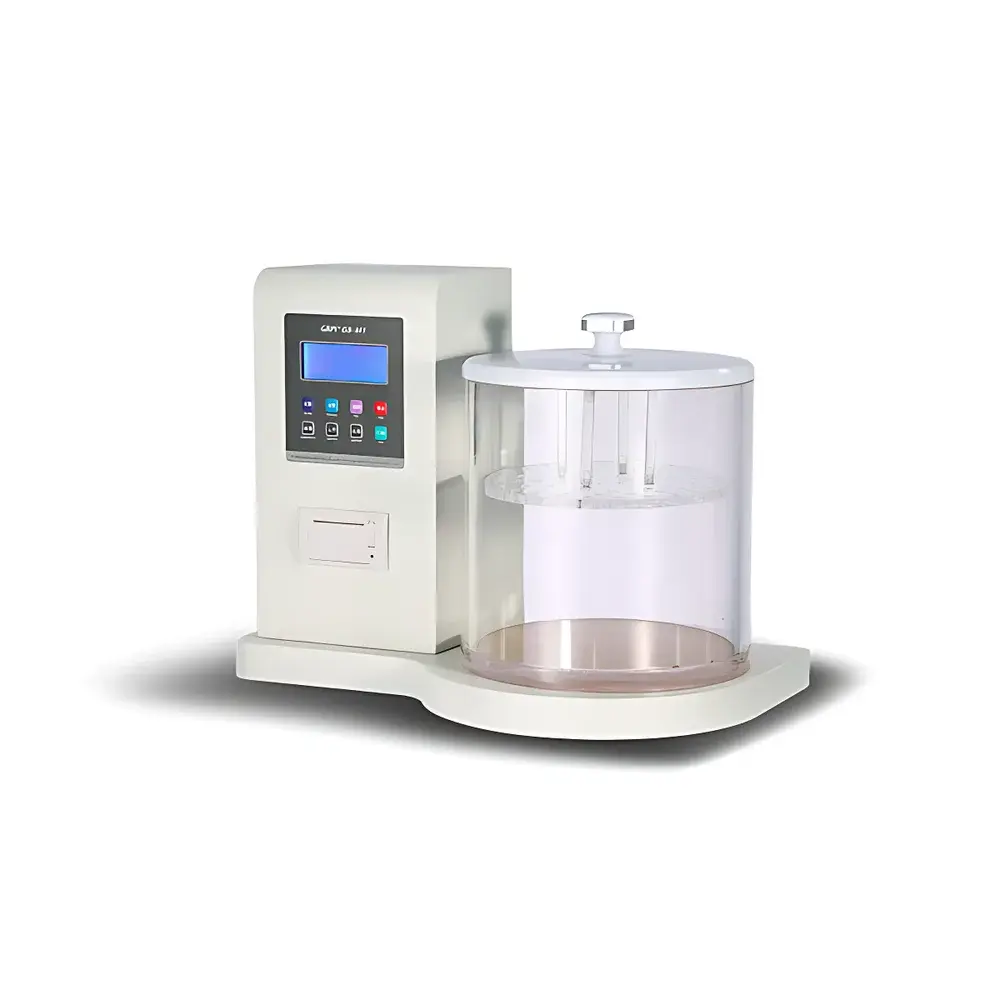
GBPI GB-M2M Vacuum Decay Leak Tester for Packaging Integrity Verification
| Brand | GBPI |
|---|---|
| Model | GB-M2M |
| Origin | Guangdong, China |
| Manufacturer Type | Direct Manufacturer |
| Country of Origin | China |
| Price Range | USD 1,400 – 4,200 (FOB) |
| Vacuum Range | 0 to –90 kPa |
| Vacuum Accuracy | ±1 kPa |
| Vacuum Hold Time | 0.1–9999.9 s |
| Test Chamber Dimensions | Ø270 × 270 mm (effective) |
| Vacuum Chamber (Standard) | Ø300 × 300 mm (custom sizes available) |
| Compressed Air Supply | 0.6–0.8 MPa |
| Air Consumption | 20 L/min |
| Power Supply | 220 V AC, 50 Hz |
| Control Unit Dimensions | 580 × 350 × 440 mm (L×W×H) |
| Net Weight | 10.2 kg |
| Rated Power | 100 W |
| Display | LCD with real-time parameter and status feedback |
| Actuation | Pneumatic, air-driven |
| Automation Level | Fully automatic cycle (vacuum draw → hold → vent → return) with manual pause/abort override |
Overview
The GBPI GB-M2M Vacuum Decay Leak Tester is an engineered solution for non-destructive, quantitative assessment of seal integrity in flexible and semi-rigid packaging—primarily plastic pouches, blister packs, sachets, and trays used across pharmaceutical, food, personal care, and medical device industries. It operates on the principle of vacuum decay testing: a sealed test chamber containing the sample is evacuated to a user-defined negative pressure; the system then monitors pressure change over a programmable dwell time. A statistically significant rise in chamber pressure indicates leakage through compromised seals, microchannels, or material defects. Unlike subjective dye penetration or bubble emission methods, vacuum decay provides objective, repeatable, and traceable pass/fail data aligned with deterministic quality control protocols. The GB-M2M complies with internationally recognized standards including ASTM D3078–2002 (reapproved 2013) for detection of gross leaks in flexible packaging and GB/T 15171–1994 for seal strength and integrity evaluation in Chinese regulatory contexts.
Key Features
- Pneumatically actuated design ensures consistent force application and eliminates mechanical wear associated with motor-driven vacuum pumps—enhancing long-term measurement reproducibility.
- Full-cycle automation: integrated sequence control manages vacuum draw, precise hold timing (0.1–9999.9 s), controlled venting, and pneumatic repositioning without operator intervention.
- High-resolution vacuum monitoring with ±1 kPa accuracy across the full 0 to –90 kPa range enables detection of subtle pressure drifts indicative of marginal seal failures.
- Large-diameter test chamber (Ø270 × 270 mm effective volume) accommodates standard commercial packaging formats, including side-gusseted pouches and multi-cavity trays.
- Embedded LCD interface displays real-time vacuum level, elapsed hold time, cycle status, and error codes—supporting immediate operational verification and troubleshooting.
- Built-in thermal printer generates auditable test reports with embedded date/time stamp, vacuum setpoint, hold duration, and result status—facilitating GLP-compliant documentation.
- Modular chamber configuration allows field replacement or customization of vacuum tanks (e.g., Ø300 × 350 mm standard; optional custom geometries available upon request).
Sample Compatibility & Compliance
The GB-M2M is validated for use with heat-sealed polymeric films (e.g., PET/PE, OPP/CPP, Alu-laminates), foil-backed laminates, and thermoformed trays. It supports both filled and empty package configurations, provided internal headspace permits stable vacuum establishment. The instrument meets functional requirements of ISO 11607-2:2019 (Packaging for terminally sterilized medical devices — Part 2: Validation requirements for forming, sealing and assembly processes) for gross leak screening during process validation. While not a substitute for ASTM F2338–22 (vacuum decay for quantitative leak rate estimation), it serves as a robust first-line QC tool aligned with FDA Guidance for Industry: Container Closure Integrity Testing in Sterile Product Manufacturing (2022). All electronic logging—including print timestamps and parameter settings—is structured to support 21 CFR Part 11 readiness when integrated into validated laboratory information management systems (LIMS).
Software & Data Management
The GB-M2M operates via embedded firmware with no external PC dependency. All test parameters—including vacuum target, hold time, and pass/fail thresholds—are stored in non-volatile memory. Thermal printouts provide permanent, tamper-evident records compliant with ALCOA+ principles (Attributable, Legible, Contemporaneous, Original, Accurate, Complete, Consistent, Enduring, Available). Optional RS-232 or USB-to-serial interfaces (available under custom configuration) enable connection to external data loggers or SCADA platforms for centralized batch record aggregation. Audit trail functionality is implemented at firmware level: each print event logs timestamp, operator ID (if entered), and cycle-specific metadata—supporting GMP-aligned review and investigation workflows.
Applications
- Pharmaceutical: Seal integrity verification of blister cards, aluminum-fold pouches, and barrier-laminated sachets prior to stability storage or release.
- Food & Beverage: Detection of channel leaks in retort pouches, vacuum-packed meats, and coffee foil bags where oxygen ingress compromises shelf life.
- Medical Devices: Functional screening of peel-open pouches for sterile instruments, ensuring absence of gross breaches before autoclaving or ethylene oxide sterilization.
- Consumer Goods: Routine QC of zipper-lock bags, stand-up pouches, and single-serve detergent pods where consumer safety hinges on hermetic closure.
- Process Development: Correlation studies between heat-seal temperature/pressure/dwell time and measurable leak incidence using statistical process control (SPC) frameworks.
FAQ
What compressed air specifications are required for reliable operation?
A clean, dry, oil-free air supply at 0.6–0.8 MPa (6–8 bar) and minimum 20 L/min flow rate is mandatory. An inline three-stage filter (particulate, coalescing, adsorption) is strongly recommended to prevent pneumatic valve contamination.
Can the GB-M2M quantify leak size or flow rate?
No—it is designed for qualitative gross leak detection per ASTM D3078. Quantitative leak rate determination requires complementary instrumentation such as helium mass spectrometry or pressure decay systems with calibrated reference leaks.
Is calibration certification included with shipment?
A factory-issued calibration report (traceable to NIM, China) is provided. Optional third-party ISO/IEC 17025 calibration certificates are available at additional cost.
How is the vacuum chamber sealed during testing?
The unit employs a dual-seal elastomeric gasket system integrated into the lid assembly, combined with pneumatically assisted clamping force to ensure chamber integrity up to –90 kPa.
What maintenance intervals are recommended?
Daily visual inspection of gaskets and air lines; quarterly verification of vacuum sensor linearity using a certified reference manometer; annual full-system performance validation per GB/T 15171–1994 Annex B procedures.




