
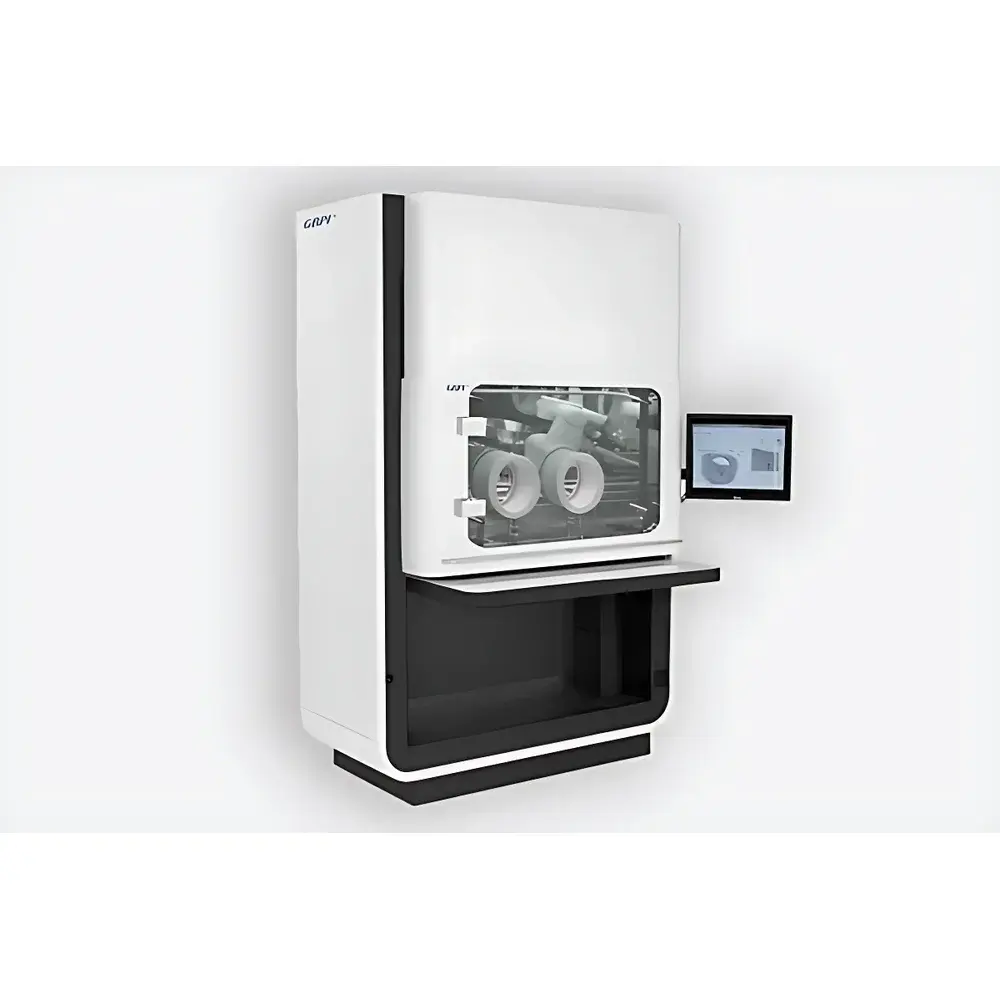
GBPI GB-XF1000AB Bacterial Filtration Efficiency (BFE) Tester for Meltblown Nonwovens
| Brand | GBPI |
|---|---|
| Origin | Guangdong, China |
| Manufacturer | GBPI Packaging Instruments Co., Ltd. |
| Model | GB-XF1000AB |
| Compliance | YY 0469–2004, YY/T 0969–2013, ASTM F2100, ASTM F2101, EN 14683 |
| Sampling Flow Rate | 28.3 L/min ±2.5% |
| Aerosol Generation Flow Rate | 8–10 L/min ±2.5% |
| Peristaltic Pump Flow Range | 0.006–3.0 mL/min ±2.5% |
| Pressure Before Flow Meter | −20 to 0 kPa ±2.5% |
| Pressure Before Nebulizer | 0–300 kPa ±2.5% |
| Ambient Temperature Range | −40 to 99 °C ±2.5% |
| Aerosol Chamber Negative Pressure | −90 to −120 Pa ±2.0% |
| Cabinet Negative Pressure | −50 to −200 Pa |
| Data Storage Capacity | >100,000 test records |
| Vortex Mixer | 8 × Φ16×150 mm tubes |
| HEPA Filter Efficiency | ≥99.99% for particles ≥0.3 µm |
| Aerosol Mass Median Diameter (MMD) | 3.0 ± 0.3 µm, GSD ≤1.5 |
| 6-Stage Andersen Cascade Impactor Cut-Points | Stage I >7 µm, II 4.7–7 µm, III 3.3–4.7 µm, IV 2.1–3.3 µm, V 1.1–2.1 µm, VI 0.6–1.1 µm |
| Aerosol Chamber Dimensions | 600 × 85 × 30 mm (L×D×H) |
| Positive Control Recovery | 2200 ± 500 CFU |
| Cabinet Ventilation Flow Rate | ≥5 m³/min |
| Cabinet Dimensions (W×D×H) | 755 × 400 × 990 mm |
| Main Unit Dimensions (W×D×H) | 1200 × 630 × 2100 mm |
| Noise Level | <65 dB(A) |
| Weight | ~150 kg |
| Power Supply | AC 220 V ±10%, 50 Hz |
| Power Consumption | <1500 W |
Overview
The GBPI GB-XF1000AB Bacterial Filtration Efficiency (BFE) Tester is a fully integrated, ISO/IEC 17025-aligned laboratory instrument engineered for quantitative assessment of bacterial aerosol filtration performance in meltblown nonwoven fabrics—particularly those used in surgical masks, respirators, and other personal protective equipment (PPE). It operates on the principle of controlled bioaerosol challenge using Staphylococcus aureus (ATCC 6538) as the test organism, delivered via a calibrated, monodisperse aerosol generator with a mass median aerodynamic diameter (MMAD) of 3.0 ± 0.3 µm and geometric standard deviation (GSD) ≤1.5. The system employs dual-path, simultaneous sampling with parallel impactor-based collection and agar plate impaction to enable statistically robust comparative analysis of upstream and downstream microbial load. This architecture ensures high reproducibility (CV <5% across repeated runs under identical conditions), traceable calibration, and compliance with regulatory validation requirements for medical device manufacturers operating under ISO 13485 and FDA QSR frameworks.
Key Features
- Negative-pressure containment cabinet with real-time pressure monitoring (−50 to −200 Pa), certified airflow ≥5 m³/min, and integral HEPA filtration (≥99.99% efficiency for ≥0.3 µm particles) to ensure operator biosafety per WHO Laboratory Biosafety Manual and ISO 15190.
- Integrated 6-stage Andersen cascade impactor with validated cut-point performance across six aerodynamic size fractions (0.6–7.0+ µm), enabling granular particle-size-resolved deposition analysis aligned with ASTM F2101 Annex A3.
- Embedded industrial-grade microcomputer controller with 10.4-inch high-brightness capacitive touchscreen interface, supporting full parameter programmability—including nebulizer flow (8–10 L/min), peristaltic pump delivery (0.006–3.0 mL/min), and sampling duration—without external software dependency.
- Dual independent flow control loops with NIST-traceable thermal mass flow meters (±2.5% accuracy) for both challenge aerosol and sampling air streams, minimizing inter-channel drift and enabling true differential filtration calculation.
- Vortex mixer module accommodating eight Φ16×150 mm culture tubes for standardized elution and colony enumeration; designed for compatibility with common microbiological media (e.g., TSB, TSA).
- Comprehensive electrical safety architecture including built-in RCD (residual-current device), fire-retardant insulation between inner and outer cabinet layers, and front-mounted tempered glass access door with positive-seal gasketing.
Sample Compatibility & Compliance
The GB-XF1000AB accommodates flat-sheet specimens up to 100 mm × 100 mm, secured within a precision-machined stainless-steel holder ensuring uniform exposure area and leak-free sealing against the aerosol chamber (600 × 85 × 30 mm internal volume). It supports standardized testing of meltblown polypropylene, electrospun nanofibers, and hybrid composite filter media. Regulatory alignment includes full conformance with YY 0469–2004 (Chinese standard for surgical masks), YY/T 0969–2013 (disposable medical mask specification), ASTM F2100 (performance specification for medical face masks), ASTM F2101 (test method for BFE using S. aureus), and EN 14683 (European standard for medical face masks). All critical subsystems—including pressure transducers, flow sensors, and temperature probes—are factory-calibrated with documented uncertainty budgets and support third-party recalibration per ISO/IEC 17025 requirements.
Software & Data Management
The embedded control firmware provides audit-ready data integrity features compliant with FDA 21 CFR Part 11 principles: user-level access control (admin/operator roles), electronic signatures for test initiation and report finalization, immutable timestamped records, and full audit trail logging of all parameter changes and system events. Test results—including calculated BFE (%), raw colony counts (CFU), flow stability metrics, and environmental parameters—are stored internally (>100,000 records) and exportable via USB 2.0 to CSV or PDF formats. No cloud connectivity or remote telemetry is implemented, preserving data sovereignty—a requirement for GLP-compliant laboratories and Class II/III medical device QA/QC environments subject to MHRA, TÜV SÜD, or Notified Body audits.
Applications
This instrument serves as a primary verification tool in quality control laboratories of PPE manufacturers, national metrology institutes (e.g., CNAS-accredited labs), and academic research centers investigating filtration mechanisms in fibrous media. Typical use cases include: routine lot-release testing of meltblown fabric batches; development and optimization of electret-charged nonwovens; comparative evaluation of novel antimicrobial coatings; validation of sterilization-induced degradation effects on filtration integrity; and generation of technical dossiers for CE marking, FDA 510(k), or NMPA registration. Its dual-sampling architecture also supports method transfer studies between laboratories seeking inter-laboratory agreement per ISO 5725.
FAQ
What biological agent is used for BFE testing on the GB-XF1000AB?
Staphylococcus aureus ATCC 6538 is the standard challenge organism specified in ASTM F2101, YY 0469, and EN 14683. The system includes protocols for viable aerosol generation, concentration control, and recovery validation.
Is the Andersen impactor included as a permanent fixture or optional accessory?
The 6-stage Andersen impactor is fully integrated into the negative-pressure cabinet and mechanically aligned with the aerosol chamber outlet port. No field assembly or alignment is required.
Can the instrument be used for viral filtration efficiency (VFE) testing?
While not validated for VFE per ASTM E1052 or ISO 18184, the aerosol generation and sampling architecture is physically compatible with bacteriophage surrogates (e.g., Φ6, MS2) when paired with appropriate biosafety level 2 (BSL-2) containment upgrades and protocol modifications.
Does the system support automated colony counting integration?
The GB-XF1000AB outputs enumerated CFU values from agar plates but does not include image-based colony recognition hardware. It exports raw count data for downstream processing with third-party systems such as ProtoCOL or OpenCFU.
What maintenance intervals are recommended for the HEPA filter and aerosol generator?
HEPA filters require replacement every 12 months or after 2000 operational hours, whichever occurs first. The stainless-steel nebulizer head should be ultrasonically cleaned weekly and inspected for clogging or erosion prior to each test series.




