
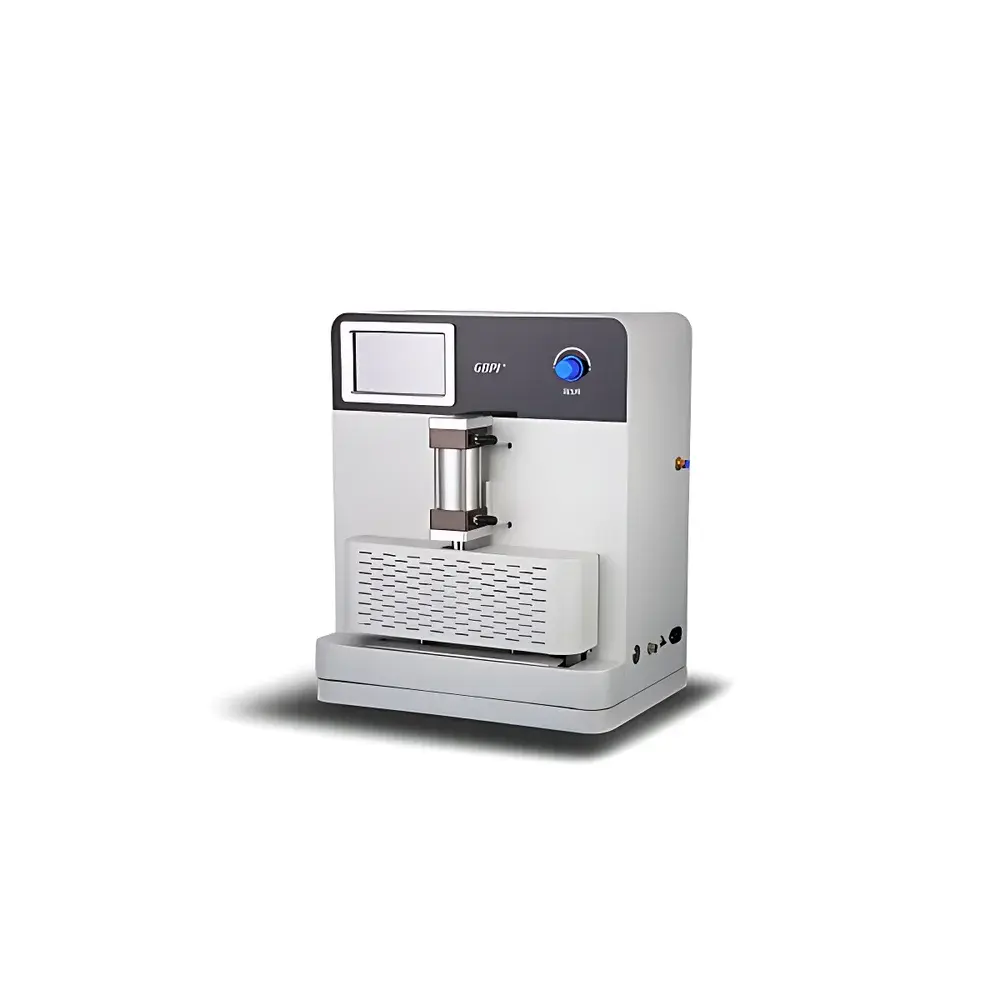
GBPI GBB-F10 Five-Point Heat Sealing Tester
| Brand | GBPI |
|---|---|
| Origin | Guangdong, China |
| Manufacturer | GBPI Packaging Instruments Co., Ltd. |
| Model | GBB-F10 |
| Temperature Range | Ambient to 300 °C |
| Temperature Control Accuracy | ±1 °C |
| Sealing Time | 0.1–999.9 s |
| Sealing Pressure | 0.05–0.8 MPa |
| Sealing Surface | Five independent 35 mm × 10 mm upper sealing blades (heated), lower silicone-cushioned sealing bar |
| Heating Method | Electric resistance heating with dual auto/manual control |
| Actuation | Pneumatic (compressed air required) |
| Power Supply | AC 220 V, 50 Hz, 2000 W |
| Dimensions (W×D×H) | 700 × 400 × 540 mm |
| Weight | 55 kg |
| Compressed Air Requirement | ≥0.8 MPa, clean and dry (filtered) |
Overview
The GBPI GBB-F10 Five-Point Heat Sealing Tester is an engineered laboratory instrument designed for precise, repeatable evaluation of heat seal integrity in flexible packaging materials. It operates on the principle of controlled thermal energy transfer under defined pressure and dwell time—parameters critical to establishing reliable hermetic seals in medical device pouches, pharmaceutical blister lidding, food packaging films, and sterile barrier systems. Unlike single-point seal testers, the GBB-F10 integrates five independently controllable sealing zones, enabling simultaneous assessment of multiple thermal profiles across a single sample or comparative analysis of five distinct material configurations. This architecture supports method development per international standards including ASTM F2029–2016 (Standard Test Method for Measuring Heat Seal Strength of Thermoplastic Films and Laminates), QB/T 2358–1998 (Chinese standard for plastic film heat seal strength), and YBB 00122003–2015 (Chinese pharmaceutical packaging standard). Its pneumatic actuation ensures consistent force application, while electric resistance heating elements deliver stable temperature ramping and hold characteristics essential for GLP-compliant seal optimization studies.
Key Features
- Five independent sealing zones: Each of the five 35 mm × 10 mm upper sealing blades features individual PID temperature control, allowing discrete thermal setpoints within a single test cycle—ideal for gradient testing or multi-material validation.
- Pneumatic force delivery: Compressed air-driven actuation delivers linear, repeatable sealing pressure from 0.05 to 0.8 MPa, eliminating mechanical hysteresis associated with spring-loaded or manual systems.
- Dual operation modes: Fully automated programmable cycles (with timer-based dwell control) and manual foot-switch activation for rapid prototyping or operator-guided seal trials.
- Customizable sealing interface: Lower sealing bar incorporates replaceable silicone cushioning; upper blades accept custom geometries (e.g., round, stepped, or micro-patterned faces) and surface finishes (polished, matte, or anti-adhesive coatings).
- Traceable thermal calibration: Integrated Pt100 RTD sensors at each blade location support field verification using external reference thermometers—facilitating ISO/IEC 17025-compliant equipment qualification.
- Robust industrial construction: Stainless steel frame, reinforced aluminum housing, and sealed electrical compartments ensure long-term stability in QC laboratories and regulated manufacturing environments.
Sample Compatibility & Compliance
The GBB-F10 accommodates a broad range of thermoplastic substrates—including polyethylene (PE), polypropylene (PP), polyester (PET), ethylene vinyl acetate (EVA), and multilayer laminates used in sterile medical packaging and child-resistant pharmaceutical blisters. Its modular sealing head design allows adaptation to non-standard film widths up to 150 mm via optional extended bars or custom blade arrays. The instrument meets mechanical and electrical safety requirements per IEC 61010-1 and supports compliance workflows aligned with FDA 21 CFR Part 11 (when paired with validated data acquisition software), ISO 11607–1/–2 (packaging for terminally sterilized medical devices), and USP (Package Integrity Evaluation). Calibration documentation, including as-found/as-left reports and uncertainty budgets, can be generated for audit readiness.
Software & Data Management
While the GBB-F10 operates via intuitive front-panel controls, it supports RS-232 and USB interfaces for integration with third-party lab information management systems (LIMS) or custom Python/Matlab scripts. Optional GBPI DataLink™ software provides real-time logging of temperature, pressure, and time parameters with timestamped CSV export, electronic signature capability, and configurable audit trails. All stored test records include operator ID, environmental conditions (if linked to external hygrometer/thermometer), and pass/fail flags against user-defined specification limits—enabling full traceability per GMP Annex 11 and EU GDP guidelines.
Applications
- Optimization of heat seal parameters for form-fill-seal (FFS) line setup and validation
- Comparative evaluation of seal strength vs. temperature gradients in coextruded films
- Accelerated aging studies correlating seal integrity with storage conditions
- Root cause analysis of seal failures in complaint investigations (e.g., channel leaks, delamination)
- Qualification of new packaging materials prior to regulatory submission (e.g., FDA 510(k), CE marking)
- Training and proficiency testing for packaging technicians in ISO 13485-certified facilities
FAQ
What compressed air specifications are required for reliable operation?
Minimum supply pressure: 0.8 MPa (8 bar); recommended flow rate: ≥120 L/min at 0.8 MPa; air must be filtered to ISO 8573–1 Class 2:2:2 (particulate, water, oil) using a three-stage coalescing filter.
Can the GBB-F10 be used for peel strength testing?
No—this instrument is strictly a heat seal parameter tester. Peel or tensile strength measurement requires integration with a universal testing machine (e.g., Instron or Zwick) following ASTM F88 or ISO 11607–2 protocols.
Is calibration certification included with purchase?
A factory calibration report (traceable to NIM China) is supplied standard. A UKAS-accredited calibration certificate is available as a paid option (order code: CAL-GBB-F10-UKAS).
How is temperature uniformity verified across the five sealing zones?
GBPI provides a five-point thermal mapping procedure using calibrated thermocouples and a documented SOP (included in the User Manual). Uniformity tolerance is ±1.5 °C across all active zones at steady state.
Does the instrument support IQ/OQ/PQ documentation packages?
Yes—GBPI supplies a complete qualification toolkit including protocol templates, acceptance criteria matrices, and blank execution records compliant with ASTM E2500 and Annex 15 of the EU GMP Guide.
Related Products




