
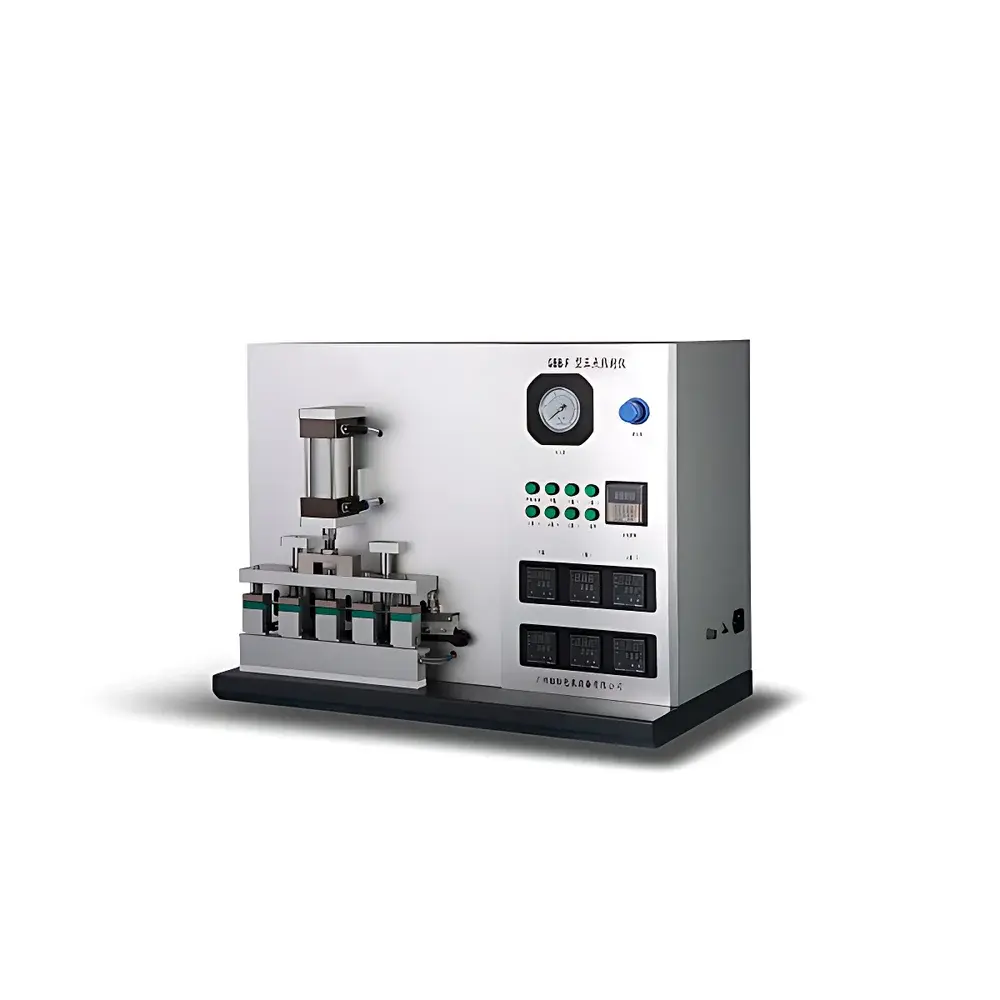
GBPI GBB-F1B Five-Point Heat Sealing Tester
| Brand | GBPI |
|---|---|
| Origin | Guangdong, China |
| Manufacturer | GBPI Packaging Equipment Co., Ltd. |
| Model | GBB-F1B |
| Temperature Range | Ambient to 250 °C |
| Temperature Control Accuracy | ±1 °C |
| Sealing Time | 0.1–999.9 s |
| Sealing Pressure | 0.1–0.8 MPa |
| Sealing Surface | Five independent 35 mm × 10 mm upper sealing blades (heated) + silicone-padded lower sealing bar |
| Heating Mode | Electric resistance heating with dual auto/manual operation |
| Actuation | Pneumatic (compressed air required) |
| Power Supply | AC 220 V, 50 Hz |
| Rated Power | 2000 W |
| Dimensions (L×W×H) | 730 × 400 × 535 mm |
| Weight | 35.6 kg |
Overview
The GBPI GBB-F1B Five-Point Heat Sealing Tester is an engineered laboratory instrument designed for precise, repeatable evaluation of heat seal integrity in flexible packaging materials. It operates on the principle of controlled thermal energy transfer under defined pressure and dwell time—mimicking real-world packaging line conditions—to determine optimal sealing parameters (temperature, pressure, and time) that yield maximum seal strength and hermeticity. Unlike single-point testers, the GBB-F1B features five independently controllable heating zones along the upper sealing blade assembly, enabling simultaneous assessment of multiple temperature setpoints across a single sample strip. This capability supports rapid thermal profiling, failure mode analysis (e.g., cold seal, over-seal, or adhesive degradation), and validation of seal window boundaries per ASTM F2029-2016, QB/T 2358-1998, and YBB 00122003-2015. Its pneumatic actuation system ensures consistent force application, while its modular thermal architecture allows for traceable calibration and long-term stability in regulated environments.
Key Features
- Five-zone independent temperature control: Each of the five 35 mm × 10 mm upper sealing elements is individually heated and monitored, supporting multi-temperature seal mapping without sample repositioning.
- Dual-mode operation: Fully automated sequence control (programmable time/pressure/temperature ramps) and manual foot-switch–activated sealing for quick verification or troubleshooting.
- Pneumatic sealing actuation: Compressed-air-driven mechanism delivers stable, adjustable pressure (0.1–0.8 MPa) with minimal mechanical hysteresis and high cycle repeatability.
- Modular sealing interface: Lower sealing bar equipped with replaceable silicone padding; upper blades configurable for custom geometry, surface finish (e.g., polished, etched, or anti-adhesive coated), and material compatibility (e.g., fluoropolymer-coated for PVDC or foil-laminates).
- Traceable thermal management: Integrated Pt100 RTD sensors with accessible calibration ports; temperature uniformity verified per ISO/IEC 17025–aligned internal procedures.
- Rugged industrial design: Steel-reinforced frame, EMI-shielded power electronics, and CE-compliant safety interlocks—including emergency stop, over-temperature cutoff, and pressure-loss detection.
Sample Compatibility & Compliance
The GBB-F1B accommodates a broad spectrum of thermoplastic packaging substrates, including but not limited to LDPE, HDPE, PP, PET, CPP, aluminum laminates, metallized films, and pharmaceutical-grade blister foils. Its five-point configuration is especially valuable for characterizing heterogeneous structures—such as peel-open pouches or child-resistant seals—where localized thermal sensitivity varies across the seal path. The instrument complies with key international test standards: ASTM F2029-2016 (Standard Test Method for Making Heat Seals for Determination of Heat Seal Strength), QB/T 2358-1998 (Plastic Films—Heat Seal Strength Test Method), and YBB 00122003-2015 (National Medicine Packaging Standard for Heat Seal Strength of Plastic Composite Films). While not intrinsically 21 CFR Part 11 compliant, its operational logs (when paired with optional GBPI LabLink software) support ALCOA+ data integrity principles for GLP/GMP-aligned laboratories conducting seal process validation.
Software & Data Management
The GBB-F1B operates via an embedded industrial controller with a high-contrast LCD interface for local parameter entry, real-time status monitoring, and pass/fail flagging. For enhanced documentation and audit readiness, it integrates seamlessly with GBPI’s optional LabLink v3.x software suite (Windows-based). LabLink enables full method storage, automated report generation (PDF/CSV), electronic signature capture, and audit trail logging—including user ID, timestamp, parameter changes, and seal result metadata. All data files are stored with SHA-256 checksums and support folder-level encryption. When deployed in networked lab environments, LabLink can interface with LIMS via HL7 or RESTful API extensions—facilitating direct ingestion into enterprise quality systems for CAPA linkage and trend analysis.
Applications
- Pharmaceutical packaging: Validation of blister cavity seals, sachet weld integrity, and barrier film lamination parameters under accelerated aging protocols.
- Food packaging R&D: Optimization of retortable pouch seal profiles to prevent delamination during sterilization cycles.
- Medical device packaging: Determination of minimum seal temperature thresholds for Tyvek®/polyethylene pouches per ISO 11607-2.
- Quality assurance labs: Routine incoming inspection of rollstock heat sealability; root cause analysis of field failures linked to seal variability.
- Academic research: Investigation of polymer chain mobility at the interface under dynamic thermal–mechanical loading.
- Regulatory submissions: Generation of reproducible seal parameter datasets for FDA 510(k), EU MDR technical files, or PMDA dossiers.
FAQ
What compressed air specifications are required for reliable operation?
A minimum supply of 2.5 HP air compressor delivering ≥8 bar (116 psi) with integrated three-stage filtration (particulate, oil, and moisture removal) is recommended. Air line pressure at the inlet must be regulated to 0.6–0.8 MPa with a precision regulator and gauged inline.
Can the sealing blades be calibrated independently?
Yes—each of the five upper sealing zones includes a dedicated Pt100 sensor and heater circuit. Calibration is performed using NIST-traceable dry-block calibrators or reference thermocouples inserted into designated sensor ports; procedure documented in the included Calibration Manual.
Is the GBB-F1B suitable for testing paper–plastic laminates?
It is compatible with cellulose-based laminates when configured with low-thermal-mass blades and reduced dwell times. Users should verify surface temperature uniformity across the 35 mm width using infrared thermography prior to qualification runs.
Does the instrument support IQ/OQ protocol execution?
GBPI provides a validated IQ/OQ template aligned with ASTM E2500 and Annex 15, including acceptance criteria, test scripts, and evidence worksheets. Installation and operational qualification require on-site technician support or remote supervision by GBPI-certified engineers.
What maintenance intervals are recommended for sustained accuracy?
Daily visual inspection of sealing surfaces and air filters; quarterly torque verification of pneumatic fittings and RTD mounting; annual full calibration and mechanical alignment check—performed by GBPI Service Center or authorized partners with ISO/IEC 17025 accreditation.







