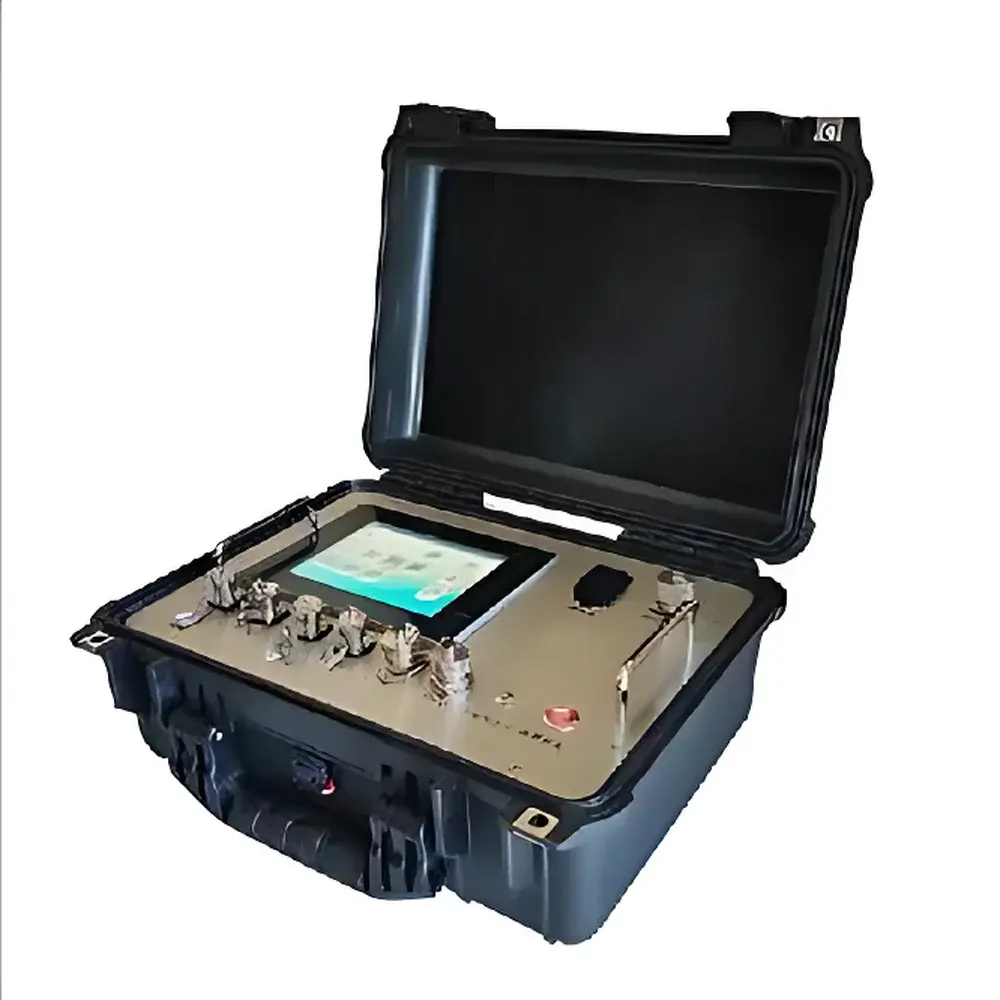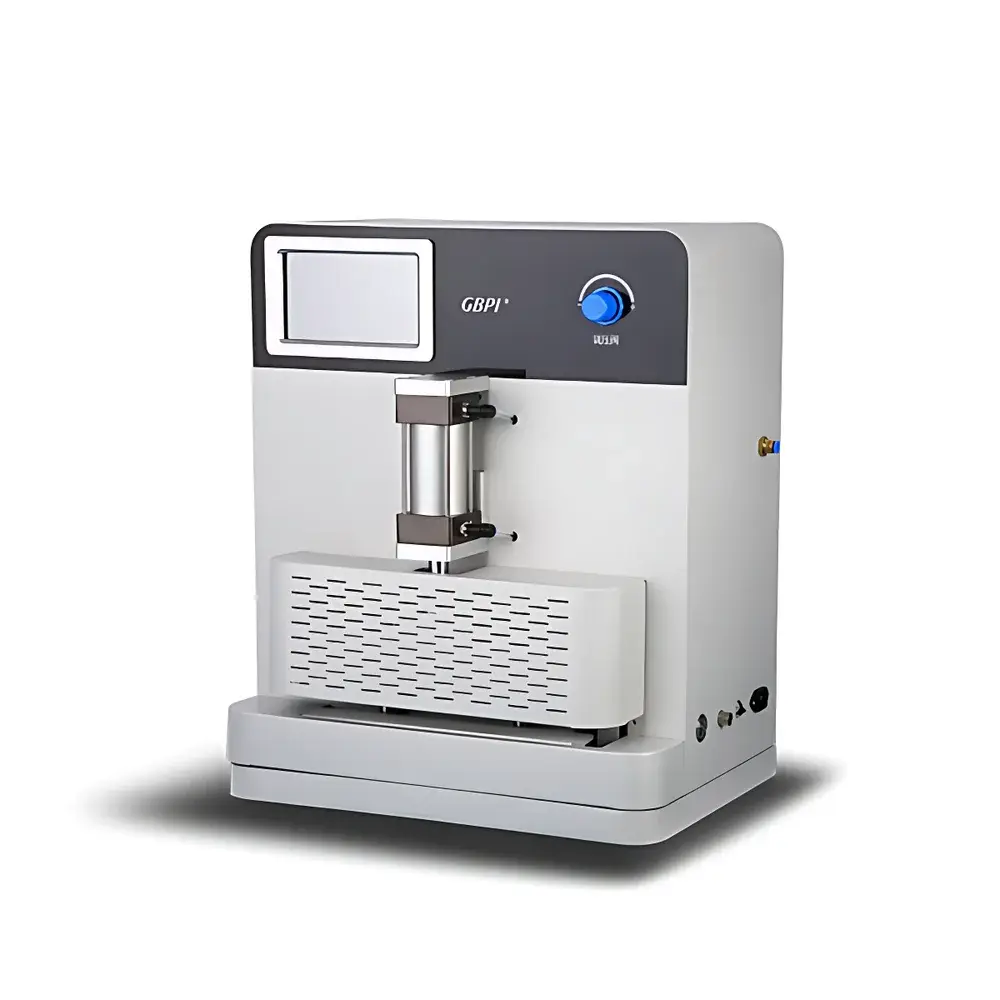
GBPI GBB-F1N Five-Point Heat Sealing Tester
| Brand | GBPI |
|---|---|
| Origin | Guangdong, China |
| Manufacturer Type | Direct Manufacturer |
| Country of Origin | China |
| Model | GBB-A1N |
| Price | USD 8,200 (FOB Guangzhou) |
| Heat Seal Temperature Range | Ambient to 250 °C |
| Temperature Control Accuracy | ±0.1 °C |
| Sealing Time Range | 0.1 s to 99 h 59 min 59.9 s |
| Sealing Pressure Range | 0.1–0.8 MPa |
| Upper Sealing Jaw Configuration | Five independent 35 mm × 10 mm sealing segments |
| Lower Sealing Bar | Silicone-padded cylindrical bar (customizable) |
| Heating Method | Dual-zone resistive heating with digital PID control |
| Drive System | Pneumatic, dual-cylinder synchronized actuation (bottom-mounted) |
| Operating Modes | Automatic, Manual, and Foot-pedal triggered |
| Display | 7-inch color capacitive touchscreen with real-time parameter monitoring (temperature, pressure, time) |
| Compliance Standards | QB/T 2358–1998, ASTM F2029, YBB00122003–2015 |
| Optional Features | Audit-trail-enabled software with multi-level user authentication (admin/operator/observer), GLP-compliant electronic records, USB data export, calibration certificate |
Overview
The GBPI GBB-F1N Five-Point Heat Sealing Tester is an engineered precision instrument designed for quantitative evaluation of heat seal integrity in flexible packaging materials. It operates on the principle of controlled thermal compression—applying calibrated temperature, pressure, and dwell time across five discrete sealing zones—to replicate industrial heat sealing conditions under laboratory-grade repeatability. Unlike single-point testers, the GBB-F1N enables simultaneous assessment of thermal sensitivity gradients across heterogeneous laminates (e.g., PET/AL/PE, CPP-based pharmaceutical blisters, or metallized paper composites), making it indispensable for formulation development, process validation, and QC release testing in regulated environments. Its architecture conforms to fundamental metrological requirements for thermal stability (±0.1 °C), mechanical reproducibility (pneumatic force consistency), and temporal resolution (0.1 s timing granularity), ensuring data traceability aligned with ISO/IEC 17025 and FDA 21 CFR Part 11 expectations when paired with optional compliant software.
Key Features
- Five independently controllable upper sealing jaws (35 mm × 10 mm each), plus a silicone-cushioned lower sealing bar—enabling segmented thermal profiling and comparative seal strength mapping across heterogeneous substrates.
- Dual-zone digital PID temperature control with high-stability platinum RTD sensors; temperature calibration accessible via front-panel interface without external hardware.
- Pneumatic actuation system featuring bottom-mounted dual cylinders with synchronized motion circuitry—eliminating lateral skew and ensuring uniform pressure distribution (0.1–0.8 MPa range, ±1.5% full-scale accuracy).
- Integrated 7-inch color touchscreen HMI displaying real-time values for upper/lower jaw temperatures, applied pressure, elapsed sealing time, and mode status—no external PC required for basic operation.
- Triple operational modes: fully automatic sequence execution, manual step-by-step control, and foot-switch–triggered single-cycle activation—optimized for both high-throughput labs and method development workflows.
- Thermal safety interlocks including overtemperature cutoff, pneumatic pressure monitoring, and physical guard shielding—certified to IEC 61000-6-2 EMC and IEC 61000-6-4 emission standards.
Sample Compatibility & Compliance
The GBB-F1N accommodates a broad spectrum of thermoplastic and thermoset-based packaging substrates, including but not limited to polyethylene (LDPE, LLDPE, HDPE), polypropylene (CPP, BOPP), polyester (PET, PETG), aluminum foil laminates, metallized films, cold-seal coatings, and barrier-coated papers. Seal jaw geometry is customizable per client specification—including radius, flatness tolerance, surface finish (Ra ≤ 0.4 µm standard), and anti-adhesion treatments (e.g., ceramic-coated or fluoropolymer-impregnated surfaces). The instrument satisfies mandatory test protocols defined in QB/T 2358–1998 (Chinese national standard for plastic film heat seal strength), ASTM F2029–22 (Standard Test Method for Making Heat-Sealed Packages for Testing), and YBB00122003–2015 (Chinese Pharmacopoeia packaging material guidance). When configured with audit-trail software, it supports GLP/GMP documentation requirements including user role-based access, electronic signature capture, and immutable change logs.
Software & Data Management
Optional GBPI SealMaster™ software provides full lifecycle data governance. It implements a three-tier user model—Administrator (system configuration, method creation, audit log review), Operator (test execution, parameter input, result export), and Observer (read-only dashboard viewing)—with password enforcement and session timeout. All actions—including method edits, parameter overrides, and result deletions—are timestamped and attributed to individual users. Electronic records comply with 21 CFR Part 11 through cryptographic hash validation, digital signature binding, and tamper-evident storage. Raw data exports are generated in CSV and PDF formats, preserving metadata such as environmental conditions (optional ambient sensor integration), calibration history, and instrument firmware version. USB flash drive support enables offline archiving without network dependency.
Applications
- Pharmaceutical packaging validation: blister foil lamination integrity, sachet seal strength verification per USP , and sterile barrier system qualification.
- Food packaging R&D: optimizing seal parameters for retortable pouches, vacuum-sealed trays, and modified-atmosphere packaging (MAP) films under accelerated aging conditions.
- Regulatory submission support: generating repeatable, auditable datasets for DMF filings, ANDA dossiers, and ISO 11607–2 Annex A compliance evidence.
- Quality control laboratories: routine incoming material inspection of extrusion-coated films, adhesive-laminated structures, and cold-seal label stocks.
- Academic research: investigating polymer melt behavior at the seal interface, interfacial adhesion kinetics, and degradation onset under thermal stress.
FAQ
What standards does the GBB-F1N directly support?
It natively executes test procedures specified in QB/T 2358–1998, ASTM F2029–22, and YBB00122003–2015. Optional software extends compliance to ISO 11607–2 and USP through configurable reporting templates.
Can sealing jaw dimensions be modified for non-standard samples?
Yes—GBPI offers custom machining of upper jaw segments and lower sealing bars per client drawings, including tapered profiles, recessed zones, and specialized surface coatings.
Is compressed air supply included with the base unit?
No—users must provide a clean, dry, oil-free air source meeting minimum 2.5 HP capacity and 0.8 MPa (8 bar) output pressure, along with inline filtration (particulate, moisture, and oil removal).
How is temperature calibration verified?
The instrument includes internal reference junction compensation and supports NIST-traceable RTD probe verification using external dry-block calibrators; calibration certificates are available as optional add-ons.
Does the system meet cybersecurity requirements for networked labs?
When operated standalone (touchscreen only), no network exposure occurs. For network-connected SealMaster™ deployments, TLS 1.2 encryption, role-based firewall rules, and periodic vulnerability scanning are recommended per ISO/IEC 27001 Annex A.8.2.