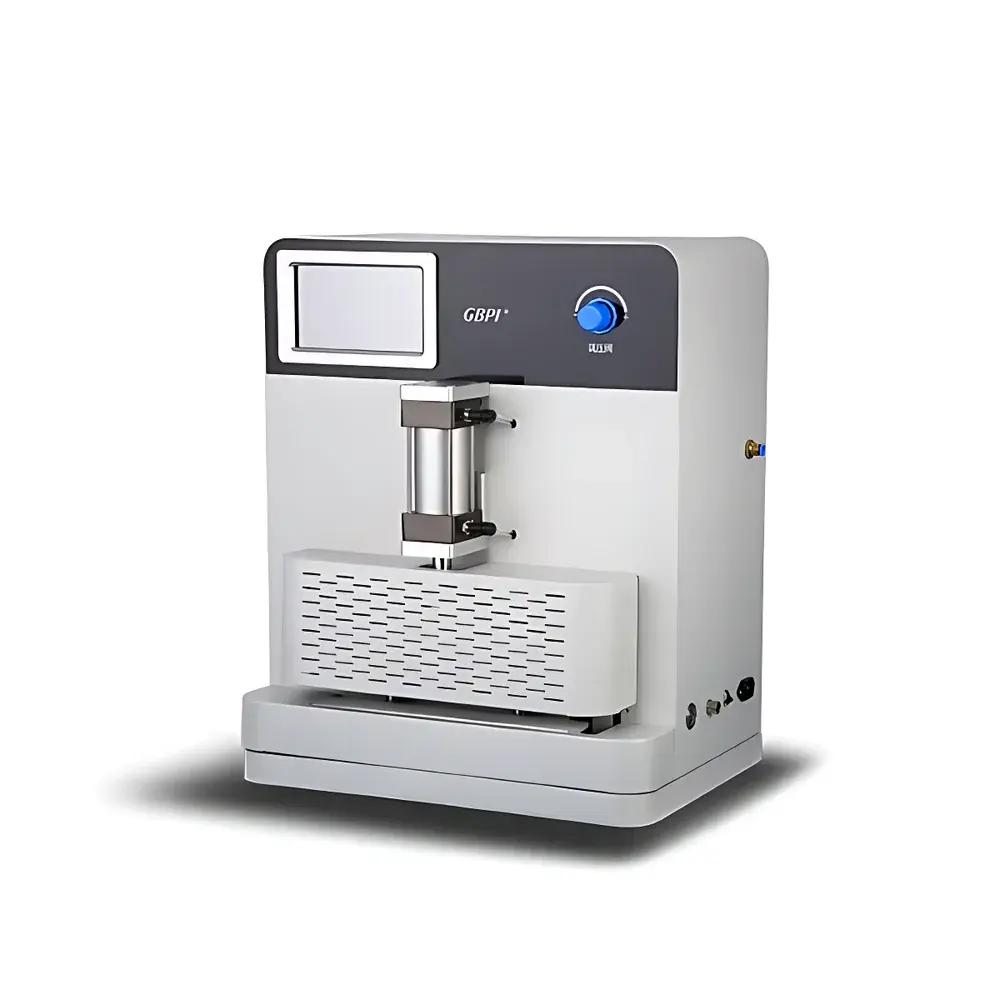
GBPI GBB-F1Z Heat Sealing Tester for Packaging Film Integrity and Process Validation
| Brand | GBPI |
|---|---|
| Model | GBB-F1Z |
| Origin | Guangdong, China |
| Manufacturer | GBPI Packaging Instruments Co., Ltd. |
| Temperature Range | 25–250 °C |
| Temperature Control Accuracy | ±0.1 °C |
| Sealing Time Range | 0.1 s to 99 h 59 min 59.9 s |
| Sealing Pressure Range | 0.1–0.8 MPa |
| Sealing Area | Five independent 35 mm × 10 mm upper sealing bars + silicone-padded lower sealing bar |
| Drive System | Dual-pneumatic cylinder (bottom-mounted, synchronized) |
| Control Mode | Digital PID temperature control with real-time touch-screen display of temperature, pressure, time, and mode status |
| Compliance Standards | QB/T 2358–1998, ASTM F2029, YBB00122003–2015 |
| Power Supply | AC 220 V, 50 Hz |
Overview
The GBPI GBB-F1Z Heat Sealing Tester is an engineered solution for quantitative evaluation of heat seal integrity in flexible packaging materials—specifically designed for laboratories requiring repeatable, traceable, and standards-compliant thermal bonding characterization. It operates on the principle of controlled thermal compression, where defined temperature, dwell time, and pressure are applied across a standardized sealing interface to replicate industrial sealing conditions. This enables precise determination of optimal sealing parameters—including onset of seal initiation, peak seal strength window, and degradation threshold—for multilayer laminates, polymer films (e.g., PE, PP, PET), aluminum foils, coated papers, and pharmaceutical blister lidding materials. Unlike empirical bench-top sealers, the GBB-F1Z integrates metrological-grade thermal regulation and pneumatic force control to deliver data suitable for QC release testing, process validation (IQ/OQ/PQ), and regulatory submissions under ISO 11607-2 and FDA guidance for packaging qualification.
Key Features
- Five-zone independent thermal control: Five individually programmable upper sealing bars (35 mm × 10 mm each) plus a silicone-cushioned lower sealing bar allow simultaneous multi-parameter profiling—critical for evaluating heterogeneous structures such as peelable lids or barrier-coated pouches.
- High-fidelity thermal regulation: Digital PID temperature control with ±0.1 °C stability across the full 25–250 °C range; calibrated platinum RTD sensors ensure NIST-traceable accuracy and minimal thermal drift during extended dwell cycles.
- Pneumatic precision actuation: Dual bottom-mounted air cylinders with synchronized motion path eliminate lateral skew and ensure uniform pressure distribution (0.1–0.8 MPa) across the entire sealing surface—verified via integrated pressure transducer feedback.
- Operational flexibility: Supports manual, automatic, and foot-switch-triggered modes; dwell time resolution down to 0.1 s supports both rapid screening and long-duration aging simulations (up to 99 hours).
- Integrated human-machine interface: 7-inch color capacitive touchscreen displays real-time values for upper/lower zone temperatures, applied pressure, elapsed time, and active mode—no external PC required for basic operation.
- Safety-engineered design: Thermal shielding, auto-locking guard interlocks, and insulated housing meet IEC 61000-6-2 EMC and IEC 61010-1 safety requirements for laboratory instrumentation.
Sample Compatibility & Compliance
The GBB-F1Z accommodates standard film specimens (≥50 mm wide × ≥100 mm long) and supports custom tooling for non-standard geometries—including circular, stepped, or micro-patterned sealing surfaces (optional). Its sealing interface complies with the dimensional and thermal specifications mandated by QB/T 2358–1998 (Chinese national standard for plastic film heat seal strength), ASTM F2029 (standard test method for determining heat seal strength of thermoplastic polymers), and YBB00122003–2015 (Chinese pharmaceutical packaging standard for sterile barrier systems). When equipped with optional audit-trail software, the system satisfies 21 CFR Part 11 requirements for electronic records and signatures—including user-level role assignment (Administrator, Operator, Reviewer), immutable event logging, and method version control—making it suitable for GLP/GMP-regulated environments in pharmaceutical, medical device, and food packaging QA/QC labs.
Software & Data Management
An optional Windows-based application provides advanced method development, batch reporting, and statistical process monitoring. The software enforces user authentication via encrypted login, assigns granular permissions per role (e.g., only Administrators may modify calibration coefficients or delete raw datasets), and maintains three-tier audit trails: system-level (login/logout, firmware updates), method-level (parameter changes, sequence edits), and run-level (actual temperature/pressure/time deviations from setpoints). All exported reports include embedded metadata—test ID, operator ID, instrument serial number, calibration due date, and environmental ambient conditions—ensuring full data lineage for internal audits or regulatory inspections. Raw data is stored in .CSV and .XML formats compatible with LIMS integration and third-party statistical analysis tools (e.g., JMP, Minitab).
Applications
- Determination of minimum sealing temperature (MST) and hot-tack onset for extrusion-coated paperboard used in dairy cartons.
- Validation of seal integrity for cold-form foil blisters in solid oral dosage packaging under accelerated aging protocols.
- Comparative evaluation of ethylene vinyl alcohol (EVOH) barrier layer performance across different seal temperature gradients.
- Process window mapping for vertical form-fill-seal (VFFS) line qualification—correlating lab-scale GBB-F1Z data with production-line seal quality metrics.
- Root cause analysis of delamination failures in retort-stable pouches by isolating pressure-sensitive vs. temperature-sensitive failure modes.
FAQ
What standards does the GBB-F1Z comply with out-of-the-box?
The base unit meets mechanical and electrical safety requirements per IEC 61010-1 and electromagnetic compatibility per IEC 61000-6-2. Thermal and pressure calibration aligns with QB/T 2358–1998 and ASTM F2029 methodologies.
Is external compressed air required for operation?
Yes—a clean, dry, oil-free air supply (minimum 0.8 MPa, 2.5 HP compressor recommended) is mandatory. An inline triple-filter (particulate, oil, moisture) is strongly advised to prevent pneumatic valve contamination.
Can the sealing bar geometry be customized?
Yes. GBPI offers OEM tooling services for non-standard sealing profiles—including radius edges, embossed patterns, or asymmetric widths—subject to mechanical feasibility review.
Does the system support IQ/OQ protocol execution?
Yes. Documentation packages—including URS, FAT/SAT checklists, calibration certificates, and blank OQ test scripts aligned with ISO 13485 and Annex 11—are available upon request.
What maintenance intervals are recommended?
Daily visual inspection of sealing surfaces and pneumatic fittings; quarterly verification of temperature sensor offset using certified reference blocks; annual full calibration by GBPI-certified service engineer or accredited third-party lab.