
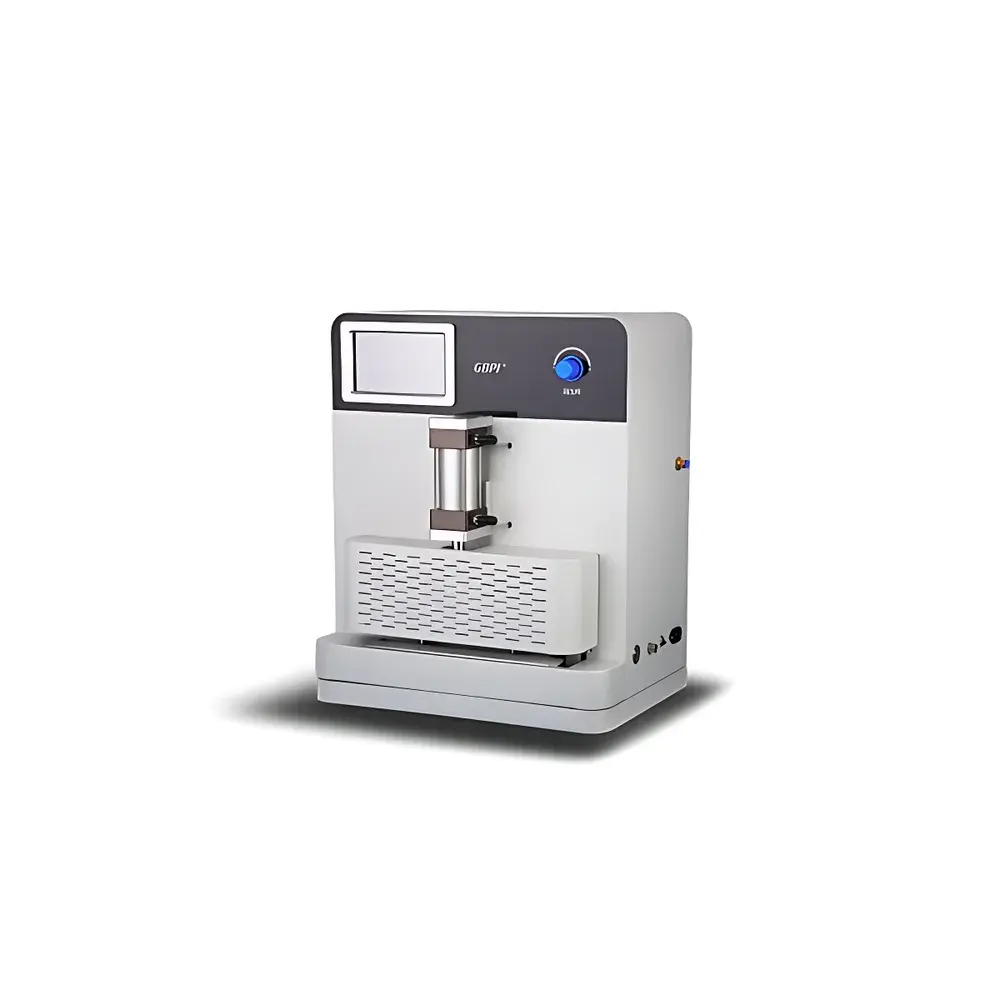
GBPI GBB-F2B Heat Sealing Tester for Packaging Integrity and Seal Strength Evaluation
| Brand | GBPI |
|---|---|
| Model | GBB-F2B |
| Origin | Guangdong, China |
| Manufacturer Type | Direct Manufacturer |
| Country of Origin | China |
| Price Range | USD 4,200 – 7,000 (FOB Guangzhou) |
| Thermal Sealing Temperature Range | Ambient to 300 °C |
| Temperature Control Accuracy | ±0.2 °C |
| Sealing Time Range | 0.01 s to 99.99 h |
| Sealing Pressure Range | 0.05–0.8 MPa |
| Sealing Surface Dimensions | 35 mm × 10 mm (smooth lower sealing bar with silicone pad) |
| Heating Method | Dual-zone resistive heating |
| Actuation | Pneumatic (external cylinder) |
| Control Interface | Touchscreen HMI |
| Operating Modes | Automatic & Manual (foot-switch enabled) |
| Compliance Standards | QB/T 2358–1998, ASTM F2029–22, YBB00122003–2015 |
Overview
The GBPI GBB-F2B Heat Sealing Tester is an engineered laboratory instrument designed to quantitatively determine the optimal thermal sealing parameters—temperature, pressure, and dwell time—for flexible packaging materials. It operates on the principle of controlled pneumatic compression combined with precision-resistive heating, enabling reproducible seal formation under defined boundary conditions. This device is essential for establishing process windows during packaging development, validating seal integrity in quality control environments, and supporting regulatory submissions for pharmaceutical blister packs, food pouches, medical device sterile barriers, and laminated sachets. Its dual-zone heating architecture allows independent thermal profiling of upper and lower sealing elements, supporting comparative evaluation of asymmetric material structures and multi-layer film systems.
Key Features
- Five independently controllable upper sealing bars plus one lower sealing bar—enabling simultaneous multi-point thermal parameter mapping across a single sample strip.
- Digital PID temperature control with ±0.2 °C stability; integrated thermocouple calibration interface for traceable sensor verification per ISO/IEC 17025 requirements.
- Pneumatic actuation system with real-time pressure feedback and adjustable regulator—ensuring consistent force application across varying material thicknesses and compressibility profiles.
- Touchscreen HMI with intuitive parameter entry, real-time display of actual vs. setpoint temperatures (upper/lower zones), applied pressure (MPa), and elapsed sealing time (down to 0.01-second resolution).
- Manual mode activated via industrial-grade foot switch—ideal for rapid prototyping, operator training, or low-volume validation runs without software intervention.
- Modular sealing bar design: standard smooth surface with silicone-backed lower bar; optional upgrades include anti-adhesion coatings (e.g., PTFE-impregnated anodized aluminum), custom geometries (rounded, stepped, or embossed), and extended dimensions up to 100 mm width.
Sample Compatibility & Compliance
The GBB-F2B accommodates a broad spectrum of polymeric packaging substrates—including LDPE, PP, PET/AL/PE laminates, cold-form foil, Tyvek®/polyethylene composites, and pharmaceutical-grade thermoformable films. Its 35 mm × 10 mm active sealing area meets minimum dimensional requirements specified in ASTM F2029–22 for peel strength correlation studies. The instrument conforms to national and international standards governing packaging seal evaluation: QB/T 2358–1998 (China), ASTM F2029–22 (Standard Test Method for Making Heat-Sealed Packages for Testing), and YBB00122003–2015 (Chinese Pharmacopoeia packaging guidance for sterile products). When integrated into validated QC workflows, it supports GLP-compliant documentation and aligns with FDA 21 CFR Part 11 expectations for electronic record integrity when paired with audit-trail-enabled data export protocols.
Software & Data Management
While the GBB-F2B operates as a standalone benchtop unit with embedded firmware, its RS-232 and USB interfaces support seamless integration with third-party LIMS or MES platforms. Exported data includes timestamped parameter logs (setpoint/actual temperature per zone, pressure profile, cycle duration), operator ID (via optional RFID badge reader), and pass/fail flags based on user-defined acceptance criteria. All exported CSV files retain native units and comply with ASTM E1447–21 metadata conventions. Optional PC-based configuration software enables batch programming of up to 99 sealing protocols, automated report generation (PDF/Excel), and trend analysis across production lots—facilitating root cause investigation during out-of-specification seal events.
Applications
- Establishing thermal seal initiation and hot tack onset temperatures for new film formulations.
- Validating seal strength consistency across production shifts using standardized test coupons per ISO 11607–2 Annex C.
- Supporting packaging process qualification (PPQ) for pharmaceutical primary packaging under ICH Q5C and EU Annex 15 guidelines.
- Conducting accelerated aging correlation studies by linking seal parameter changes to post-storage peel strength degradation.
- Performing comparative testing of alternative sealants, barrier layers, or adhesive primers in R&D laboratories.
- Training packaging line technicians on optimal sealer setup parameters prior to full-scale equipment commissioning.
FAQ
What standards does the GBB-F2B directly support for regulatory submissions?
It complies with ASTM F2029–22, QB/T 2358–1998, and YBB00122003–2015—each cited in FDA, NMPA, and PMDA packaging review dossiers.
Can the sealing pressure be calibrated in-house?
Yes—the integrated pressure transducer supports zero/span adjustment using NIST-traceable deadweight testers; calibration certificates are issued per ISO/IEC 17025.
Is the touchscreen interface available in English language firmware?
Standard firmware includes English, Simplified Chinese, and Spanish UI options; additional languages can be added via firmware update.
Does the instrument support dynamic pressure ramping during sealing?
No—it delivers constant pressure throughout the dwell period; variable-pressure profiles require external PLC integration via analog I/O expansion module (optional accessory).
What maintenance intervals are recommended for pneumatic components?
Air filter lubricator units require quarterly inspection; cylinder seals are rated for ≥500,000 cycles and should be replaced every 24 months under continuous lab use.





