GBPI GBB-F3 Five-Point Heat Sealing Tester
| Brand | GBPI |
|---|---|
| Origin | Guangdong, China |
| Manufacturer Type | Direct Manufacturer |
| Country of Origin | China |
| Model | GBB-F3 |
| Temperature Range | Ambient to 300 °C |
| Temperature Control Accuracy | ±1 °C |
| Sealing Time Range | 0.01 s to 99.99 h |
| Sealing Pressure Range | 0.05–0.8 MPa |
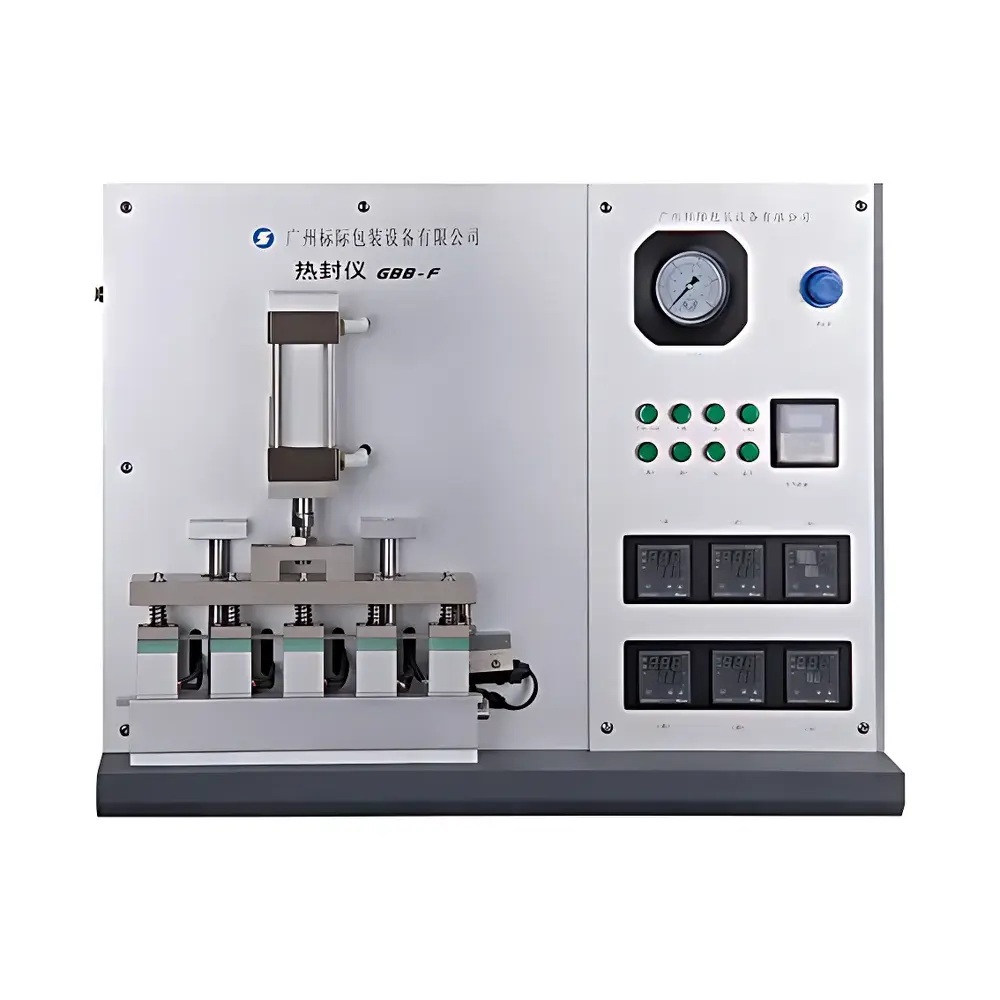
| Sealing Surface Configuration | Five independent 35 mm × 10 mm upper sealing blades (heated) + one silicone-padded lower sealing bar (heated) |
| Heating Method | Dual-zone resistive heating (upper and lower independently controlled) |
| Pneumatic Source | Compressed air, 0.5–0.8 MPa |
| Dimensions (W×D×H) | 700 × 400 × 540 mm |
| Weight | 55 kg |
| Power Rating | 2000 W |
| Electrical Supply | AC 220 V, 50 Hz |
| Compliance Standards | QB/T 2358–1998, ASTM F2029–2016, YBB 00122003–2015 |
Overview
The GBPI GBB-F3 Five-Point Heat Sealing Tester is an engineered laboratory instrument designed for precise, repeatable evaluation of thermoplastic seal integrity across packaging materials. It operates on the principle of controlled thermal energy transfer under regulated pressure and dwell time—fundamental parameters governing seal formation in flexible packaging structures. Unlike single-zone heat sealers, the GBB-F3 implements a distributed five-point sealing architecture, enabling simultaneous assessment of seal strength variability across discrete regions of a single sample or comparative analysis of multiple material configurations under divergent thermal profiles. This capability is critical for validating seal robustness in pharmaceutical blister lidding, sterile barrier systems, medical device pouches, and food-grade laminates where localized thermal gradients or heterogeneous material composition may compromise overall package integrity.
Key Features
- Five independently programmable sealing zones: Each of the five 35 mm × 10 mm upper sealing blades features dedicated temperature control (ambient to 300 °C, ±1 °C accuracy), allowing differential thermal profiling across a single test specimen.
- Dual-zone heating architecture: Both upper blades and lower silicone-padded sealing bar are actively heated and separately regulated—ensuring uniform thermal input regardless of material thickness or thermal conductivity asymmetry.
- Pneumatically actuated sealing mechanism: Driven by clean, oil-free compressed air (0.5–0.8 MPa), delivering consistent, reproducible force application (0.05–0.8 MPa) with minimal mechanical hysteresis.
- Flexible operational modes: Supports both manual (foot-switch triggered) and automated sequences, accommodating rapid screening or fully documented, protocol-driven testing workflows.
- Configurable sealing interface: Sealing blade geometry, surface finish (e.g., polished, matte, or micro-textured), and anti-adhesion coatings (e.g., PTFE or ceramic composite) can be customized per application requirements.
- Traceable temperature calibration: Integrated Pt100 RTD sensors at each zone enable field verification and NIST-traceable recalibration without disassembly.
Sample Compatibility & Compliance
The GBB-F3 accommodates a broad spectrum of thermoplastic packaging substrates—including polyethylene (LDPE, HDPE), polypropylene (CPP, OPP), polyester (PET), aluminum foil laminates, and multilayer coextrusions used in pharmaceutical, food, and medical packaging. Its five-point configuration supports ASTM F2029–2016 (Standard Test Method for Making Heat-Sealed Packages for Use in Determining the Hot Tack Strength of Thermoplastic Films), QB/T 2358–1998 (Chinese standard for plastic film heat seal strength), and YBB 00122003–2015 (Chinese pharmacopoeial standard for packaging material heat seal performance). The system’s pneumatic force delivery and digital timing resolution (0.01 s) ensure compliance with GLP and GMP documentation requirements when integrated with validated data acquisition software.
Software & Data Management
While the base unit operates via intuitive front-panel controls, optional PC-based software enables full test method definition, real-time parameter logging (temperature, pressure, time), and export of timestamped CSV reports compliant with FDA 21 CFR Part 11 audit trail requirements. All setpoints, actual readings, and operator IDs are recorded with immutable timestamps. Software modules support multi-user access control, electronic signatures, and automatic report generation aligned with ISO/IEC 17025 documentation frameworks.
Applications
- Optimization of heat seal parameter windows (temperature, pressure, dwell time) for new packaging materials or process transfers.
- Hot tack strength evaluation during early-stage seal formation—critical for vertical form-fill-seal (VFFS) and horizontal form-fill-seal (HFFS) line qualification.
- Root cause analysis of seal failures (leakage, delamination, channeling) through spatially resolved thermal mapping.
- Validation of sterilization-compatible seals subjected to autoclave or ethylene oxide post-seal treatment.
- Regulatory submission support for packaging validation dossiers (e.g., FDA Drug Master File, EU CEP).
FAQ
Does the GBB-F3 support automated data export for regulatory submissions?
Yes—when paired with optional compliant software, it generates audit-ready CSV and PDF reports with full electronic signatures, timestamped event logs, and user access tracking per 21 CFR Part 11.
Can sealing blade dimensions be modified for non-standard pouch geometries?
Yes—custom blade lengths, widths, and cross-sectional profiles (e.g., rounded, chamfered, or stepped) are available upon request, subject to mechanical compatibility and thermal uniformity validation.
Is compressed air supply included with the instrument?
No—the unit requires an external, oil-free compressed air source meeting ISO 8573-1 Class 2:2:2 specifications; GBPI provides interface fittings and pressure regulation guidance.
How is temperature uniformity verified across the five sealing zones?
Each zone is calibrated using traceable surface thermocouples; GBPI supplies a calibration certificate with initial delivery and recommends annual verification per ISO/IEC 17025-accredited procedures.
What maintenance intervals are recommended for long-term reliability?
Pneumatic valve inspection every 6 months, silicone pad replacement every 12 months under continuous use, and full thermal calibration annually—documented in the provided maintenance log template.