
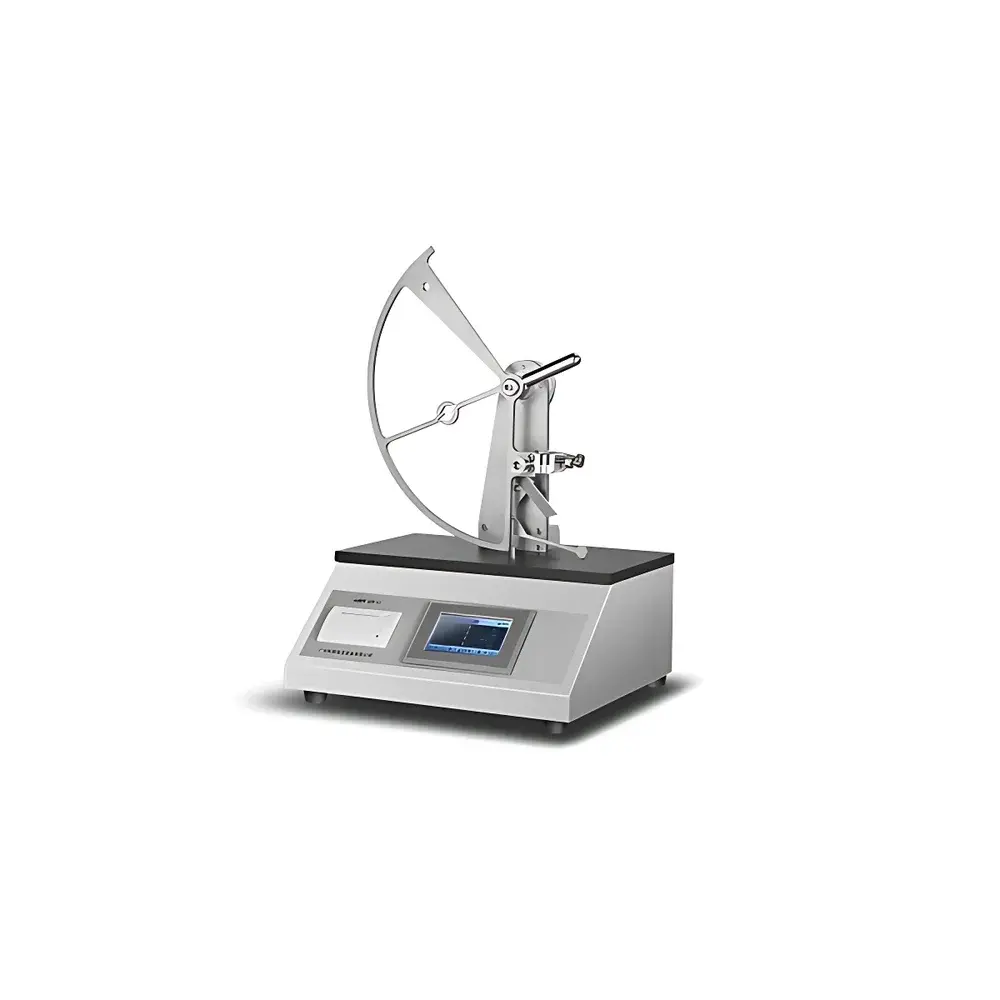
GBPI GBD-S1 Dart Impact Tester for Plastic Film Tear Resistance
| Brand | GBPI |
|---|---|
| Model | GBD-S1 |
| Application | Dart impact energy measurement per GB/T 9639.1 & ASTM D1709-01 |
| Test Range | 0–6400 gf (0–18000 mN) |
| Tear Arm Length | 104 ± 1 mm |
| Initial Tear Angle | 27.5° ± 0.5° |
| Indication Error | ≤ ±0.5% of full scale (20–90% range) |
| Relative Indication Variation | ≤ 1% |
| Pneumatic Supply | 0.2–0.4 MPa (user-supplied, Φ6 mm polyurethane tubing) |
| Dimensions | 430 × 370 × 650 mm |
| Weight | 50 kg |
| Power | 100 W, AC 220 V, 50 Hz |
Overview
The GBPI GBD-S1 Dart Impact Tester is an electromechanical instrument engineered for precise determination of tear resistance in thin flexible materials—primarily plastic films and sheets up to 1 mm thickness—using the free-falling dart method. It operates on the principle defined in ISO 6383, ISO 1974, ASTM D1709-01 (Standard Test Method for Impact Resistance of Plastic Film by the Free-Falling Dart Method), and GB/T 9639.1. The device measures the kinetic energy required to initiate and propagate a tear under standardized impact conditions, expressed as the mass (in grams-force or millinewtons) of a falling dart that produces specimen failure. This quantification supports material selection, process validation, and quality assurance in packaging development and production environments where mechanical durability under dynamic stress is critical.
Key Features
- Integrated LCD interface with real-time display of test status, force values, and impact event timing—enabling standalone operation without external computing hardware.
- Pneumatically actuated clamping system ensures consistent sample fixation across repeated tests, minimizing operator-induced variability and supporting GLP-compliant repeatability.
- Built-in thermal printer generates immediate hard-copy reports containing test date, sample ID, impact mass, pass/fail flag, and operator signature field—fully traceable per ISO/IEC 17025 documentation requirements.
- Calibration-ready architecture with six certified reference weights (110 g, 220 g, 440 g, 880 g, 1730 g, 3470 g) traceable to national metrological standards; calibration verification intervals align with ASTM E4 and ISO/IEC 17025 recommendations.
- Modular software suite (supplied on USB drive) provides data logging, statistical analysis (mean, SD, CV%), curve visualization (force vs. time), and export to CSV/PDF formats compatible with LIMS integration.
- Robust mechanical design featuring rigid aluminum frame, precision-machined tear arm (104 ± 1 mm), and angularly constrained pendulum path (27.5° ± 0.5° initial tear angle) to ensure compliance with geometric tolerances specified in GB/T 16578.2 and ASTM D1922.
Sample Compatibility & Compliance
The GBD-S1 accommodates specimens conforming to standard dimensions per GB/T 455, ASTM D1424 (tongue tear), ASTM D689 (Elmendorf tear), and TAPPI T414. It is validated for use with polyethylene (PE), polypropylene (PP), polyester (PET), laminated structures, coated metal foils, and polymer-coated steel substrates. All mechanical and pneumatic components meet CE machinery directive (2006/42/EC) safety requirements. The instrument supports audit readiness for FDA-regulated packaging validation (21 CFR Part 11 compliant data handling when used with optional software configuration), and its measurement uncertainty budget is documented per ISO/IEC 17025 Annex A.2 for accredited testing laboratories.
Software & Data Management
The proprietary GBPI TestSuite software enables automated test sequencing, batch reporting, and multi-user access control. Audit trails record all parameter changes, calibration events, and report generation timestamps. Data files include embedded metadata (operator ID, environmental temperature/humidity if logged externally), and digital signatures can be applied prior to export. Raw force-time datasets are stored in open-format ASCII for third-party statistical analysis (e.g., JMP, Minitab). Software updates are delivered via secure HTTPS portal; version history and change logs comply with ICH Q9 risk-based validation principles.
Applications
- Quality control of blown and cast film extrusion lines—monitoring batch-to-batch consistency in tear initiation energy.
- R&D evaluation of additive effects (e.g., slip agents, antioxidants) on film toughness and propagation resistance.
- Regulatory submission support for medical device packaging per ISO 11607-1, where seal integrity under impact must be demonstrated.
- Supplier qualification testing against contractual tear specifications (e.g., ≥2500 gf minimum for heavy-duty shipping sacks).
- Educational labs teaching polymer mechanics, fracture dynamics, and standardized test methodology per ASTM E29 and ISO 5725.
FAQ
What standards does the GBD-S1 fully support out-of-the-box?
GB/T 9639.1, ASTM D1709-01, ISO 6383, ISO 1974, GB/T 16578.2, GB/T 455, ASTM D1922, ASTM D1424, ASTM D689, and TAPPI T414.
Is compressed air supply included with the instrument?
No—the unit requires user-supplied clean, dry compressed air at 0.2–0.4 MPa via Φ6 mm polyurethane tubing; air filtration (particulate, oil, moisture) is mandatory for long-term valve reliability.
Can test data be integrated into a laboratory information management system (LIMS)?
Yes—CSV and PDF exports are structured for direct ingestion; optional API module enables real-time data push to LIMS platforms compliant with ASTM E1469 and ISO/IEC 17025 Clause 7.7.
What maintenance is required for routine operation?
Monthly visual inspection of pneumatic fittings and tear arm pivot bearings; annual recalibration using supplied weights and traceable torque wrench; biannual verification of LCD contrast and print head alignment.
Does the GBD-S1 meet regulatory requirements for pharmaceutical packaging validation?
When operated with validated software configuration and documented calibration records, it satisfies data integrity expectations under FDA 21 CFR Part 11 and EU Annex 11 for non-sterile packaging component testing.






