
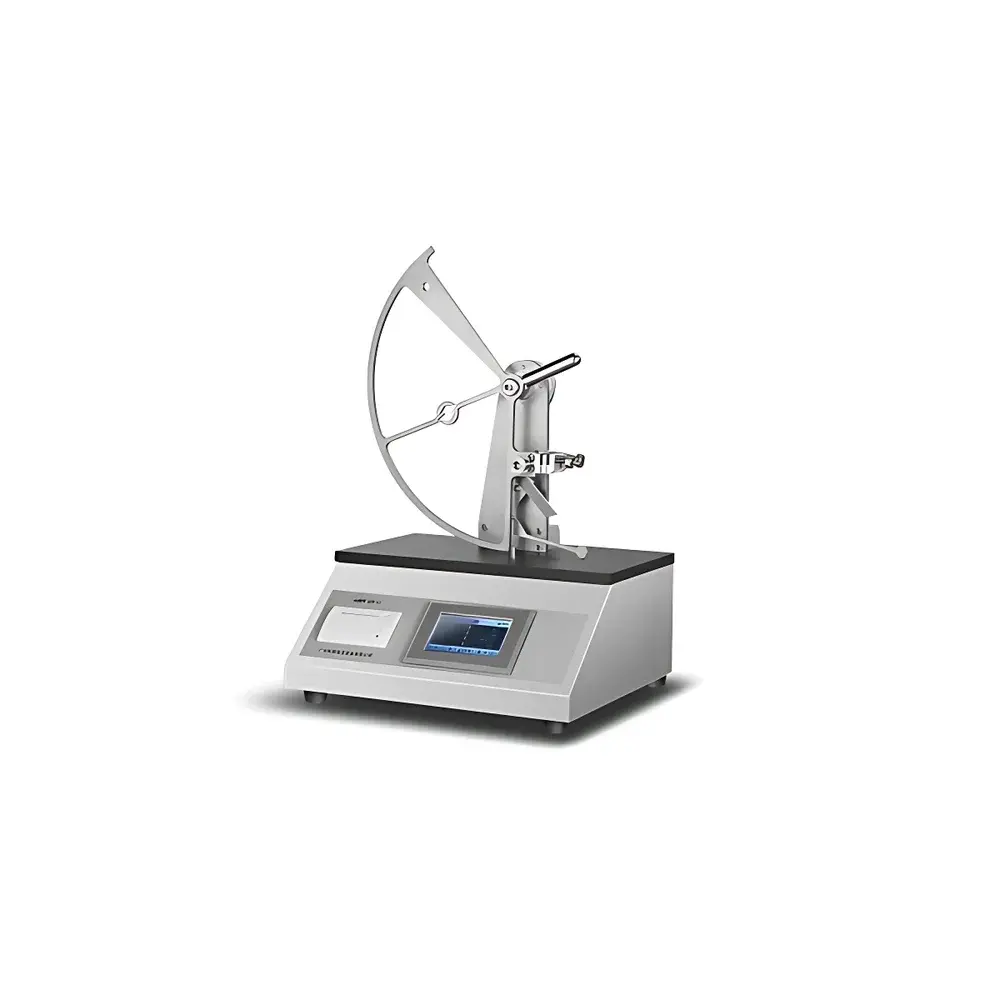
GBPI GBD-S2 Dart Impact Tester for Plastic Film Tear Resistance
| Brand | GBPI |
|---|---|
| Model | GBD-S2 |
| Origin | Guangdong, China |
| Manufacturer Type | Direct Manufacturer |
| Country of Origin | China |
| Price Range | USD 4,200 – 7,000 |
| Test Standard Compliance | GB/T 9639.1, ASTM D1709-01, GB/T 16578.2, GB/T 455, ASTM D1922, ASTM D1424, ASTM D689, ISO 6383, ISO 1974, TAPPI T414 |
| Measurement Range | 0–6400 gf (0–18000 mN) |
| Tear Pendulum Arm Length | 104 ± 1 mm |
| Initial Tear Angle | 27.5° ± 0.5° |
| Indication Error | ≤ ±0.5% of full scale (within 20–90% FS) |
| Relative Indication Variation | ≤ 1% |
| Pneumatic Supply Pressure | 0.2–0.4 MPa |
| Air Inlet Fitting | Φ6 mm polyurethane tubing |
| Dimensions (W×D×H) | 430 × 370 × 650 mm |
| Weight | 50 kg |
| Power Consumption | 100 W |
| Electrical Supply | AC 220 V, 50 Hz |
Overview
The GBPI GBD-S2 Dart Impact Tester is a precision-engineered instrument designed for the quantitative evaluation of tear resistance in thin, flexible sheet materials—primarily plastic films, foils, coated papers, and thin polymer-coated metal substrates. It operates on the principle of pendulum-type dart impact testing, where a weighted dart is released from a fixed height to strike a clamped specimen under controlled conditions. The energy required to initiate and propagate a tear is determined by the mass of the dart at the threshold of specimen failure, expressed in gram-force (gf) or millinewtons (mN). This method aligns with established mechanical fracture mechanics principles for brittle-to-ductile transition behavior in thin-section polymers. The instrument is rigorously calibrated and validated against international standard test protocols—including GB/T 9639.1 (Chinese national standard), ASTM D1709-01 (Standard Test Method for Impact Resistance of Plastic Film by the Free-Falling Dart Method), and complementary tear propagation standards such as ASTM D1922 (Propagating Tear Resistance) and ISO 1974 (Tearing Resistance of Paper and Board). Its design emphasizes repeatability, operator independence, and traceable metrology—making it suitable for routine quality control, R&D material screening, and regulatory conformance testing in packaging development laboratories.
Key Features
- Integrated high-contrast LCD display showing real-time force readings, test status, and pass/fail indicators—enabling fully standalone operation without external computing hardware.
- Pneumatically actuated specimen clamping and dart release mechanism ensures consistent preload application and eliminates manual variability in trigger timing.
- Onboard thermal printer provides immediate hard-copy output of test reports, including sample ID, test date/time, measured tear force, standard deviation, and compliance flagging per selected method.
- Dual-range force transduction system with calibrated load cell covering 0–6400 gf (0–18000 mN), compliant with ISO/IEC 17025 traceability requirements when used with certified calibration weights.
- Fixed-pendulum geometry with precisely machined 104 ± 1 mm arm length and 27.5° ± 0.5° initial tear angle—ensuring strict adherence to ASTM D1709 geometric constraints for inter-laboratory comparability.
- Low-drift analog signal conditioning and digital filtering minimize noise-induced fluctuations, achieving ≤1% relative indication variation across repeated measurements under identical conditions.
Sample Compatibility & Compliance
The GBD-S2 accommodates specimens up to 1 mm in thickness, including biaxially oriented polypropylene (BOPP), low-density polyethylene (LDPE), polyethylene terephthalate (PET), metallized films, laminated structures, and polymer-coated steel sheets. Specimen dimensions conform to standard circular die-cut formats (typically Ø100 mm) as specified in GB/T 9639.1 and ASTM D1709. The instrument supports dual-mode validation: single-point verification using certified reference masses and full-range linearity checks across 20–90% of full scale, meeting the ±0.5% indication error tolerance mandated by ISO 6383-1. All mechanical components are constructed from corrosion-resistant anodized aluminum and hardened stainless steel, ensuring long-term dimensional stability under industrial lab environments. Calibration certificates issued by GBPI’s CNAS-accredited metrology lab (CNAS L8225) are available upon request, supporting GLP/GMP audit readiness.
Software & Data Management
A dedicated Windows-based software suite (GBPI TestSuite v3.2) is optionally available for advanced data handling. It enables multi-sample batch configuration, automated statistical analysis (mean, SD, CV%, min/max), trend charting over time, and customizable report generation compliant with FDA 21 CFR Part 11 requirements—including electronic signatures, audit trails, and user access controls. Raw force-time datasets are exportable in CSV and XML formats for integration into LIMS or enterprise QA platforms. The embedded firmware supports firmware updates via USB, with version logging and checksum validation to ensure integrity of measurement algorithms.
Applications
- Quality assurance of food, pharmaceutical, and medical device packaging films during incoming raw material inspection and finished product release testing.
- Formulation optimization of polymer blends and additive packages (e.g., impact modifiers, slip agents) in R&D settings.
- Validation of coating adhesion and substrate-film interfacial toughness in flexible electronics and barrier film manufacturing.
- Comparative tear performance benchmarking across supplier lots or competitive benchmarking studies.
- Supporting technical documentation for ISO 9001, IATF 16949, and packaging-specific certifications such as ISTA 3A or ASTM D4169.
FAQ
What standards does the GBD-S2 directly support?
It is configured and verified for GB/T 9639.1, ASTM D1709-01, and cross-referenced with GB/T 16578.2, ASTM D1922, ISO 6383, and TAPPI T414 for tear propagation assessment.
Is compressed air supply included with the instrument?
No—the unit requires an external clean, dry compressed air source delivering 0.2–0.4 MPa via a standard Φ6 mm polyurethane tube; regulators and filters must be provided by the user.
Can test data be exported to Excel or LIMS systems?
Yes—both the onboard printer and optional PC software support CSV and XML exports compatible with Microsoft Excel, LabWare LIMS, and TrackWise QA platforms.
What maintenance is required for long-term accuracy?
Annual recalibration using NIST-traceable weights is recommended; routine cleaning of the dart tip, clamp jaws, and pneumatic pathways is advised every 200 tests or monthly—whichever occurs first.
Does the instrument meet regulatory requirements for pharmaceutical packaging testing?
When operated with documented calibration, preventive maintenance logs, and validated software (if used), it satisfies the instrumentation qualification criteria outlined in USP <1207> and EU Annex 15 for deterministic tear resistance verification.






