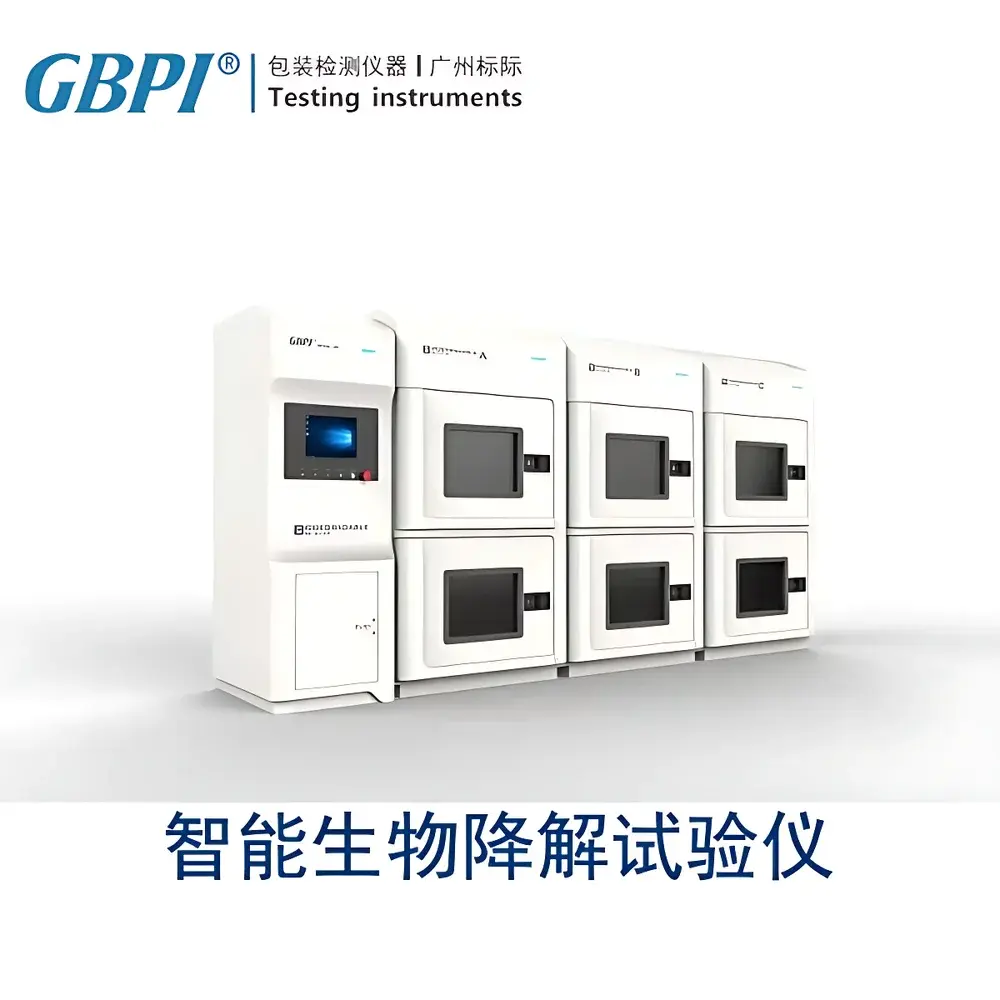
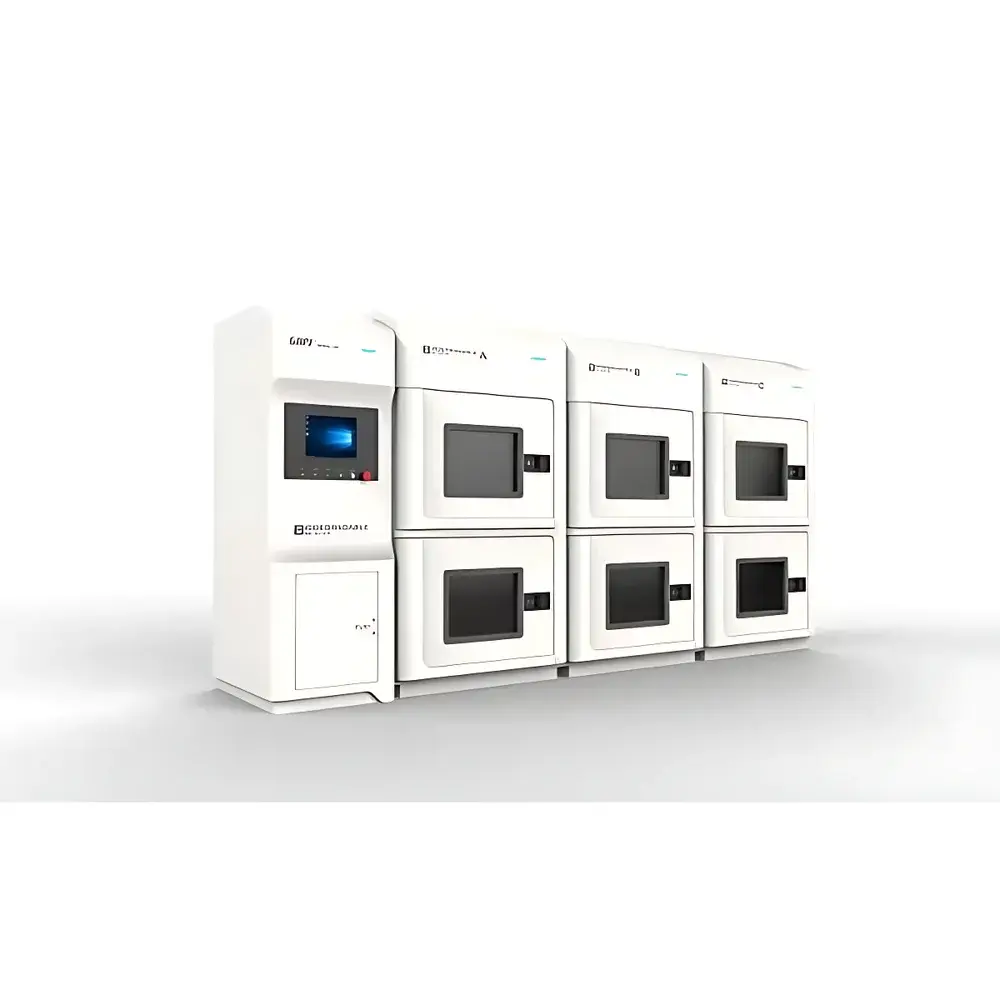

GBPI GBDA-180a High-Throughput Aerobic Biodegradation Testing System
| Brand | GBPI |
|---|---|
| Origin | Guangdong, China |
| Manufacturer Type | Direct Manufacturer |
| Country of Origin | China |
| Model | GBDA-180a |
| Price Range | USD 70,000–112,000 (FOB Guangzhou) |
| Measurement Resolution | ±1.0% FS |
| Gas Flow Rate | 0.01–10 L/min |
| Reactor Volume | 3 L |
| Maximum Number of Simultaneous Reactors | 18 |
| Temperature Control Range | Ambient to 80 °C |
| Temperature Control Accuracy | ±0.5 °C |
| CO₂ Detection Range | 0–10,000 ppm |
| CO₂ Detection Accuracy | ±1% FS |
| O₂ Detection Range | 0–25% vol |
| O₂ Detection Accuracy | ±1% FS |
| Pressure Range | 0–100 kPa |
| Pressure Accuracy | ±1% FS |
| Gas Supply Pressure | 0.2–0.8 MPa |
| Power Supply | AC 220 V, 50 Hz |
| Total Power Consumption | 5 kW |
| Dimensions (L×W×H) | 6950 × 1800 × 650 mm |
| Weight | 1500 kg |
Overview
The GBPI GBDA-180a High-Throughput Aerobic Biodegradation Testing System is an engineered platform for standardized, quantitative assessment of aerobic biodegradability under controlled composting conditions. It implements the respirometric principle—measuring cumulative CO₂ evolution as the primary indicator of organic carbon mineralization—per ASTM D5338, ISO 14855-1:2012, and GB/T 19277.1–2011 (identical to ISO 14855-1). The system supports simultaneous evaluation of up to 18 independent test specimens across identical or variable environmental regimes—including temperature (ambient to 80 °C), relative humidity, aeration rate (0.01–10 L/min), and mechanical agitation—enabling statistically robust inter-sample comparison and accelerated method development. Each reactor operates with fully isolated gas routing, real-time multi-parameter monitoring (CO₂, O₂, pressure, flow, temperature), and closed-loop feedback control, ensuring reproducible test conditions compliant with GLP-aligned laboratory practices.
Key Features
- Eighteen independently controlled 3 L stainless-steel reactors with integrated heating jackets, humidity regulation, and programmable orbital shaking (frequency and duty cycle configurable)
- High-stability gas delivery architecture featuring mass flow controllers (MFCs) calibrated to ±1.0% full-scale accuracy and traceable to NIST-traceable standards
- Dual-channel optical NDIR CO₂ sensors (0–10,000 ppm, ±1% FS) and electrochemical O₂ sensors (0–25% vol, ±1% FS), both factory-calibrated and field-verifiable via built-in zero/span verification routines
- PID-fuzzy logic temperature control with ±0.5 °C stability across all reactors; independent thermal zoning prevents cross-reactor thermal coupling
- Modular PLC-based acquisition system with 100 ms sampling resolution per channel; timestamped raw data stored locally and synchronized to host PC via Ethernet
- Medical-grade three-tier user permission architecture (Administrator, Operator, Observer) with role-specific access to configuration, method editing, data export, and audit trail review
- Full 21 CFR Part 11 compliance support: electronic signatures, immutable audit trails (system, method, run-level), automatic session timeout, and password policy enforcement
- Self-diagnostic gas-tightness verification protocol executed prior to each test sequence; leak detection sensitivity < 0.5 mL/min at 100 kPa
Sample Compatibility & Compliance
The GBDA-180a accommodates solid polymeric materials (films, fibers, molded parts), granular additives, and powdered organic substrates within standard 3 L reactor vessels. Sample mass is determined per ISO 14855-1 guidelines (typically 1–2% w/w of total compost matrix). The system meets regulatory requirements for testing bioplastics, mulch films, packaging components, and medical device polymers intended for industrial composting facilities. It is validated for conformance with GB/T 19277.1–2011 (ISO 14855-1), GB/T 19277.2–2013 (ISO 14855-2), GB/T 19811–2005 (ISO 20200), GB/T 29649–2013, GB/T 33797–2017, and GB/T 22047–2008. All sensor calibrations are traceable to national metrology institutes; annual calibration certificates are provided with instrument delivery.
Software & Data Management
GBPI BioTrack™ v4.2 software provides end-to-end experimental lifecycle management—from method creation and batch scheduling to real-time visualization, statistical analysis, and report generation. The interface supports customizable dashboards with live trend plots (CO₂ evolution rate, O₂ depletion, temperature profiles), automated calculation of biodegradation percentage (based on theoretical CO₂ yield), and pass/fail determination against threshold criteria (e.g., ≥90% mineralization in 180 days). Raw data exports include CSV, Excel (.xlsx), and PDF formats with embedded metadata (operator ID, timestamp, instrument serial number, calibration status). Audit trails record every action—including parameter changes, manual overrides, and report modifications—with user ID, timestamp, and pre-/post-value logging. Data integrity is ensured through AES-256 encryption at rest and TLS 1.2 encrypted transmission.
Applications
- Quantitative evaluation of aerobic biodegradation kinetics for polyhydroxyalkanoates (PHA), polylactic acid (PLA), polybutylene adipate terephthalate (PBAT), and starch-blend composites
- Regulatory submission testing for EN 13432, OK Compost INDUSTRIAL, and ASTM D6400 certification
- Comparative screening of pro-degradant additives and enzymatic masterbatches in polyolefin matrices
- Assessment of soil-burial biodegradation potential under modified OECD 301F protocols
- Process optimization of industrial composting parameters (aeration rate vs. CO₂ yield, temperature ramping profiles)
- Validation of biodegradation claims for food-contact packaging, agricultural mulch films, and single-use medical devices
FAQ
What international standards does the GBDA-180a support out-of-the-box?
The system includes pre-configured test methods for ISO 14855-1, ISO 14855-2, GB/T 19277.1, GB/T 19277.2, and ASTM D5338, with all required calculation algorithms and reporting templates embedded in BioTrack™ software.
Can individual reactors operate at different temperatures or gas flow rates?
Yes—each of the 18 reactors features independent PID temperature control and dedicated MFCs, enabling heterogeneous experimental designs such as temperature gradient studies or comparative aeration trials.
Is remote monitoring and data retrieval supported?
The system supports secure remote access via VPN or corporate intranet; real-time data streaming, alarm notifications, and historical query are available through the web-enabled BioTrack™ Server module.
How is measurement traceability maintained across sensor replacements?
All sensors ship with individual calibration certificates referencing national standards; the software enforces mandatory recalibration logging before test initiation, and deviation alerts trigger automatic suspension of data acquisition.
What maintenance intervals are recommended for long-term operational reliability?
Quarterly verification of gas-tightness and flow calibration, semi-annual sensor performance validation using certified gas standards, and annual full-system metrological recalibration by GBPI-certified engineers are advised per ISO/IEC 17025-based maintenance protocols.