
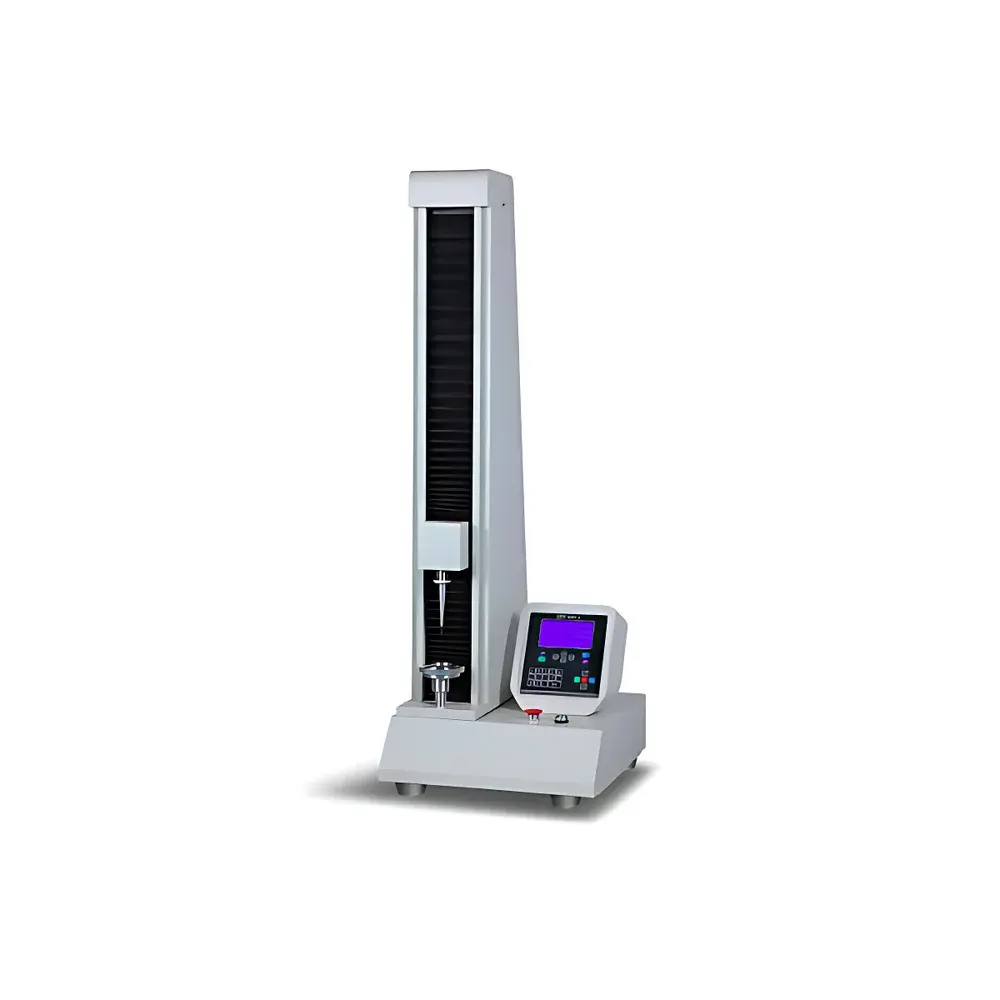
GBPI GBH-1AT Single-Column Electronic Tensile Testing Machine
| Brand | GBPI |
|---|---|
| Origin | Guangdong, China |
| Manufacturer Type | Direct Manufacturer |
| Country of Origin | China |
| Model | GBH-1AT |
| Instrument Type | Electronic Tensile Testing Machine |
| Maximum Test Load | 1.5 kN |
| Force Range | 0–500 N (optional 0–1500 N) |
| Elongation Capacity | up to 1400% |
| Force Accuracy | ±0.5% of reading (Class 0.5) |
| Crosshead Travel | 750 mm |
| Displacement Resolution | ±0.5% of reading |
| Effective Specimen Width | 30 mm (customizable to 50 mm) |
| Test Speed | 0–500 mm/min (infinitely variable) |
| Power Supply | AC 220 V, 50 Hz |
| Rated Power | 1000 W |
| Dimensions (W×D×H) | 600 × 600 × 1300 mm |
| Weight | 70 kg |
Overview
The GBPI GBH-1AT is a single-column, microprocessor-controlled electronic tensile testing machine engineered for high-reproducibility mechanical property evaluation of flexible packaging materials and thin-sheet specimens. It operates on the principle of controlled uniaxial force application via precision electromechanical actuation—utilizing an imported AC servo motor coupled with a high-rigidity ball-screw drive system—to deliver stable loading, minimal thermal drift, and zero-position offset compensation over extended test cycles. Designed specifically for compliance-driven environments in food, pharmaceutical, and packaging R&D and QC laboratories, the GBH-1AT supports standardized mechanical testing protocols across tensile strength, elongation at break, peel adhesion, heat seal strength, tear resistance (including Elmendorf and trouser tear), puncture force, compression, bending, and shear deformation. Its architecture conforms to fundamental metrological requirements defined in ISO/IEC 17025 for testing laboratories and integrates seamlessly into GLP/GMP workflows where auditability and traceability are mandatory.
Key Features
- Class 0.5 force accuracy (±0.5% of reading) validated per ASTM E4 and JJG 139 calibration standards, supported by dual-channel load cell signal conditioning and real-time digital filtering.
- High-resolution displacement measurement with ±0.5% linearity over full 750 mm travel range; enabled by optical encoder feedback and closed-loop position control.
- Infinitely variable crosshead speed from 0.01 to 500 mm/min, programmable in 0.01 mm/min increments—optimized for both quasi-static polymer characterization and dynamic peel rate studies.
- Dual configuration options: integrated control unit (compact desktop footprint) or external controller (enabling standalone operation, firmware upgrades, and hardware modularity).
- Multi-channel data acquisition at 100 Hz sampling rate ensures precise capture of transient events such as seal failure onset or film necking initiation.
- Modular fixture interface compatible with standard 30 mm manual clamps (included), optional pneumatic clamping systems (accessory), and application-specific tooling (e.g., dart impact adapters, heat seal testers, Elmendorf tear blades).
- Comprehensive safety architecture including mechanical limit switches, overload cut-off relays, emergency stop circuitry, and software-enforced operational boundaries.
- Open data structure compliant with ASTM E1447 and ISO 10360-5: all raw channel data (load, displacement, time, extensometer if attached) exported in CSV/ASCII format without proprietary encryption.
Sample Compatibility & Compliance
The GBH-1AT accommodates specimens up to 50 mm wide and 750 mm gauge length, making it suitable for ASTM D882-compliant tensile testing of plastic films, ISO 37 rubber sheet characterization, and GB/T 1040-based polymeric material qualification. It meets or exceeds technical requirements specified in over 30 national and international standards—including GB/T 8808 (peel strength of composite films), GB/T 2792 (180° peel adhesion), GB/T 7753 (pressure-sensitive tape adhesion), ASTM F88 (heat seal strength), ASTM D1938 (tear propagation), and YBB pharmaceutical packaging monographs. All force and displacement transducers are traceably calibrated to NIM (National Institute of Metrology, China) standards, with optional factory-issued CNAS-accredited calibration certificates available upon request. The system supports full audit trail logging per FDA 21 CFR Part 11 when paired with validated software configurations.
Software & Data Management
The GBH-1AT is supplied with GBPI TestMaster v3.x—a Windows-based control and analysis suite supporting multilingual UI (English default), customizable test method templates, and automated report generation. Software modules include real-time curve overlay (up to 8 concurrent tests), statistical comparison (mean, SD, CV%, confidence intervals), modulus calculation (secant/tangent), yield point detection (ISO 527-1), and automatic pass/fail flagging against user-defined specification limits. Raw data exports preserve timestamped metadata (operator ID, environmental conditions, calibration ID) and support direct import into MATLAB, Python pandas, or Excel for advanced statistical modeling. Audit logs record all parameter changes, test executions, and export actions—retained for ≥18 months unless purged under documented retention policy.
Applications
- Food packaging QA: tensile strength and elongation of BOPP, PET, PE laminates per GB/T 10004 and ASTM D828.
- Pharmaceutical blister and pouch validation: heat seal integrity per YBB00112003 and ASTM F2054.
- Paperboard and corrugated substrate testing: compressive crush resistance (ECT), bending stiffness (ISO 5628), and surface tear (TAPPI T494).
- Medical device packaging: peel force profiling of Tyvek®-film seals per ISO 8553 and ASTM F88.
- Adhesive development: 90° and 180° peel adhesion kinetics, loop tack, and probe tack per PSTC-101 and FINAT FTM 1.
- Academic research: constitutive modeling of viscoelastic thin films using stress-relaxation and creep-recovery protocols.
FAQ
What standards does the GBH-1AT support out-of-the-box?
The instrument includes preloaded test methods aligned with GB/T 8808, GB/T 1040.1, ASTM D882, ISO 37, and ASTM F88. Custom method creation is fully supported via the TestMaster scripting interface.
Is the system compliant with FDA 21 CFR Part 11?
Yes—when deployed with validated software configuration, electronic signatures, and audit-trail-enabled operation, the GBH-1AT satisfies Part 11 requirements for electronic records and signatures in regulated environments.
Can I upgrade the force capacity post-purchase?
Force sensor modules are field-replaceable; upgrading from 500 N to 1500 N requires installation of a higher-capacity load cell and recalibration—performed by GBPI-certified service engineers.
Does the system support extensometer integration?
Yes—the GBH-1AT provides analog and digital input channels for contact and non-contact extensometers (e.g., video-based DIC systems), enabling strain measurement independent of crosshead displacement.
What maintenance is required for long-term accuracy?
Annual verification against certified reference standards is recommended; routine checks include ball-screw lubrication, encoder alignment verification, and load cell zero-balance validation—all documented in the included Maintenance Logbook.



