
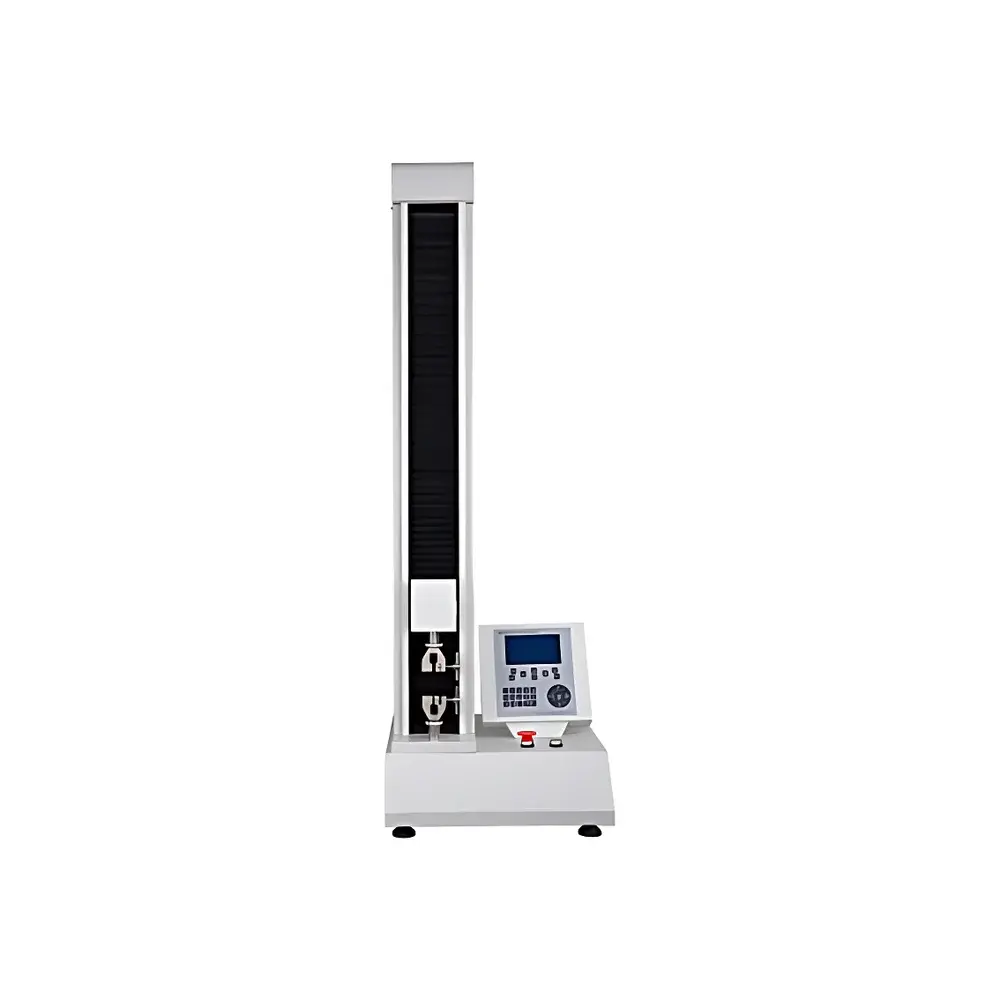
GBPI GBH-1C Desktop Single-Column Electronic Tensile Testing Machine
| Brand | GBPI |
|---|---|
| Origin | Guangdong, China |
| Manufacturer Type | Direct Manufacturer |
| Model | GBH-1C |
| Maximum Test Load | 0.5 kN (500 N) |
| Force Measurement Range | 0–500 N |
| Elongation Capacity | up to 1500% |
| Force Accuracy | ±0.5% of reading (Class 0.5) |
| Crosshead Travel | 750 mm |
| Displacement Resolution | ±0.5% of reading |
| Test Speed Range | 0–500 mm/min (infinitely variable) |
| Specimen Width Limit | ≤30 mm |
| Dimensions (W×D×H) | 600 × 600 × 1300 mm |
| Weight | 70 kg |
| Power Supply | AC 220 V, 50 Hz |
| Compliance Standards | GB 8808, GB 13022, GB/T 1040, ASTM D882, ASTM D1938, ISO 37, JIS P8113, YBB pharmaceutical packaging standards, and others |
Overview
The GBPI GBH-1C is a precision-engineered desktop single-column electronic tensile testing machine designed for high-reproducibility mechanical characterization of thin, flexible polymeric and composite materials. Operating on the fundamental principle of uniaxial force application under controlled displacement, it delivers calibrated load measurement via high-stability load cells and real-time strain tracking through encoder-based crosshead position feedback. Its architecture adheres to international metrological traceability requirements—force transducers are calibrated per ISO 376 and displacement systems validated per ISO 204, ensuring full alignment with GLP-compliant laboratory workflows. The system is purpose-built for routine quality control in packaging R&D labs, pharmaceutical packaging validation, food contact material certification, and academic polymer mechanics research—where regulatory adherence, repeatability, and multi-test versatility are non-negotiable.
Key Features
- Single-column rigid frame with dual upright columns and precision-ground ball-screw drive mechanism—optimized for long-term dimensional stability and minimal deflection under load.
- Class 0.5 force accuracy (±0.5% of reading) across the full 0–500 N range, verified per ASTM E4 and JJG 139 calibration protocols.
- High-resolution displacement sensing with ±0.5% linearity over 750 mm travel, enabling accurate elongation quantification up to 1500%—critical for elastomeric films and heat-seal layers.
- Infinitely variable test speed control (0–500 mm/min), programmable in 0.01 mm/min increments to match material-specific deformation kinetics.
- Dual-mode control architecture: integrated embedded controller (compact, space-saving) or external PC-based operation—both support real-time curve overlay, auto-stop on break, and pre-set test sequence recall.
- Modular sensor interface supporting up to four simultaneous analog inputs—enabling concurrent force, extension, temperature (via optional probe), and environmental chamber synchronization.
- 100 Hz data acquisition rate ensures fidelity in capturing transient failure events such as tear initiation or seal delamination.
- Comprehensive safety suite including mechanical end-limit switches, software-defined overload cutoff (adjustable threshold), emergency stop circuitry compliant with IEC 60204-1, and automatic brake engagement on power loss.
- Optional pneumatic clamping system with adjustable pressure (0.2–0.7 MPa) and interchangeable jaw faces—minimizing specimen slippage for low-modulus films and coated substrates.
Sample Compatibility & Compliance
The GBH-1C accommodates specimens ≤30 mm wide—including biaxially oriented polypropylene (BOPP), PET/AL/PE laminates, medical-grade Tyvek®, hydrocolloid dressings, aluminum foil composites, and pharmaceutical blister lidding materials. Its mechanical design and firmware logic are explicitly validated against 28 national and international standards, including GB/T 1040.3 (plastics tensile testing), ASTM D882 (thin plastic sheeting), ISO 37 (vulcanized rubber), YBB00112003 (pharmaceutical packaging), and ASTM F88 (peel strength of flexible barrier materials). All test methods are pre-configured in software with parameter presets aligned to standard clause requirements—e.g., gauge length (25 mm or 50 mm), preload (0.1 N), and crosshead speed (100 mm/min for seal strength per ASTM F904). Data audit trails comply with FDA 21 CFR Part 11 when used with GBPI’s validated software package, supporting electronic signatures, user access tiers, and immutable raw-data archiving.
Software & Data Management
The proprietary GBPI TestMaster v4.2 software provides ISO/IEC 17025-aligned data governance: all test sessions generate timestamped, digitally signed XML metadata files containing instrument ID, operator credentials, calibration certificate IDs, environmental conditions (if logged), and full waveform datasets sampled at 100 Hz. Raw force–displacement curves are exportable in CSV and Excel-compatible formats; statistical summaries (mean, SD, CV%, min/max) are auto-generated per batch. Advanced features include comparative curve superposition across lot numbers, pass/fail flagging against configurable specification limits (e.g., “seal strength ≥1.2 N/15 mm”), and customizable report templates meeting ISO 10012 and GLP documentation requirements. Software validation documentation (IQ/OQ/PQ protocols) is available upon request for regulated laboratories.
Applications
- Quantitative tensile modulus and yield strength evaluation of BOPET and CPP films per GB/T 1040.3.
- Heat seal strength and peel adhesion testing of pharmaceutical blister packs per YBB00112003 and ASTM F88.
- Tear resistance assessment of medical packaging per ASTM D1938 (trouser tear) and GB/T 16578.1.
- Peel strength verification of pressure-sensitive adhesives on labels and tapes per ASTM D3330.
- Compression behavior analysis of foam-backed laminates and cushioning structures.
- Educational mechanics labs requiring traceable, repeatable demonstrations of Hooke’s law, necking phenomena, and ductile-to-brittle transitions.
FAQ
What standards does the GBH-1C natively support?
It includes pre-loaded test methods for 28 standards—including GB/T 1040, ASTM D882, ISO 37, and YBB pharmaceutical packaging specifications—with automatic parameter initialization.
Can the system be integrated into an existing LIMS or MES environment?
Yes—via TCP/IP API and standardized CSV/XML export, enabling automated data ingestion into LabVantage, Thermo Fisher SampleManager, or custom enterprise platforms.
Is third-party calibration certification included?
A factory-issued ISO/IEC 17025-accredited calibration certificate (traceable to NIM, China) is provided with each unit; annual recalibration services are available globally.
What maintenance intervals are recommended?
Ball-screw lubrication every 6 months; load cell verification annually; encoder alignment check after 10,000 cycles—or per internal SOP based on usage intensity.
Does the system meet FDA 21 CFR Part 11 requirements?
When deployed with GBPI TestMaster v4.2 and configured with role-based user accounts, electronic signatures, and audit-trail logging, it satisfies Part 11 technical controls for electronic records and signatures.



