
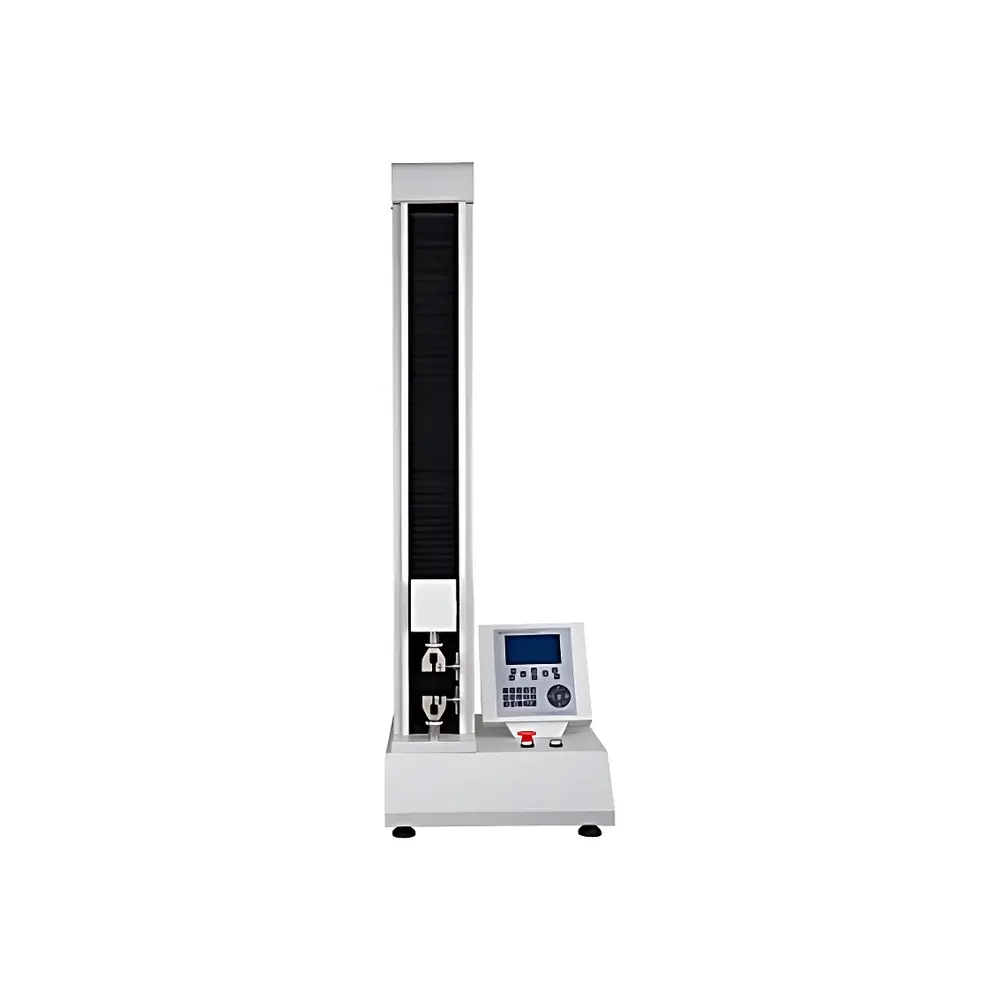
GBPI GBH-1D Desktop Single-Column Universal Tensile & Peel Testing Machine
| Brand | GBPI |
|---|---|
| Origin | Guangdong, China |
| Manufacturer Type | Direct Manufacturer |
| Country of Origin | China |
| Model | GBH-1D |
| Instrument Type | Electronic Tensile Tester |
| Max Test Load | 0.5 kN |
| Force Range | 0–500 N, 1500% Elongation |
| Force Accuracy | ±0.5% of reading (Class 0.5) |
| Travel Distance | 750 mm |
| Displacement Resolution | ±0.5% of reading |
| Speed Range | 0–500 mm/min (infinitely variable) |
| Specimen Width Capacity | ≤30 mm |
| Dimensions | 600 × 600 × 1300 mm |
| Weight | 70 kg |
| Power | 1000 W |
| Supply | AC 220 V, 50 Hz |
Overview
The GBPI GBH-1D is a precision-engineered desktop single-column universal testing machine designed for static mechanical characterization of flexible and semi-rigid packaging materials and thin-film substrates. It operates on the principle of controlled uniaxial force application via a high-stiffness滚珠丝杠 (ball screw) drive system coupled with a digitally regulated AC servo motor. The instrument delivers traceable, repeatable force–displacement data under ISO 7500-1 and ASTM E4-compliant loading conditions, supporting standardized tensile, peel, tear, puncture, seal strength, compression, flexural, and shear testing protocols. Its modular architecture enables rapid reconfiguration between test modes without hardware recalibration—critical for QC labs handling diverse material formats across pharmaceutical blister packaging, food-grade laminates, medical device pouches, and functional barrier films.
Key Features
- Class 0.5 force measurement accuracy per ISO 7500-1 and JJG 139, validated across the full 0–500 N range using calibrated reference load cells.
- High-resolution displacement sensing with ±0.5% linearity over 750 mm travel, ensuring fidelity in elongation and deformation quantification up to 1500% strain.
- Infinitely variable crosshead speed from 0.01 to 500 mm/min, programmable in real time to match dynamic requirements of standards such as ASTM D882 (thin plastics), ASTM F88 (seal strength), and ISO 37 (rubber tensile).
- Integrated digital control unit supports both embedded operation (standalone mode) and PC-synchronized acquisition at 100 Hz sampling rate—enabling precise capture of transient failure events like seal burst or film necking.
- Dual-mount design accommodates optional pneumatic clamps (available as accessory), eliminating manual torque variability and improving inter-operator reproducibility for peel and tear tests per ASTM D1938 and GB/T 2790.
- Robust structural frame with dual upright columns ensures torsional rigidity and minimal deflection during high-speed or high-load cycles, extending service life and maintaining long-term calibration stability.
- Comprehensive safety architecture includes mechanical end-stop limit switches, electronic overload cutoff (>110% FS), emergency stop button, and software-enforced operational boundaries.
Sample Compatibility & Compliance
The GBH-1D is optimized for specimens ≤30 mm wide—including biaxially oriented polypropylene (BOPP), PET/AL/PE laminates, aluminum foil composites, nonwovens, rubber sheets, paperboard, and hydrocolloid dressings. It conforms to over 35 national and international standards referenced in its technical documentation, including but not limited to: GB/T 1040.3 (plastics tensile), GB/T 2792 (180° peel), GB/T 7753 (adhesive peel), ASTM D3330 (pressure-sensitive tape peel), ISO 11607-2 (sterile barrier systems), and YBB pharmaceutical packaging monographs. All test methods are implemented with parameter sets preloaded into the firmware to ensure out-of-the-box compliance with GLP and GMP-aligned quality control workflows.
Software & Data Management
The GBH-1D’s proprietary Windows-based software provides full audit-trail capability compliant with FDA 21 CFR Part 11 requirements when deployed with user authentication, electronic signatures, and immutable data logging. Raw force–displacement curves are stored in open XML format; results tables support direct export to Excel (.xlsx) or CSV without third-party converters. Advanced post-processing features include curve overlay comparison, automatic yield point detection (per ASTM D882 Annex A2), modulus calculation (secant/tangent), and statistical reporting across batched test series. The system supports configurable report templates with company branding, test standard citations, operator ID, environmental metadata (temperature/humidity if externally logged), and pass/fail thresholds aligned with internal SOPs or pharmacopoeial limits.
Applications
This instrument serves as a core analytical platform in regulated environments where mechanical integrity directly impacts product safety and shelf life. Typical use cases include: validation of heat-seal integrity for IV bags and diagnostic cartridges; peel strength verification of child-resistant packaging per ISO 8317; tensile modulus assessment of biodegradable mulch films; tear resistance profiling of surgical drape laminates; puncture force evaluation of transdermal patch backing layers; and compressive yield analysis of corrugated board spacers used in cold-chain logistics. Its adaptability makes it equally suitable for R&D labs developing novel elastomeric hydrogels or academic institutions conducting fundamental polymer viscoelasticity studies.
FAQ
Does the GBH-1D support ASTM D882 testing for thin plastic films?
Yes—it meets all kinematic and metrological requirements of ASTM D882, including grip separation rate control, extensometer-free strain derivation, and modulus calculation algorithms.
Can test data be exported in formats compatible with LIMS integration?
Yes—raw data files are structured in human-readable XML, and summary reports can be generated as PDF or Excel with customizable metadata fields for seamless LIMS ingestion.
Is calibration traceable to national metrology institutes?
All factory calibrations are performed using NIST-traceable deadweight standards and documented in a certificate issued per ISO/IEC 17025 requirements.
What maintenance intervals are recommended for long-term accuracy retention?
Annual verification of force and displacement sensors is advised; routine cleaning of the ball screw and lubrication every 6 months ensures mechanical longevity.
Are software updates provided post-purchase?
Yes—GBPI offers free firmware and software upgrades for the lifetime of the instrument, including new standard method implementations and regulatory compliance enhancements.



